Primal: A Unified Deterministic Framework for Quasi-Orthogonal Hashing and Manifold Learning
Abstract: We present Primal, a deterministic feature mapping framework that harnesses the number-theoretic independence of prime square roots to construct robust, tunable vector representations. Diverging from standard stochastic projections (e.g., Random Fourier Features), our method exploits the Besicovitch property to create irrational frequency modulations that guarantee infinite non-repeating phase trajectories. We formalize two distinct algorithmic variants: (1) StaticPrime, a sequence generation method that produces temporal position encodings empirically approaching the theoretical Welch bound for quasi-orthogonality; and (2) DynamicPrime, a tunable projection layer for input-dependent feature mapping. A central novelty of the dynamic framework is its ability to unify two disparate mathematical utility classes through a single scaling parameter σ. In the low-frequency regime, the method acts as an isometric kernel map, effectively linearizing non-convex geometries (e.g., spirals) to enable high-fidelity signal reconstruction and compressive sensing. Conversely, the high-frequency regime induces chaotic phase wrapping, transforming the projection into a maximum-entropy one-way hash suitable for Hyperdimensional Computing and privacy-preserving Split Learning. Empirical evaluations demonstrate that our framework yields superior orthogonality retention and distribution tightness compared to normalized Gaussian baselines, establishing it as a computationally efficient, mathematically rigorous alternative to random matrix projections. The code is available at https://github.com/VladimerKhasia/primal
Paper Prompts
Sign up for free to create and run prompts on this paper using GPT-5.
Top Community Prompts
Explain it Like I'm 14
Overview
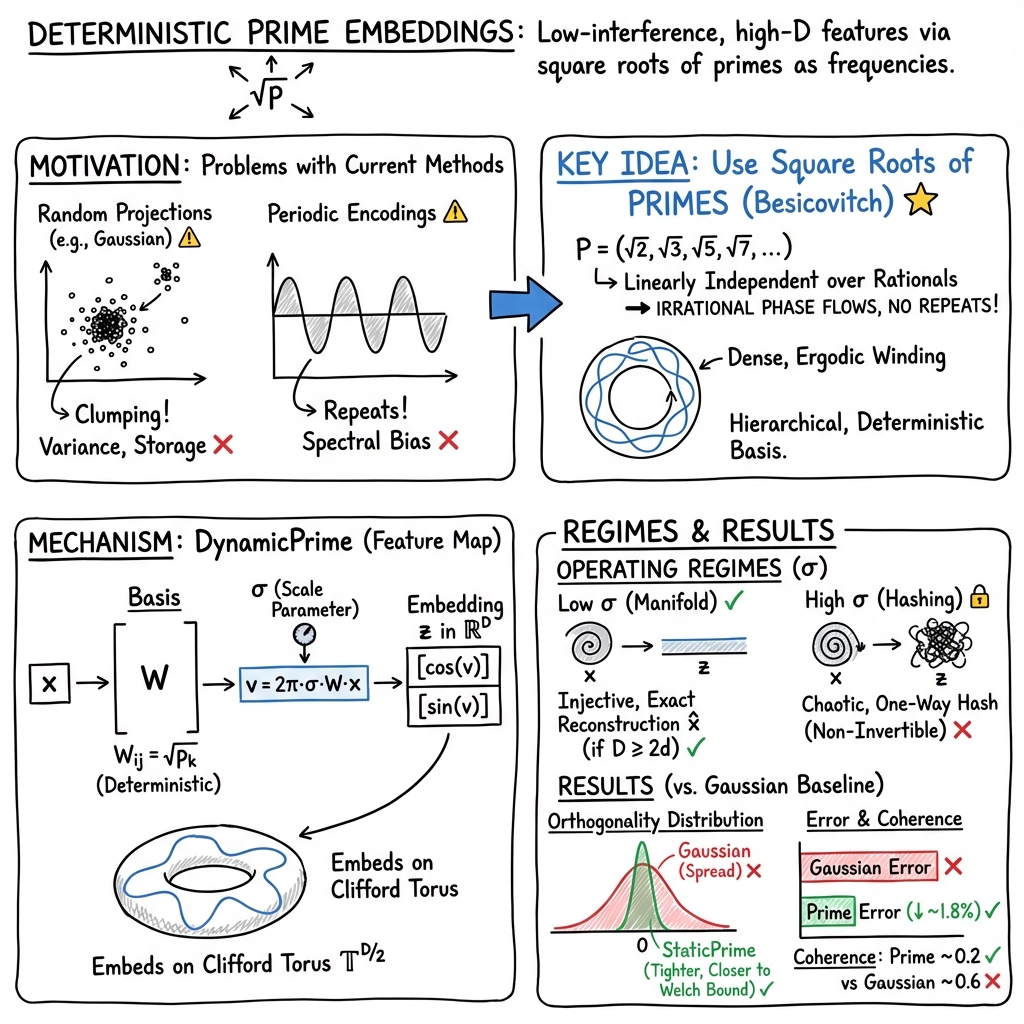
This paper introduces a new way to turn data (like images, sounds, or numbers) into high-dimensional vectors using math instead of randomness. The method is called Primal. It uses special numbers called primes and their square roots to create “frequencies” that never line up or repeat, kind of like spinning lots of wheels at slightly different speeds so their patterns never sync. This makes the vectors stay distinct from each other, which is great for storing information, learning patterns, and keeping data private.
What the paper is trying to do
The authors aim to:
- Build a deterministic (fully predictable) feature mapping method that makes vectors as different from each other as possible, reducing interference when storing or processing many items.
- Show that one method can do two jobs, controlled by a single knob (a scaling parameter called σ):
- At low settings, it helps “untangle” complicated shapes so they’re easier to learn and reconstruct (manifold learning).
- At high settings, it scrambles data into hard-to-reverse codes (hashing) that protect privacy while keeping items distinguishable.
- Demonstrate that this approach can outperform common random methods and is efficient to run, with no need to store large random matrices.
How the method works (in everyday terms)
Think of data points as cars entering a tunnel. Inside the tunnel, each car is sent through a set of rotating gates (cosine and sine functions) that spin at specific speeds. Those speeds are set using the square roots of prime numbers. Because these speeds are irrational and independent, the gates create unique “phase” patterns that don’t repeat or accidentally line up, keeping different cars (data points) separate.
Here are the two versions:
StaticPrime (sequence generation)
- Purpose: Create position encodings or time-based codes (like telling one second from two seconds) that don’t repeat and stay nearly orthogonal (point in different directions).
- How it works: It uses a small set of prime-based frequencies to generate cosine and sine waves over time. This makes a clean, non-repeating signal for each time step.
DynamicPrime (feature mapping)
- Purpose: Map any input vector into a higher-dimensional space using prime-based frequencies.
- How it works:
- Multiply the input by a matrix whose entries are square roots of primes.
- Scale by a single number σ (the frequency knob).
- Pass through cosine and sine functions to get the final embedding.
- Two modes controlled by σ:
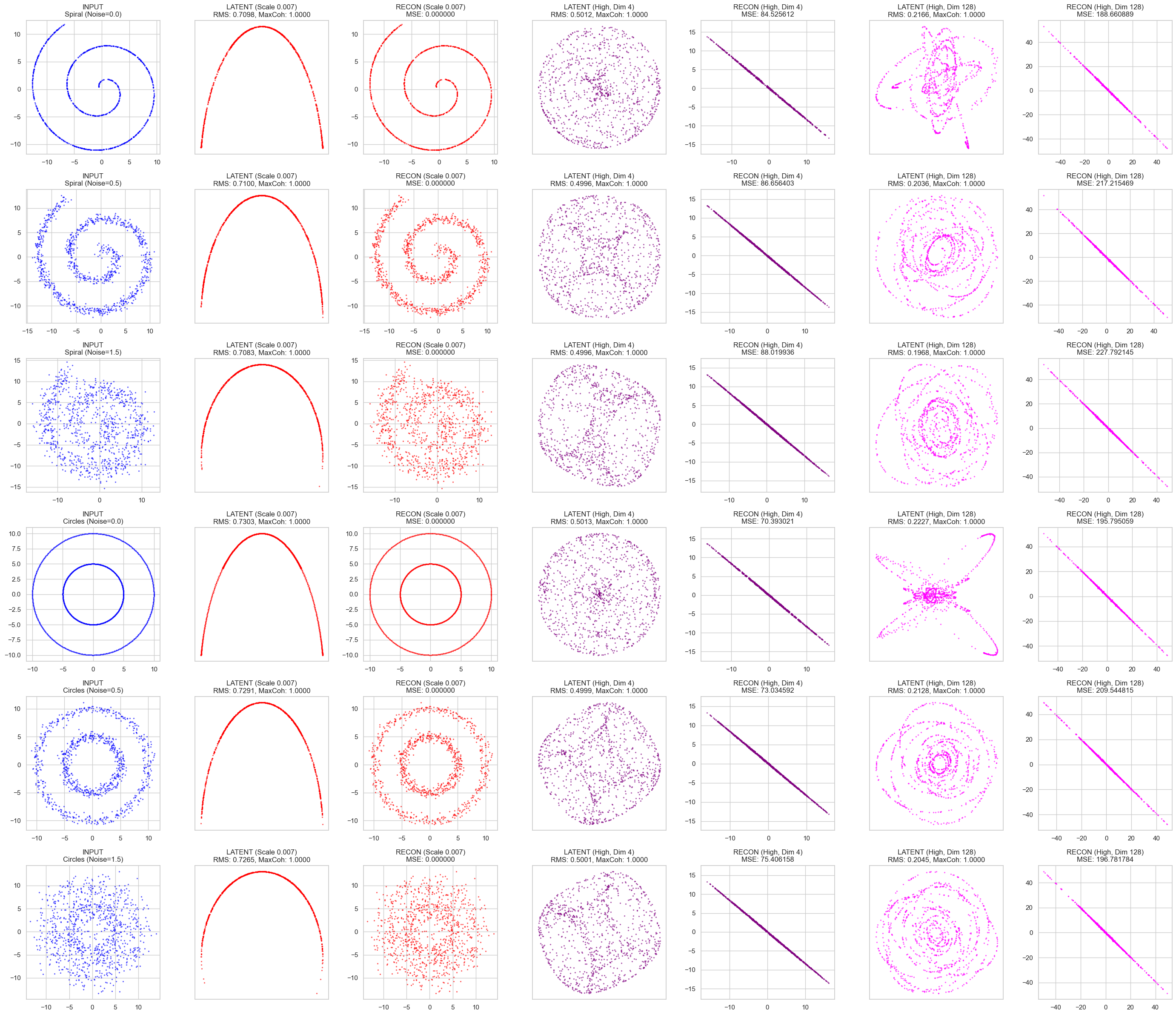
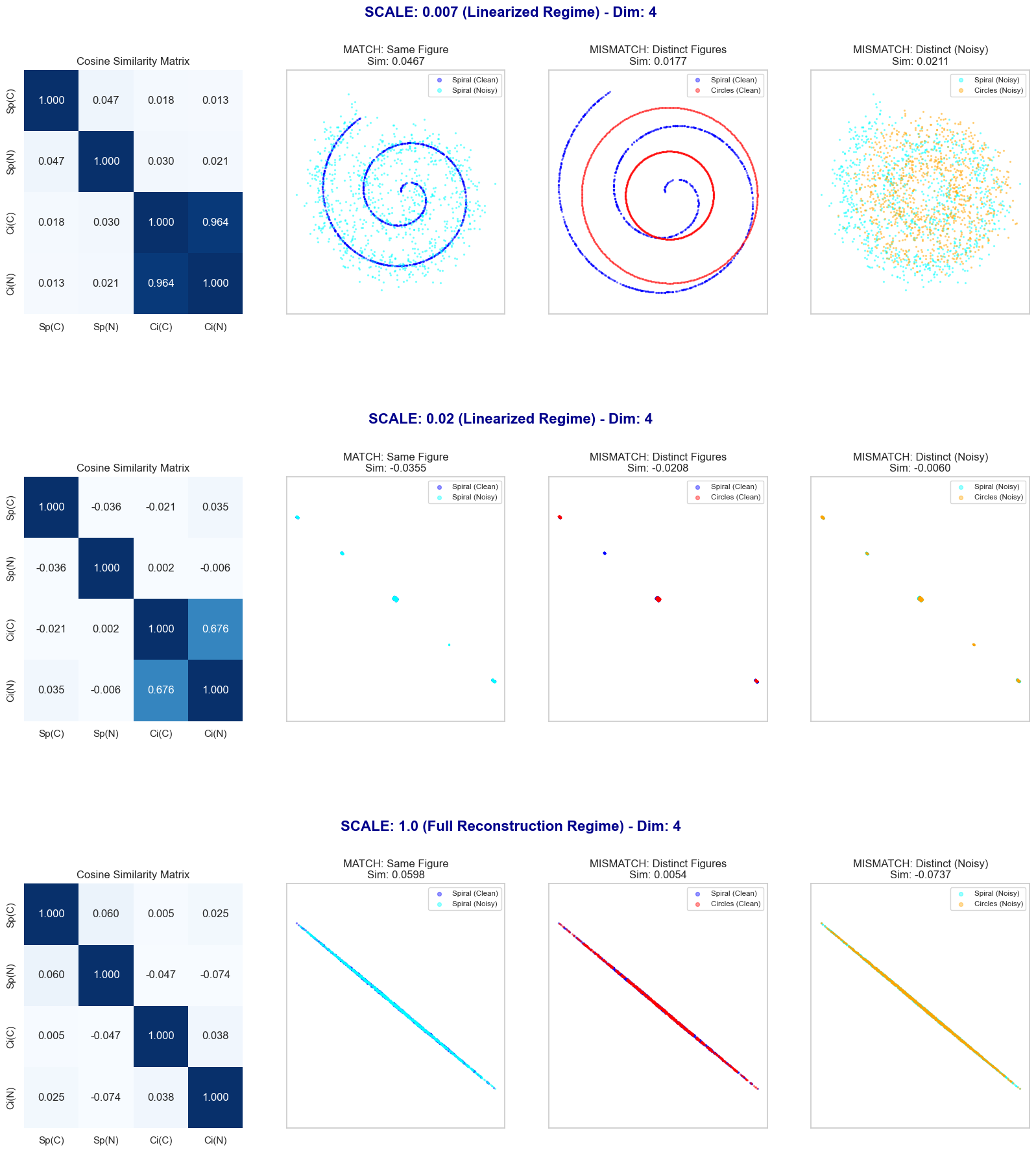
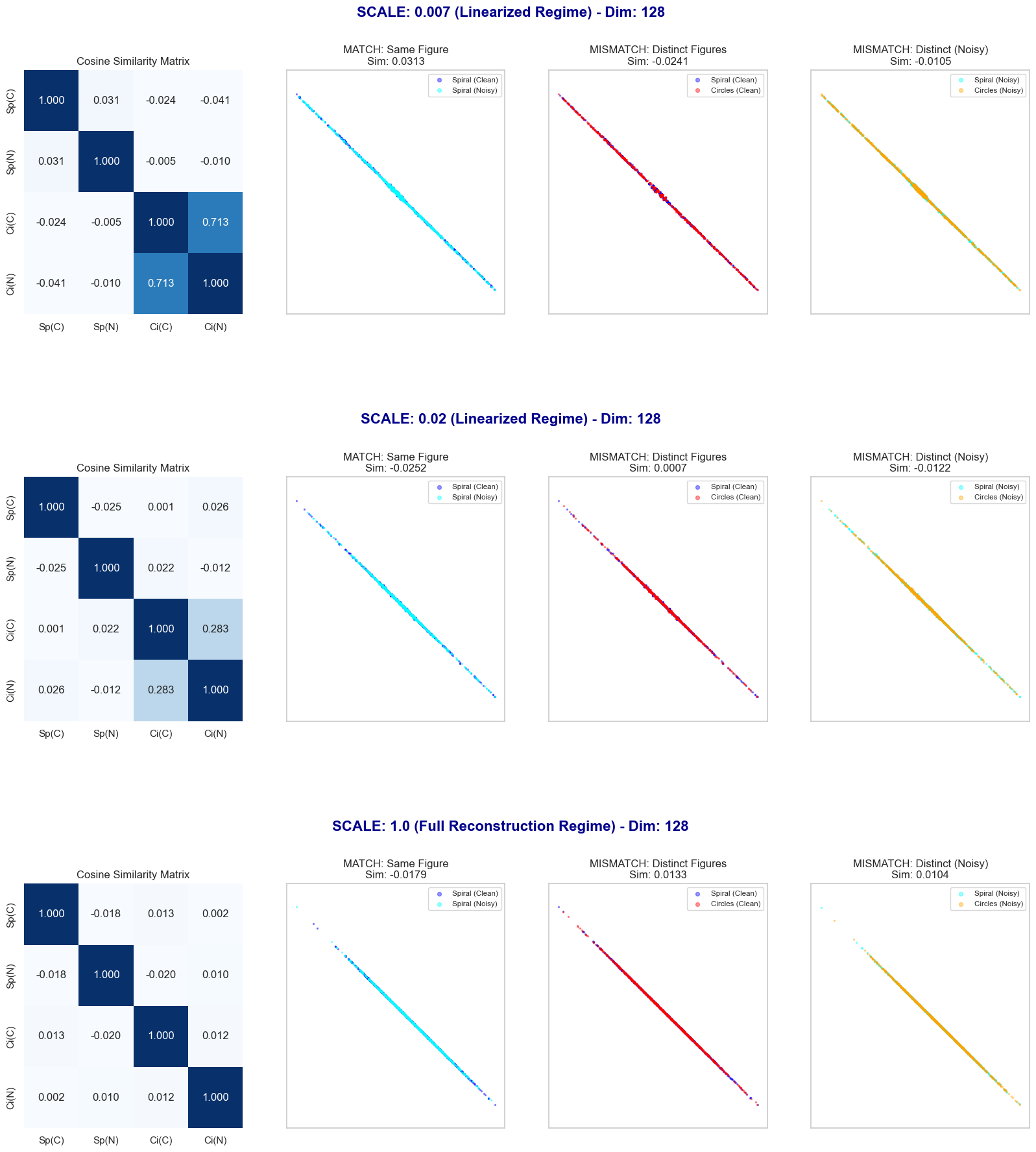
- Low σ (smooth mode): The map preserves structure; you can often reconstruct the original input exactly if you use enough dimensions.
- High σ (scramble mode): The map wraps phases many times, destroying local structure and acting like a one-way hash — great for privacy and creating highly distinct codes.
Why primes? Using square roots of primes gives frequencies that don’t “resonate” or repeat, so the encoded vectors remain distinct and evenly spread out, which reduces interference.
Main findings and why they matter
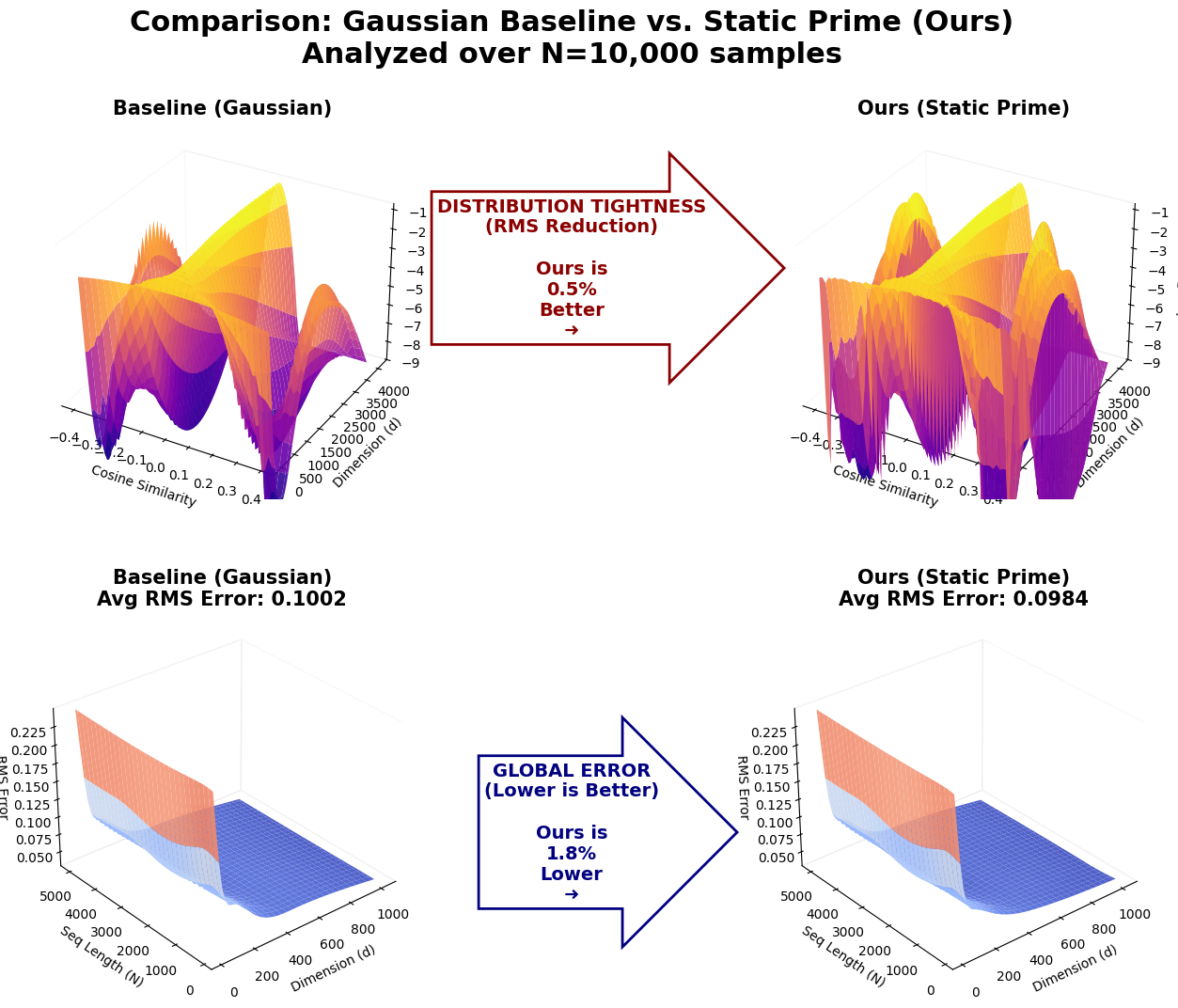
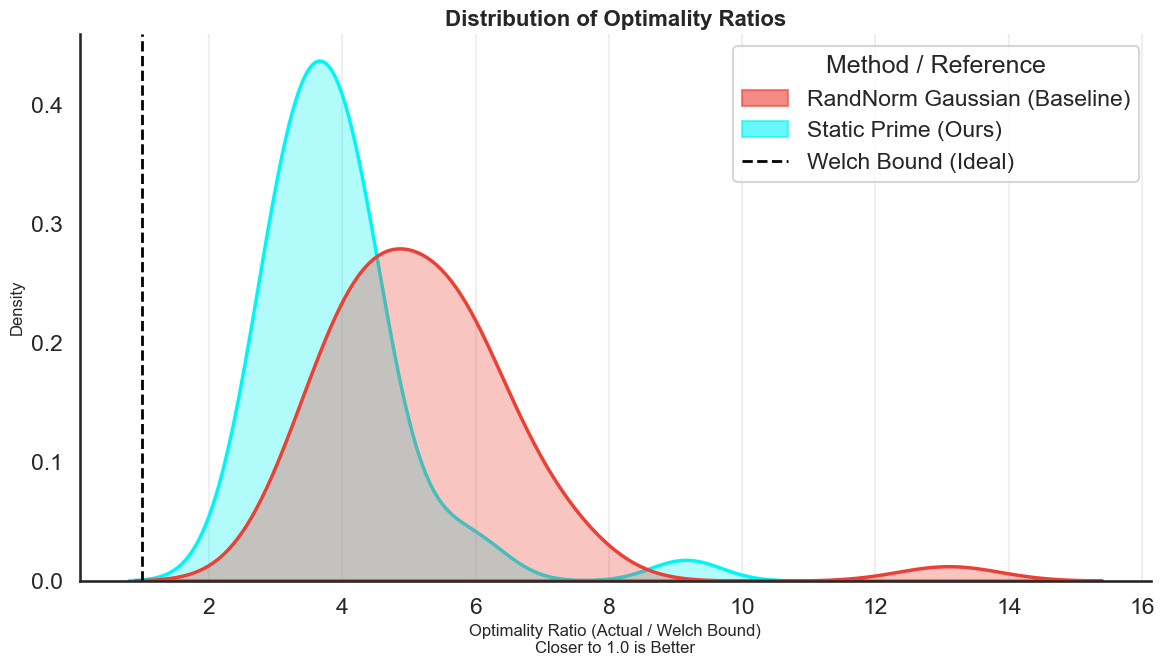
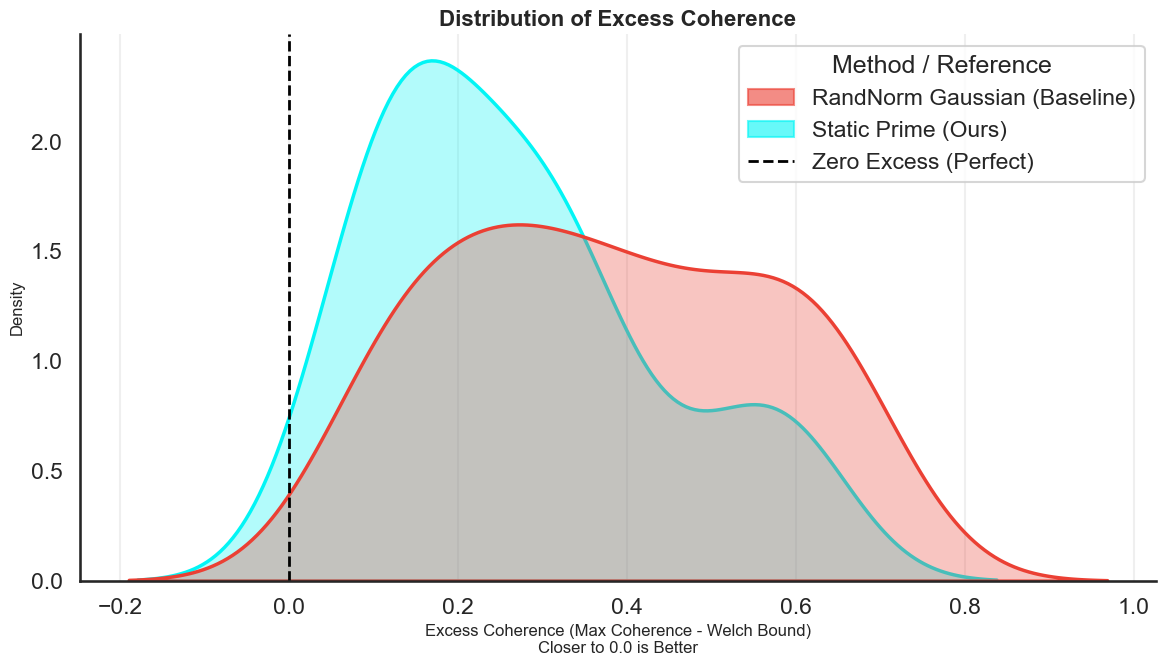
- Better separation of vectors: Compared to random Gaussian methods, the prime-based approach produces vectors that are closer to the ideal of “quasi-orthogonal” (very little overlap). The paper reports tighter distributions and lower overall cross-talk error (lower RMS), and maximum overlaps that are closer to the theoretical best (the Welch bound).
- Unified behavior with one knob (σ):
- Low σ: Helps “unroll” twisty shapes (like spirals and circles) into simpler forms so a simple model can understand them. It also enables highly accurate reconstruction when the dimension is large enough.
- High σ: Creates high-entropy, non-invertible representations useful for privacy, hashing, and Hyperdimensional Computing. Items become highly distinct without revealing the original data.
- Efficient and deterministic: The method runs in similar time as standard random features but doesn’t need random number generation or storing large random matrices. You can rebuild the whole basis from the ordered list of primes.
- Strong classification behavior: In tests, especially with enough dimensions, the low-σ mode can act like a smart denoiser — it makes similar shapes (like clean vs. noisy spirals) almost identical in the embedding, improving recognition without keeping the noise.
In simple terms: Primal makes data representations that are cleaner, more distinct, and more predictable than random methods, and it can switch between “learn-and-reconstruct” and “protect-and-separate” with one parameter.
What this could change or enable
- Better memory in AI systems: When stored vectors don’t overlap, you can fit more items reliably into the same space (less interference), which helps associative memory and reasoning systems.
- Edge devices and IoT: No need to store big random matrices; the prime basis is lightweight and reproducible, saving memory and energy.
- Privacy and “cancelable” IDs: The high-σ mode turns data into one-way codes. If a code is compromised, you can simply change the prime seed and σ and issue a new, unrelated code from the same data.
- Improved signals and images: The low-σ mode can help with compressive sensing and reconstruction, making it useful in areas like medical imaging or scientific simulations.
- Strong initializations for neural networks: Prime-based frequencies can reduce spectral bias and help networks learn fine details without tricky tuning.
A note on limitations and care
- Extremely high dimensions can create numerical issues (like phase wrapping or precision loss) if σ is too large. Careful scaling, normalization, or adaptive per-dimension scaling can fix this.
- The range of frequencies grows with dimension, which may cause very low-frequency components to become too small if σ is adjusted only to control the largest ones. Adaptive scaling can balance the spectrum.
Bottom line
Primal offers a clean, math-driven alternative to random feature methods. By using the square roots of prime numbers, it creates reliable, non-repeating frequency patterns that keep vectors separate. With one simple parameter, it can act either like a careful map that untangles complex shapes for learning and reconstruction, or like a secure hash that keeps data private while preserving separability. It’s efficient, reproducible, and often closer to theoretical bests than common random baselines. The authors provide code so others can try it out.
Knowledge Gaps
Knowledge gaps, limitations, and open questions
Below is a focused list of concrete limitations, open questions, and missing analyses that the paper leaves unresolved.
1) Theoretical foundations and guarantees
- Derive formal mutual-coherence bounds for StaticPrime/DynamicPrime as a function of and prove asymptotic closeness (or rates) to the Welch bound; current evidence is empirical only.
- Establish Restricted Isometry Property (RIP) or equivalent recovery guarantees for compressive sensing with the prime-based sensing matrix; quantify sparsity and measurement requirements for provable recovery.
- Precisely characterize the induced “Prime-Spectral Kernel”: prove positive definiteness, describe its spectral measure, and relate its approximation properties to standard kernels (e.g., RBF via Bochner’s theorem) or to universal approximation.
- Provide rigorous injectivity and stability bounds for the inverse map beyond the heuristic constraint ; analyze tightness, conditioning, and robustness to additive noise and quantization.
- Formalize when and why the high- regime yields “maximum-entropy” or approximately isotropic embeddings; establish concentration results and rates to Gaussianity in high dimensions.
- Analyze whether primes are uniquely beneficial: compare to other square-free irrational bases (e.g., for non-prime square-free ), low-discrepancy sequences on tori, or algebraic irrational constructions; identify optimality criteria.
- Study the impact of per-dimension scaling on irrational independence and ergodicity (e.g., when scaling ratios are rational/irrational), and give conditions that preserve non-repeating phase trajectories.
2) Empirical scope and baselines
- Evaluate on real-world benchmarks (vision, audio, NLP, tabular) and report downstream task metrics (accuracy, F1, regression error) instead of only geometric statistics and 2D toy data.
- Compare against a broader set of strong baselines: orthogonal/structured projections (Hadamard + random sign, FJLT), Orthogonal Random Features (ORF), circulant/Toeplitz transforms, deterministic frames (harmonic ETFs, chirp sequences), low-discrepancy Fourier features, and Transformer positional encodings (sinusoidal, RoPE, ALiBi).
- Provide ablations on design choices: (i) normalizing rows of vs not, (ii) prime ordering vs shuffled primes, (iii) spacing primes logarithmically vs consecutively, (iv) using vs other power laws, and (v) choice of and under fixed compute.
- Quantify hashing utility: collision probability, recall-at-k, Hamming/angle distributions, and retrieval accuracy in HDC/VSA tasks; compare to LSH, SimHash, and product quantization baselines.
- Report scaling curves for large and stress tests beyond ; include worst-case (max-coherence) statistics with confidence intervals, not only averages or KDEs.
3) Privacy and security properties
- Define a precise threat model and rigorously analyze invertibility under known/unknown , chosen/known-plaintext attacks, and side information; clarify whether the map is cryptographically one-way or merely hard to invert in practice.
- Provide empirical and theoretical estimates of entropy, collision rates, and leakage for the high- hashing regime; assess resistance to gradient leakage, model inversion, and membership inference attacks.
- For cancelable biometrics, evaluate revocability, unlinkability, diversity, and irreversibility according to established standards; analyze cross-application linkability when multiple seeds are issued.
- Assess whether repeated use with different seeds permits multi-view attacks (e.g., solving for from multiple projections), and quantify the number of distinct seeds needed for safe revocation.
4) Numerical stability and computational costs
- Analyze large-argument trigonometric evaluation: implement and benchmark range-reduction strategies, quantify floating-point error growth (float16/bfloat16/float32/float64), and specify error bounds on at scale.
- Revisit the “O(1) lookup” assumption: characterize the cost and memory of generating/storing the first primes and their square roots for large and ; provide practical pipelines for GPU/TPU environments.
- Benchmark end-to-end runtime and energy against fast structured projections (e.g., Fast Hadamard Transform) and RFF on commodity CPUs/GPUs and microcontrollers; quantify the trig-operation bottleneck and possible CORDIC/lookup-table approximations.
- Study the conditioning and numerical stability of the pseudoinverse used in reconstruction, especially under noise, quantization, and near the phase-wrapping boundary; propose regularization strategies if needed.
- Evaluate the proposed adaptive scaling (diagonal ) and log-spaced prime sampling for mitigating spectral dynamic-range issues; measure their effect on orthogonality, kernel quality, and invertibility.
5) Integration into learning systems
- Investigate training dynamics when Primal is used as a neural layer: gradient stability through , sensitivity to , and interactions with spectral bias; compare to SIREN initialization and training recipes.
- Explore learnable or scheduleable / and principled selection of ; develop criteria or algorithms to auto-tune regimes (manifold vs hashing) during training.
- Validate claims for Transformers (positional encodings) and sequence models (RNNs/SSMs): assess long-context extrapolation, attention performance, and interference reduction vs RoPE/sinusoidal/learned embeddings on standard benchmarks.
- Examine continual/online learning claims: quantify gradient interference reduction, capacity expansion via appending primes, and backward compatibility effects across tasks; include catastrophic forgetting metrics.
- Study compatibility with quantization-aware training and mixed-precision inference; measure impact on orthogonality and task performance.
6) Geometric and manifold analysis
- Provide local-isometry and distortion bounds in the low- regime: Lipschitz constants, geodesic preservation, and curvature distortion for typical data manifolds.
- Formalize the torus-embedding/ergodic-flow claims: quantify equidistribution and coverage rates on for discrete-time inputs, and relate to low-discrepancy metrics on tori.
- Analyze how PCA/linear projections of the torus-embedded data relate to observed “mesh-like” structures; determine when such projections hinder or help downstream tasks.
- Connect empirical closeness to the Welch bound with known constraints on Equiangular Tight Frame existence for given ; assess whether prime-based constructions can systematically yield near-ETF configurations in specific regimes.
Practical Applications
Overview
Below are actionable, sector-linked applications that follow directly from the paper’s deterministic prime-frequency framework (StaticPrime and DynamicPrime), its dual operating regimes (manifold-preserving vs. high-entropy hashing), and its empirical advantages (quasi-orthogonality near the Welch bound, reduced crosstalk, edge-friendly memory footprint). Each item specifies use cases, the sector(s), potential tools/workflows/products, and feasibility notes.
Immediate Applications
- Deterministic feature-mapping layer for ML pipelines — replacing Random Fourier Features and ad-hoc positional encodings (Software/ML) Tools/Products: PyTorch/TensorFlow layer (PrimeMap), drop-in Transformer positional encoding module, SIREN initialization preset, scikit-learn compatible transformer. Assumptions/Dependencies: D must be even; select σ to match task regime; precompute pseudoinverse for reconstruction tasks; input normalization for numerical stability; trig ops available on target hardware.
- Quasi-orthogonal codebooks for Hyperdimensional Computing on edge devices — tighter coherence, reduced crosstalk with smaller D (Robotics, IoT, Embedded AI) Tools/Products: HDC/VSA codebook generator using StaticPrime; on-device classification and symbol manipulation; microcontroller SDK with prime basis cache. Assumptions/Dependencies: Careful σ tuning; prime tables stored or generated offline; device-level trig performance; evaluate task-specific collision rates.
- Privacy-preserving Split Learning and federated analytics — high-σ regime generates non-invertible, high-entropy latents while preserving class separability (Healthcare, Finance, Education, Public Sector) Tools/Products: On-device “Primal privacy layer” that hashes inputs before transmission; SDKs for clinical analytics (ECG/EEG time series), AML fraud detection, student analytics dashboards. Assumptions/Dependencies: Non-invertibility requires high σ and/or D < 2d; formal threat modeling (membership inference, linkage attacks); governance of prime seeds and σ; compliance with GDPR/ HIPAA.
- Cancelable biometrics via prime-seeded reissuance — regenerate uncorrelated IDs from the same biometric (Security/Consumer Tech) Tools/Products: Mobile authentication library (face/voice/fingerprint feature hashing), enterprise identity management with “reissue” capability. Assumptions/Dependencies: Collision rates empirically low; policy framework for revocation/rotation; liveness detection; side-channel mitigation; standardized seed management.
- Compressive sensing and sparse coding dictionaries with low mutual coherence — deterministic overcomplete dictionaries (Healthcare imaging, Signal Processing) Tools/Products: StaticPrime dictionary generator for L1 minimization/OMP; MRI reconstruction workflows; radar/lidar signal recovery pipelines. Assumptions/Dependencies: Overcomplete regime (D ≫ d); input normalization; adaptive σ or Σ (diagonal scaling) to control dynamic range; domain validation and QA.
- Improved vector search and deduplication in vector databases — reduce “soft collisions” and improve memory packing (Software/Databases) Tools/Products: Plugin for FAISS/ScaNN/Milvus that applies Primal hashing/encoding; pre-ingest transformation to tighten similarity distributions. Assumptions/Dependencies: Careful choice of σ to preserve semantics; evaluate impact on recall/precision; integration with existing ANN indices; reproducibility benefits for audits.
- Nonconvex boundary linearization for classical ML — low-σ manifold maps enabling simple classifiers on hard datasets (Manufacturing QA, Geospatial Analytics, Text/Sensor Data) Tools/Products: Preprocessing step that unrolls spirals/circles-like manifolds; logistic regression/SVM pipelines on Primal latents. Assumptions/Dependencies: Overdetermined regime (D ≥ 2d) and low σ to prevent phase wrapping; cached pseudoinverse; robust normalization.
- Edge AI memory and bandwidth savings — deterministic basis eliminates large random matrices (IoT, Energy, Mobile) Tools/Products: Lightweight firmware module with ordered prime table indexing; reduced storage/update costs; deterministic reproducibility for auditing. Assumptions/Dependencies: Storage for prime indices (O(D)); trig performance; integer/fixed-point approximations where necessary.
- Telecommunications spreading codebooks — near-orthogonal sequences for multi-user access (Telecom/Networking) Tools/Products: StaticPrime-based CDMA/6G pilot/codebook generation without iterative optimization; dynamic regeneration workflows for mMTC. Assumptions/Dependencies: Conformance to spectral masks; field testing under multi-path and interference; system-level validation; interoperability with existing standards.
- Reproducibility-by-design and audit trails — deterministic transforms aid compliance and validation (Policy, RegTech) Tools/Products: Model cards that pin prime seeds, σ, D; auditable pipelines; deterministic retraining procedures. Assumptions/Dependencies: Organizational processes to govern seed rotation; legal frameworks acknowledging deterministic transforms; integration into MLOps governance.
Long-Term Applications
- Optical/photonic implementations of irrational prime-frequency modulators — ultra-fast, interference-minimized computing (Hardware/Optical Computing, Energy) Tools/Products: Photonic chips implementing prime-root frequency lattices; analog phase encoders for HDC and secure hashing. Assumptions/Dependencies: Materials and fabrication advances; calibration of irrational frequencies; co-design with digital controllers; substantial R&D investment.
- Standardization of cancelable biometrics and privacy layers — sector-wide frameworks (Policy/Standards, Security) Tools/Products: ISO/IEC profiles specifying prime-seed governance, σ ranges, revocation/rotation protocols; certification schemes for PPML. Assumptions/Dependencies: Broad stakeholder consensus; formal security proofs; alignment with data protection laws; operational best practices.
- Prime-spectral bases in Physics-Informed Neural Networks and PDE solvers — faster convergence, reduced spectral bias (Academia, Natural Sciences) Tools/Products: PINN toolkits with Primal basis; weather/fluid dynamics solvers using deterministic multi-resolution kernels. Assumptions/Dependencies: Theoretical bounds on approximation error; domain-specific benchmarking; hybrid scaling schemes (Σ matrices) to prevent low-frequency vanishing.
- 6G codebook adoption and mass-scale deployment — industry standards for near-orthogonal codes (Telecom/Networking) Tools/Products: Standardized codebook libraries; real-time regeneration in mMTC and URLLC scenarios. Assumptions/Dependencies: Multi-year standardization cycles; ecosystem interoperability; empirical performance under channel impairments.
- Cryptographic-grade one-way hashing with formal proofs — bridging ML hashing and cryptography (Security/Crypto, Software) Tools/Products: Security analyses proving resistance to inversion/linkage; composable privacy modules; zero-knowledge-friendly variants. Assumptions/Dependencies: Formalization of attack surfaces and hardness assumptions; σ/D conditions codified; side-channel protections.
- High-capacity associative memory and neuromorphic architectures — leveraging near-Welch-bound coherence (Hardware/Neuromorphic AI) Tools/Products: Memory matrices/arrays optimized for Primal latents; event-based controllers with low crosstalk. Assumptions/Dependencies: Co-design of hardware primitives; stability under analog noise; training algorithms that exploit deterministic orthogonality.
- Continual/online learning frameworks with grow-on-demand capacity — prime-ordered basis expansion (Software/ML) Tools/Products: Libraries that append prime roots to expand D without breaking backward compatibility; task-slotting and interference mitigation. Assumptions/Dependencies: Curriculum/optimizer strategies; empirical studies on forgetting; task-aware σ schedules.
- Medical imaging devices with integrated deterministic CS — clinical-grade systems (Healthcare/MedTech) Tools/Products: MRI/CT reconstruction stacks using Primal dictionaries; hardware acceleration; certified workflows. Assumptions/Dependencies: Regulatory approvals; clinical trials; robust numerical controls; ethics and safety validation.
- Edge neurosymbolic stacks — practical reasoning at small D (Robotics, IoT) Tools/Products: Compact HDC reasoning modules; compositional memory systems on microcontrollers. Assumptions/Dependencies: Software ecosystems; task libraries; demonstration of reliability across diverse conditions.
- Theoretical convergence to Welch-bound and ETF-inspired designs — new deterministic dictionaries (Academia/Math/Signal Processing) Tools/Products: Analytic bounds; constructions approaching equiangular tight frames; curricula for deterministic encoding theory. Assumptions/Dependencies: Advances in number theory and frame theory; cross-validation with empirical results; community adoption.
Glossary
- Besicovitch Property: Number-theoretic result stating that square roots of square-free integers (including primes) are linearly independent over the rationals, used to ensure non-repeating phase trajectories. "our method exploits the Besicovitch property to create irrational frequency modulations that guarantee infinite non-repeating phase trajectories."
- Bochner's Theorem: A theorem linking shift-invariant kernels to spectral measures; it justifies approximating such kernels via random Fourier features. "Unlike Random Fourier Features (RFF), which sample frequencies from a Gaussian distribution to approximate a shift-invariant RBF kernel (via Bochner's Theorem), the Primal construction defines a deterministic Prime-Spectral Kernel."
- Clifford Torus: The product of circles manifold embedded in a sphere; the paper’s embeddings lie on this toroidal manifold. "the surface of a high-dimensional Clifford Torus , defined as the product of circles:"
- Compressive Sensing: A framework for reconstructing sparse signals from underdetermined linear measurements using low coherence dictionaries. "In the low-frequency regime, the method acts as an isometric kernel map, effectively linearizing non-convex geometries (e.g., spirals) to enable high-fidelity signal reconstruction and compressive sensing."
- Dirac Delta Function: A generalized function sharply peaked at a point; here it represents ideal quasi-orthogonality (zero off-diagonal similarities). "In an ideal Hyperdimensional/Vector Symbolic Architecture (HDC/VSA), this distribution should approximate a Dirac delta function centered at zero, , indicating perfect quasi-orthogonality."
- Equiangular Tight Frame (ETF): An optimally spaced set of unit vectors with equal pairwise angles that attains the Welch bound on coherence. "a ratio of $1.0$ indicates that the vectors form an Equiangular Tight Frame (ETF), the optimal physical configuration."
- Gram Matrix: The matrix of all pairwise inner products of a set of vectors, capturing similarity structure. "The pairwise similarity structure of the codebook is captured by the Gram matrix , where the entry represents the cosine similarity between the -th and -th vectors."
- Hopf Fibration: A decomposition of the 3-sphere into linked circles; referenced to describe geometric structure in the latent space. "For the specific case of , the data resides on the flat torus embedded in the 3-sphere , which forms the geometric skeleton of the Hopf fibration."
- Hyperdimensional Computing (HDC): A computing paradigm that uses high-dimensional vectors for distributed representations and symbolic operations. "From the attention mechanisms in Transformers \cite{vaswani2017attention} to the symbol manipulation in Hyperdimensional Computing (HDC) \cite{kanerva2009hyperdimensional}, the geometry of the embedding space dictates the performance limits of the system."
- Johnson-Lindenstrauss Lemma: A result guaranteeing low-distortion embeddings of points into lower-dimensional spaces via random projections. "Relying on the Johnson-Lindenstrauss Lemma \cite{johnson1984extensions}, methods such as Random Fourier Features (RFF) \cite{rahimi2007random} utilize random Gaussian projections to approximate shift-invariant kernels."
- K-SVD: A popular dictionary learning algorithm for sparse representation. "Unlike learned dictionaries (e.g., K-SVD) which are computationally expensive to train, or Gaussian matrices which are probabilistic, our method provides a constructive, deterministic mechanism to generate overcomplete dictionaries () with guaranteed low coherence."
- Kronecker's Theorem: A theorem on dense, non-repeating trajectories on tori when frequencies are rationally independent. "By Kronecker's Theorem on ergodic flow, this trajectory never repeats and is dense within the manifold."
- Lissajous Knots: Complex curves formed by harmonic oscillations; used to describe observed latent structures. "A striking feature of the latent space visualizations ... is the emergence of complex, mesh-like structures that resemble Hopf fibrations or Lissajous knots."
- Moore-Penrose Pseudoinverse: The generalized inverse used to compute least-squares solutions and reconstructions in linear systems. "The reconstruction is obtained via the Moore-Penrose pseudoinverse:"
- Mutual Coherence: The maximum absolute inner product between distinct dictionary atoms; lower values improve sparse recovery guarantees. "In the domain of sparse representation, the efficacy of a dictionary is governed by its mutual coherence."
- Orthogonal Matching Pursuit (OMP): A greedy algorithm for recovering sparse representations by iteratively selecting dictionary atoms. "accurate signal recovery via minimization or greedy algorithms like Orthogonal Matching Pursuit (OMP)."
- Physics-Informed Neural Networks (PINNs): Neural networks incorporating physical laws (e.g., PDEs) into the loss function to solve scientific problems. "the framework provides a deterministic, resonance-free spectral basis for Physics-Informed Neural Networks (PINNs), potentially accelerating convergence in high-dimensional PDE solvers for fluid dynamics and weather modeling."
- Prime Number Theorem: An asymptotic description of prime distribution; here used to characterize frequency growth. "the norm of our frequency vectors grows according to the Prime Number Theorem ()."
- Radial Basis Function (RBF) Kernel: A shift-invariant kernel dependent on distance; often approximated by random Fourier features. "approximate a shift-invariant RBF kernel (via Bochner's Theorem)"
- Random Fourier Features (RFF): A method to approximate kernel functions by mapping inputs using random sinusoidal features. "Unlike Random Fourier Features (RFF), which sample frequencies from a Gaussian distribution to approximate a shift-invariant RBF kernel (via Bochner's Theorem), the Primal construction defines a deterministic Prime-Spectral Kernel."
- Restricted Isometry Property (RIP): A property ensuring near-isometric embeddings for sparse vectors; critical for compressive sensing. "Dictionaries that minimize this coherence—approaching the Welch bound—satisfy the Restricted Isometry Property (RIP) more robustly, a prerequisite for accurate signal recovery"
- Split Learning: A privacy-preserving training paradigm where model layers are split between client and server, limiting raw data exposure. "maximum-entropy one-way hash suitable for Hyperdimensional Computing and privacy-preserving Split Learning."
- Vector Symbolic Architecture (VSA): A framework for symbolic computation using operations on high-dimensional vectors. "In an ideal Hyperdimensional/Vector Symbolic Architecture (HDC/VSA), this distribution should approximate a Dirac delta function centered at zero"
- Wavelet Transforms: Multi-resolution signal analysis methods that decompose signals across scales. "allowing our method to function as a multi-resolution analysis similar to Wavelet transforms."
- Welch Bound: A lower bound on the maximal coherence achievable by any set of vectors; a target for quasi-orthogonality. "deviating from the theoretical optima known as the Welch bound"
Collections
Sign up for free to add this paper to one or more collections.