- The paper introduces a mathematical framework that separates global mean-based vs. local median-based measures in the friendship paradox.
- It demonstrates via toy and empirical analyses that local disadvantages can diverge significantly from average-based predictions in networks.
- The study highlights implications for network analysis, including insights for opinion dynamics, influence spreading, and structural robustness.
Friendship-Paradox Paradox: Mean-based Versus Majority-type Inequalities in Social Networks
The paper "Friendship-paradox paradox: Do most people's friends really have more friends than they do?" (2511.13957) critically reexamines the classical friendship paradox (FP) in network science, which states that, on average, an individual's neighbors have a higher degree than the individual. The standard alter-based and ego-based FP formulations—⟨kfriend⟩n≥⟨k⟩n and ⟨knn⟩n≥⟨k⟩n, respectively—are strictly statements about network-wide means. These average-based inequalities do not directly translate to most nodes experiencing local disadvantage, nor do they imply anything about the fraction of nodes that are individually dominated by their neighbors.
To clarify this distinction, the paper develops a precise mathematical framework that separates mean-based FP inequalities from majority-type quantities. It introduces:
- A global mean-based majority fraction (ϕglobal): the fraction of nodes with degree less than the mean degree of their neighbors.
- A local median-based majority fraction (ϕlocal): the fraction of nodes with hub centrality hi<1/2, i.e., those with more than half their neighbors having greater degree.
Neither ϕglobal nor ϕlocal are constrained by the classical FP, and, as shown by both toy and empirical network analyses, ϕglobal and ϕlocal can diverge markedly from each other and from the average-based FP conditions.
Analysis of Toy and Empirical Networks
A minimal five-node toy network demonstrates conditions where both ϕglobal<1/2 and ϕlocal<1/2, yet the classical FP inequalities hold. This construction highlights that structural properties of local neighborhoods, not merely global averages, govern majority-type disadvantage.
Empirical analyses on the Zachary Karate Club (ZKC) and NCAA Division I American Football (AFB) networks quantify these distinctions:
- In the ZKC network, both ϕglobal≈0.85 and ϕlocal≈0.71 are high, indicating broad local disadvantage that aligns with mean-based FP.
- In the AFB network, ϕglobal≈0.43<1/2 and ϕlocal≈0.84, showing a major disconnect: the majority of nodes are locally disadvantaged in the median sense, despite most having degree exceeding the mean of their neighbors.
These findings are visualized in the following density plots, which reveal the divergent arrangements of node-level degree contrasts:
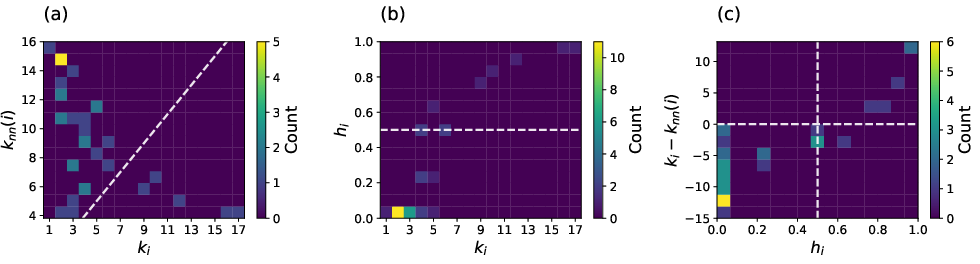
Figure 1: Density plots for the ZKC network, illustrating strong alignment between nodes with negative mean-based degree contrast and low hub centrality.
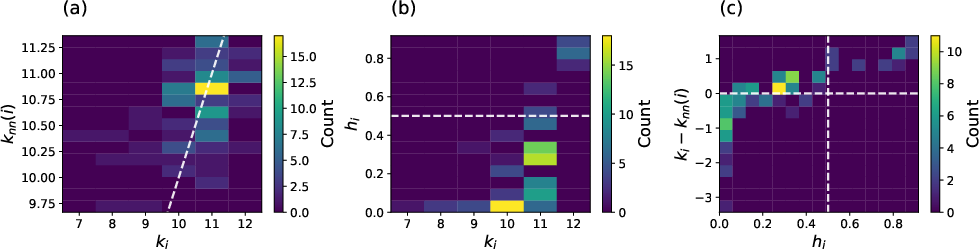
Figure 2: Density plots for the AFB network, revealing weak alignment between mean-based and median-based local disadvantage, with many nodes having high degree yet low hub centrality.
The quadrant patterns in the joint distributions of ki−knn(i) and hi demonstrate structurally why these quantities can differ. Left- or right-skewed degree distributions among neighbors can produce opposite conclusions for mean-based and median-based FP comparisons.
Implications and Directions for Future Work
The conceptual separation of FP and majority-type inequalities carries substantive theoretical and practical implications. Methodologically, this framework makes it inappropriate to interpret FP as implying "most of your friends have more friends than you." Instead, FP constrains only averages, while majority-type inequalities diagnose the network's local structure.
This distinction is particularly salient in social perception, opinion formation, influence spreading, and robustness analyses in complex networks, where local structural differences—e.g., skewness in neighborhood degree distributions—can strongly affect collective dynamics.
Future research strands prompted by these results include:
- Analytical characterization of ϕglobal and ϕlocal in random graph ensembles (configuration models, scale-free networks), focusing on complete neighbor-degree distributions.
- Investigation of network structural features (assortativity, community structure, rich-club phenomena, core-periphery) on the alignment or divergence of mean-based and median-based majority disadvantages.
- Extension to time-evolving or adaptive networks, where local rewiring or preferential attachment dynamics may shift degree contrasts in ways unseen in static averages.
- Application in domains where local perception asymmetry alters behavioral or functional outcomes (information diffusion, networked systems control, biological networks).
Conclusion
This work rigorously distinguishes between the classical friendship paradox and majority-type variants, showing that the traditional mean-based FP does not necessarily imply that most nodes are less connected than their neighbors. The systematic framework introduced herein reveals that mean-based and median-based majority disadvantages are structurally independent and can behave contrary to intuition, depending on the shape and organization of neighbor-degree distributions.
These results encourage the use of both mean-based and median-based diagnostics in the analysis of complex networks, especially when node-level perception and local interactions drive emergent phenomena. The conceptual clarity achieved by this separation will inform deeper understanding of local advantage, disadvantage, and perception asymmetry in networked systems.

