- The paper introduces a hybrid quantum-classical framework that reformulates maximum likelihood detection into a QUBO solved via Grover Adaptive Search.
- It presents a quantum circuit design with key and value registers that map cost functions using controlled phase rotations and amplitude amplification for efficient detection.
- Simulation results demonstrate enhanced BER performance and scalability in RIS-assisted SC-FDE, highlighting its potential for robust 6G communication systems.
Hybrid Quantum-Classical Detection for RIS-Assisted SC-FDE via Grover Adaptive Search
Introduction
The paper explores the development of a hybrid quantum-classical detection framework for Reconfigurable Intelligent Surface (RIS)-assisted Single-Carrier Frequency Domain Equalization (SC-FDE) over frequency-selective channels. Addressing latency and bandwidth demands in 6G networks, the Maximum Likelihood Detection (MLD) problem is reformulated into a Quadratic Unconstrained Binary Optimization (QUBO) and solved through Grover Adaptive Search (GAS). This innovative approach seeks to balance performance with computational complexity, leveraging the strengths of quantum computing to tackle detection tasks in complex wireless environments.
System Model
The system considered is a Single-Input Single-Output (SISO) setup with RIS, depicted in (Figure 1). RIS elements are strategically configured to optimize signal phase shifts for enhanced reception in challenging environments. The RIS comprises R passive elements, with the reflection coefficients optimally adjusted to mitigate phase distortion across frequency-selective channels. The RIS-based configuration enhances signal coherence by concentrating energy at specific delay taps of the channel impulse response.
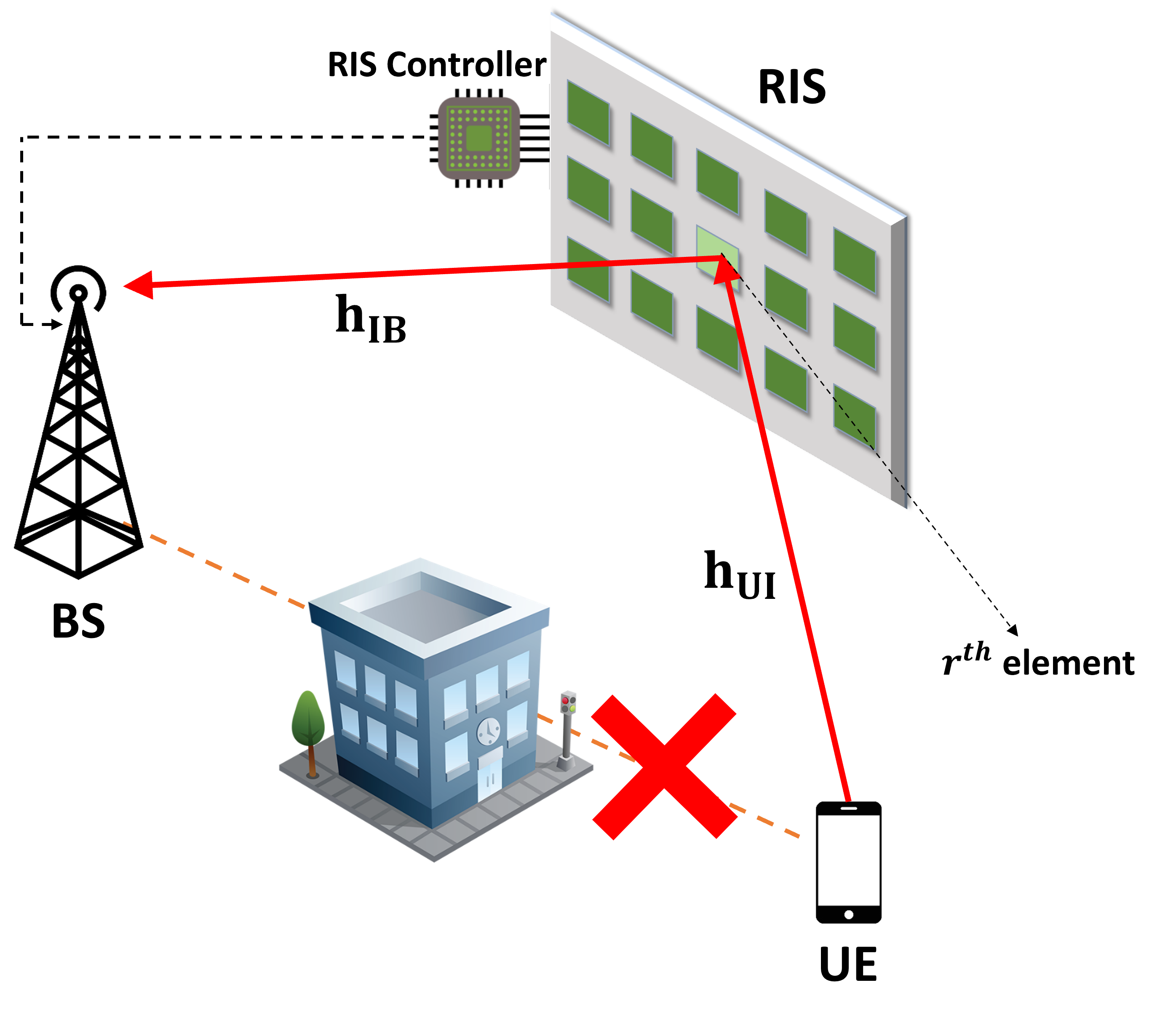
Figure 1: RIS-assisted SC-FDE uplink SISO system with blocked direct UE–BS link. The BS controls the RIS via a dedicated controller.
Grover Adaptive Search Implementation
GAS is implemented with quantum circuits to solve the QUBO detection problem. The algorithm dynamically updates cost thresholds during search iterations, achieving efficient exploration of binary optimization landscapes. The frequency-domain MLD is translated into a QUBO format, enabling the use of quantum parallelism to identify the most likely symbols efficiently. Controlled phase rotations are used to embed cost functions within quantum states, followed by amplitude amplification to progressively boost low-cost solutions.
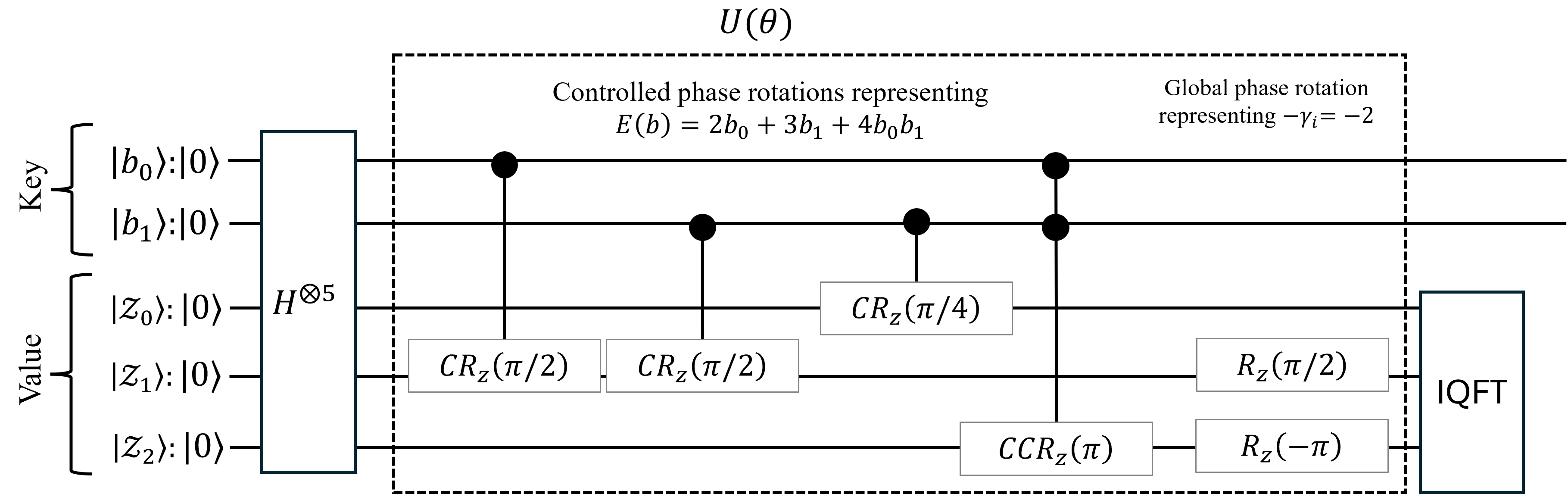
Figure 2: Quantum circuit of the GAS state-preparation stage. The example cost is E(b) = 2b_0 + 3b_1 + 4b_0 b_1 with threshold gamma_i = 2.
Quantum Circuit Design
The GAS circuit comprises two primary components: the key register for encoding candidate solutions, and the value register for representing shifted costs. The value register uses binary-weighted phase rotations to map cost functions, effectively leveraging the inverse Quantum Fourier Transform (IQFT) for coherent amplitude encoding. The algorithm proceeds with repeated oracle and diffusion operations to amplify favorable candidates (Figure 3), minimizing the number of computational queries while maintaining robustness against quantum noise.
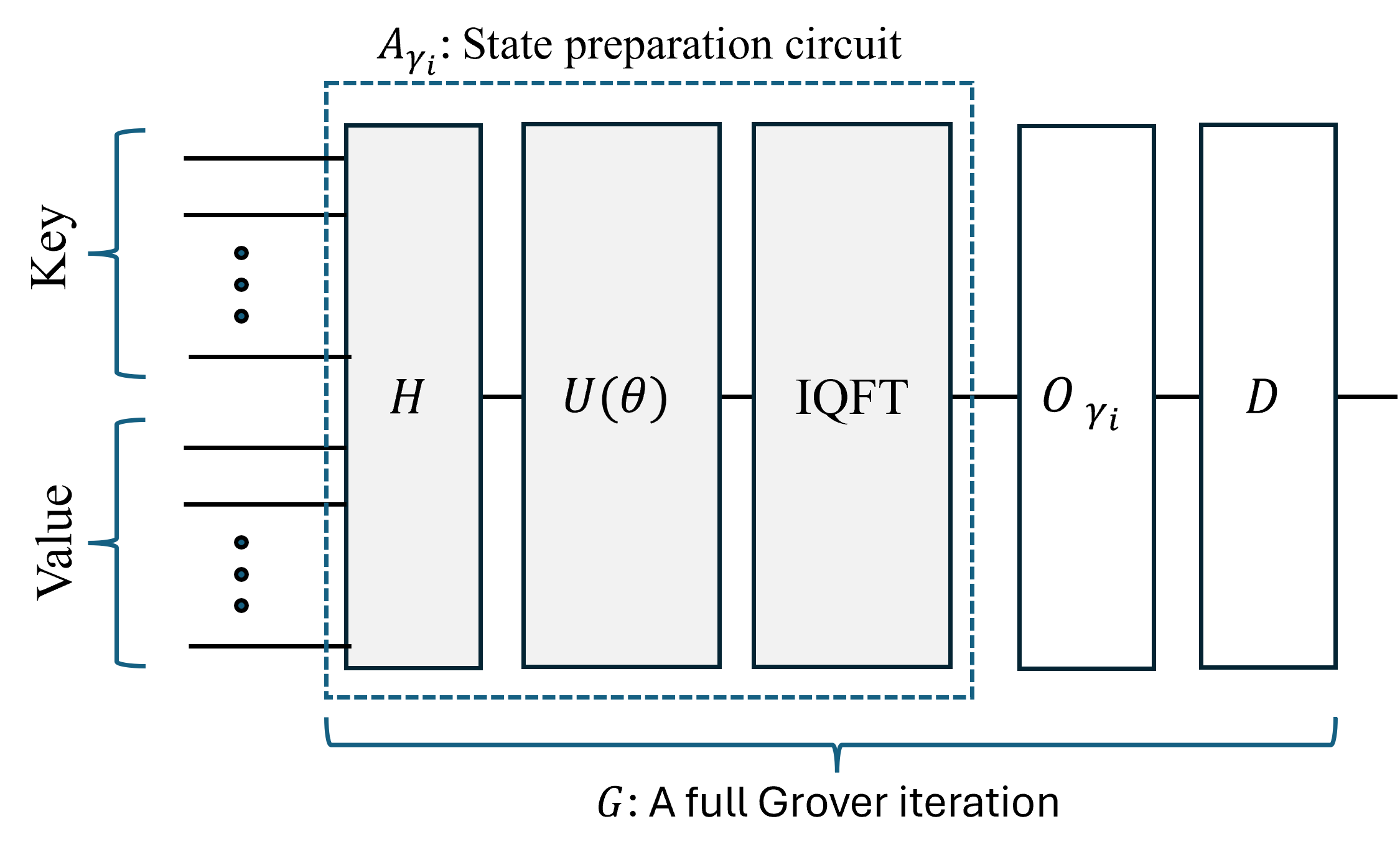
Figure 3: GAS circuit showing state preparation $A_{\gamma_{i}$, oracle O, and diffusion operator D, iterated to amplify low-cost solutions based on threshold γi.
Quantum Resource Analysis
The hybrid quantum-classical detector demonstrates efficient quantum resource allocation, characterized by scalable register widths and gate counts. The QUBO formulation reduces classical computation complexity, while Grover search offers quadratic speedup in query evaluation. Register widths for the quantum circuit are informed by error correction thresholds and qubit requirements scaled logarithmically with modulation orders and transmission block lengths. Quantum error resilience is achieved through minimized gate depth and controlled rotation architectures.
Simulation results exhibit the detector's robust performance in ideal conditions, demonstrating near-optimal detection efficacy across different RIS configurations and channel conditions. Enhanced BER performance for larger RIS sizes is observed, with multipath diversity offering notable gains in frequency-selective channels. Under noisy quantum conditions, depolarizing errors show negligible impact, affirming the algorithm's resilience through adaptive initialization and error detection strategies.
Conclusion
This work establishes a viable quantum-assisted detection framework for RIS-assisted communications, highlighting the feasibility of real-world deployment for 6G systems. By integrating advanced quantum search techniques rooted in GAS, the detection process achieves remarkable scalability and robustness without prohibitive complexity. The success of quantum-enhanced methods in RIS-assisted scenarios paves the way for further exploration into quantum communication systems, driving advancements in wireless networks powered by quantum computational principles.