- The paper identifies over 34 NLSy1 galaxies with >100 kpc radio jets, including a record 4.3 Mpc jet from J1318+2626.
- It employs cross-matching of a 22,656 NLSy1 catalog with multi-survey radio data and optical overlays for detailed morphology analysis.
- The findings challenge traditional AGN models by showing that even low-mass SMBHs can launch extensive radio jets.
Identification of Large-Scale (>100 kpc) Radio Jets in Narrow-Line Seyfert 1 Galaxies
Introduction and Context
The study systematically investigates the occurrence and properties of large-scale (>100 kpc) radio jets in Narrow-Line Seyfert 1 (NLSy1) galaxies, a subclass of AGN traditionally associated with low-mass SMBHs and spiral/disk hosts. The prevailing paradigm has linked powerful, extended radio jets to massive black holes in elliptical galaxies, but recent discoveries of relativistic jets in NLSy1s challenge this view. The paper leverages a new, extensive catalog of 22,656 NLSy1s and multi-survey radio data (FIRST, VLASS, LOFAR, RACS) to identify and characterize double-lobed radio structures exceeding 100 kpc in projected size.
Sample Selection and Methodology
The authors cross-matched the SDSS-based NLSy1 catalog with the FIRST radio survey, yielding 730 radio-detected NLSy1s. For each, they overlaid optical Pan-STARRS images with radio contours from multiple surveys, employing a systematic search for double-lobed morphologies with projected sizes >100 kpc. The approach included careful measurement of largest angular separations, conversion to physical sizes using redshift, and classification of radio morphology (FR I, FR II, WAT, X-shaped).
Results: Discovery and Characterization of Large-Scale Jets
A total of 34 NLSy1s with projected radio sizes >100 kpc were identified, including 29 confirmed double-lobed sources and 4 candidates requiring higher-resolution follow-up. Notably, J1318+2626 (z=0.62) hosts a 4.3 Mpc jet, the only known NLSy1 with Mpc-scale radio structure. The sample includes four giant radio galaxies (GRGs) and spans a wide range of morphologies, with a majority classified as FR I, contrary to earlier findings favoring FR II.
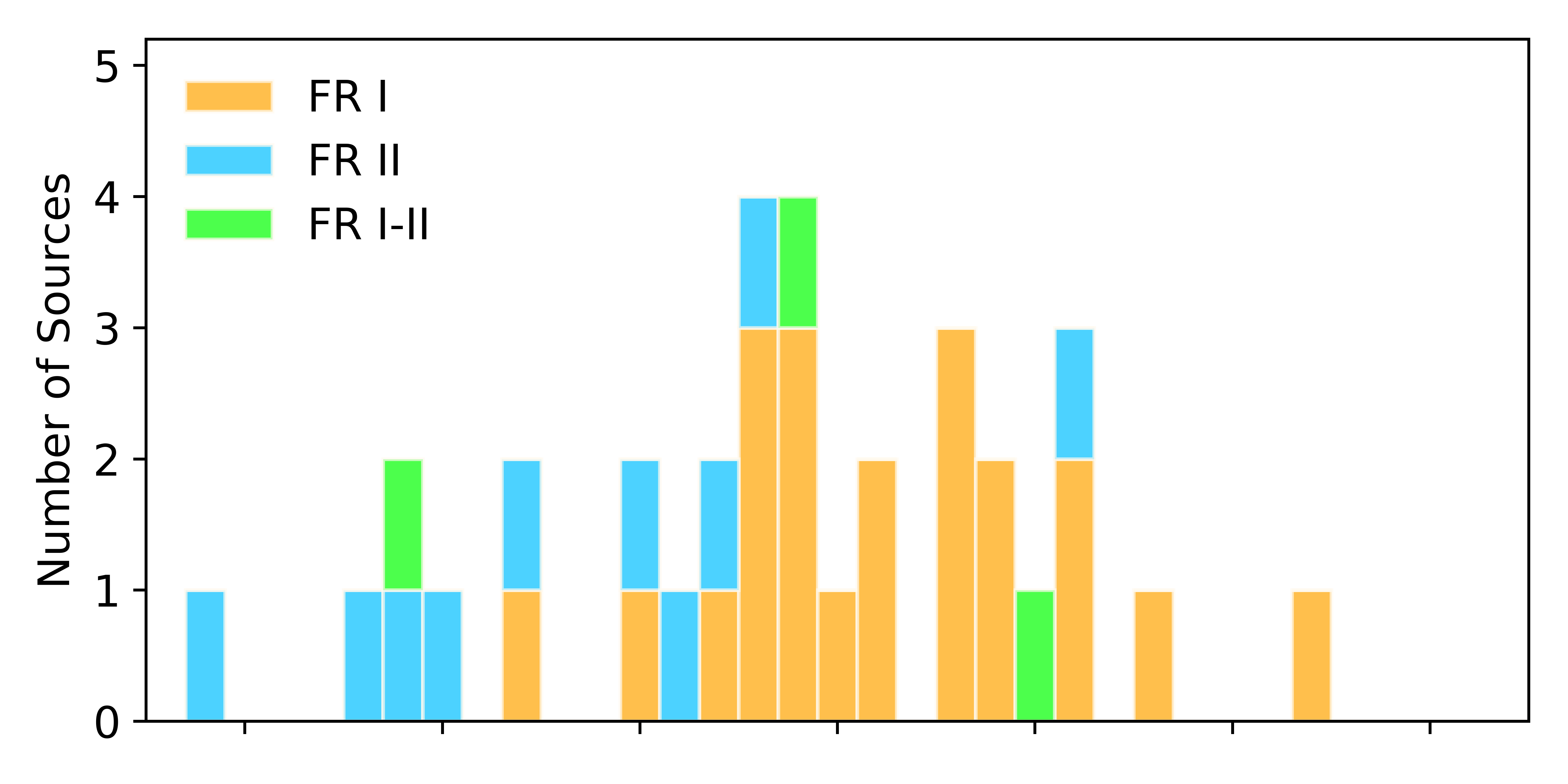
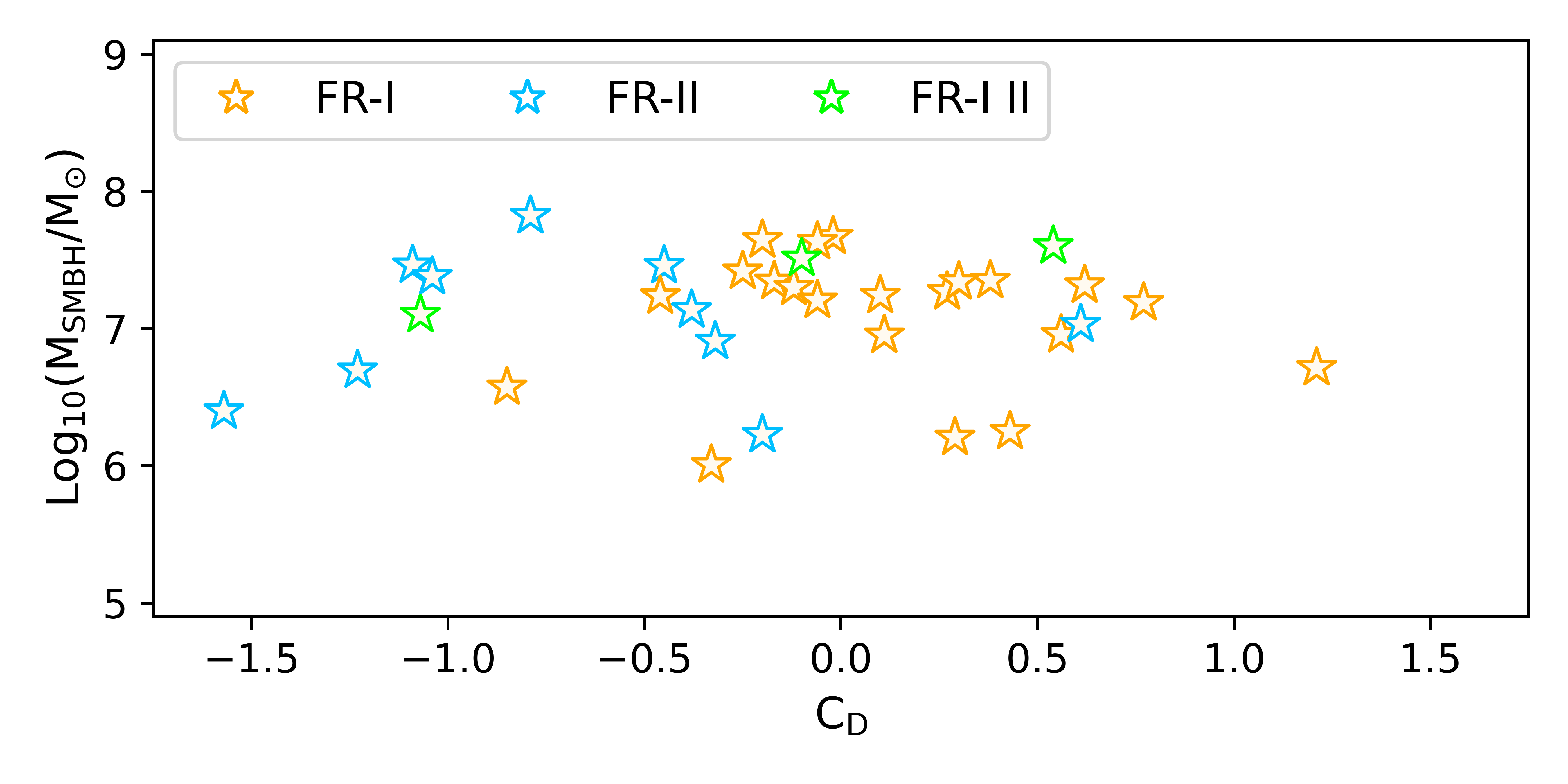
Figure 1: Histogram of the estimated core dominance for the NLSy1s with >100 kpc jets, illustrating the distribution of orientation indicators across the sample.
The use of sensitive, low-frequency surveys (especially LOFAR) was critical for detecting diffuse, extended emission, substantially increasing the known population of large-scale NLSy1 jets. The redshift distribution of these sources is skewed to higher values compared to the general radio-detected NLSy1 population, reflecting the improved sensitivity to distant, faint structures.
Physical Properties and Comparative Analysis
The >100 kpc NLSy1s are predominantly radio-loud, with ∼80% exhibiting radio loudness RL>100. Their SMBH masses are marginally higher than the general radio-detected NLSy1s, but the presence of GRGs among the least massive objects indicates that high mass is not a strict requirement for launching large-scale jets. The Eddington ratios are lower for the large-scale jet sample, likely due to higher SMBH masses.
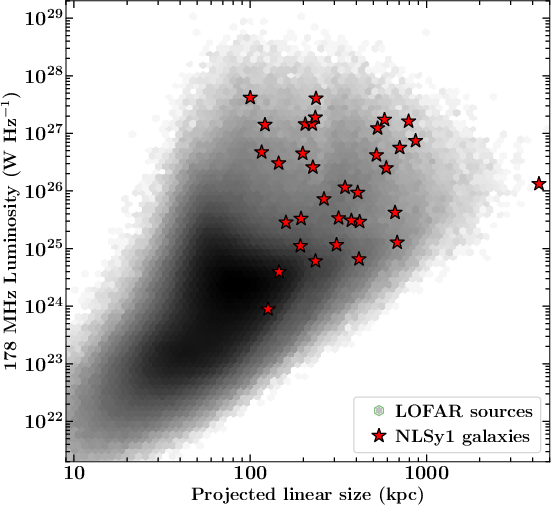
Figure 2: Power vs projected size (P–D diagram) for double-lobed NLSy1s >100 kpc, overlaid on the LOFAR-detected radio galaxy population, showing that NLSy1s occupy similar regions as other powerful radio galaxies.
Core dominance (CD), used as a statistical orientation indicator, ranges from −1.6 to $1.2$ with a median near zero. FR I sources tend to have higher CD than FR II, consistent with previous studies. The analysis finds no significant correlation between CD and SMBH mass, undermining the hypothesis that small black hole masses in NLSy1s are primarily due to orientation effects.
Morphological and Evolutionary Implications
The sample reveals a diversity of radio morphologies, including FR I, FR II, WAT, and X-shaped structures. The P–D diagram places these NLSy1s in the same evolutionary track as other luminous radio galaxies, suggesting similar jet propagation and environmental interactions. The detection of Mpc-scale jets in NLSy1s with relatively low-mass SMBHs challenges models that restrict large-scale jet formation to massive, elliptical-hosted AGN.
Blazar-like NLSy1s and γ-ray emitters within the sample exhibit higher core dominance and flatter radio spectra, consistent with small inclination angles. However, these do not systematically possess lower SMBH masses, and GRGs (expected to be oriented at large angles) can have small black holes, further decoupling orientation from mass estimation.
Theoretical and Practical Implications
The findings necessitate a revision of AGN unification models, particularly regarding the prerequisites for launching and sustaining large-scale relativistic jets. The presence of extended jets in NLSy1s implies that factors beyond SMBH mass and host morphology—such as black hole spin, accretion history, and environmental conditions—play significant roles. The results also highlight the importance of sensitive, low-frequency radio surveys for uncovering faint, extended AGN structures.
From a practical standpoint, the identification of radio-loud NLSy1s with RL>100 as a selection criterion is effective for discovering large-scale jets. The study provides a robust methodology for future surveys aiming to expand the census of extended AGN jets in diverse host environments.
Future Directions
The paper anticipates that next-generation radio telescopes and surveys will further increase the number of known large-scale NLSy1 jets, enabling detailed multi-wavelength studies of their formation, evolution, and feedback processes. Key areas for future research include:
- High-resolution imaging to resolve candidate structures and clarify morphologies.
- Multi-wavelength (optical, X-ray) studies of host environments and jet–ISM interactions.
- Investigation of black hole spin and accretion mechanisms in NLSy1s with extended jets.
- Statistical studies of jet power, duty cycles, and feedback effects in low-mass AGN.
Conclusion
This work significantly expands the known population of NLSy1 galaxies hosting >100 kpc radio jets, demonstrating that large-scale relativistic jets are not exclusive to massive, elliptical-hosted AGN. The results challenge established paradigms, suggest a broader diversity in AGN jet launching mechanisms, and provide a foundation for future observational and theoretical studies of jet physics in low-mass, young AGN systems.