- The paper introduces open-ended co-evolution, showing that static simulation frameworks do not capture dynamic societal behaviors.
- It integrates LLM-powered agents within evolving environments, enabling continuous adaptation and emergent norm formation.
- The study proposes a taxonomy based on dynamic scenario evolution and agent–environment co-evolution to better model socio-economic systems.
Revisiting Simulation Design for Societal Complexity
Introduction and Motivation
The paper "Static Sandboxes Are Inadequate: Modeling Societal Complexity Requires Open-Ended Co-Evolution in LLM-Based Multi-Agent Simulations" (2510.13982) addresses the limitations of current multi-agent systems (MAS) simulations, arguing that the rigid, task-focused paradigms are fundamentally inadequate for capturing the complexities of real-world societal behaviors. The authors propose a shift towards open-ended, co-evolutionary systems where LLM-powered agents evolve alongside their environments, enhancing both adaptability and realism.
Core Constructs and Limitations
Current multi-agent systems tend to be constrained by static benchmarks and narrowly defined tasks, thereby limiting emergent behaviors and adaptability. The paper highlights the necessity of shifting from this static paradigm to a dynamic one, emphasizing open-endedness and societal complexity. By redefining LLMs as adaptive cognitive engines and multi-agent systems as frameworks for evolving social norms, the authors lay the foundation for simulations that support dynamic evolution and adaptability.
Proposed Taxonomy for Open-Ended Co-Evolution
The authors introduce a new taxonomy centered on three pillars:
- Dynamic Scenario Evolution: Continuous change in scenarios driven by both agent interactions and external factors, encouraging agents to develop new strategies and skills for navigating these evolving environments.
- Agent–Environment Co-evolution: A framework where agent evolution and environmental changes are intrinsically linked, allowing for the modeling of real-world societal and ecological dynamics.
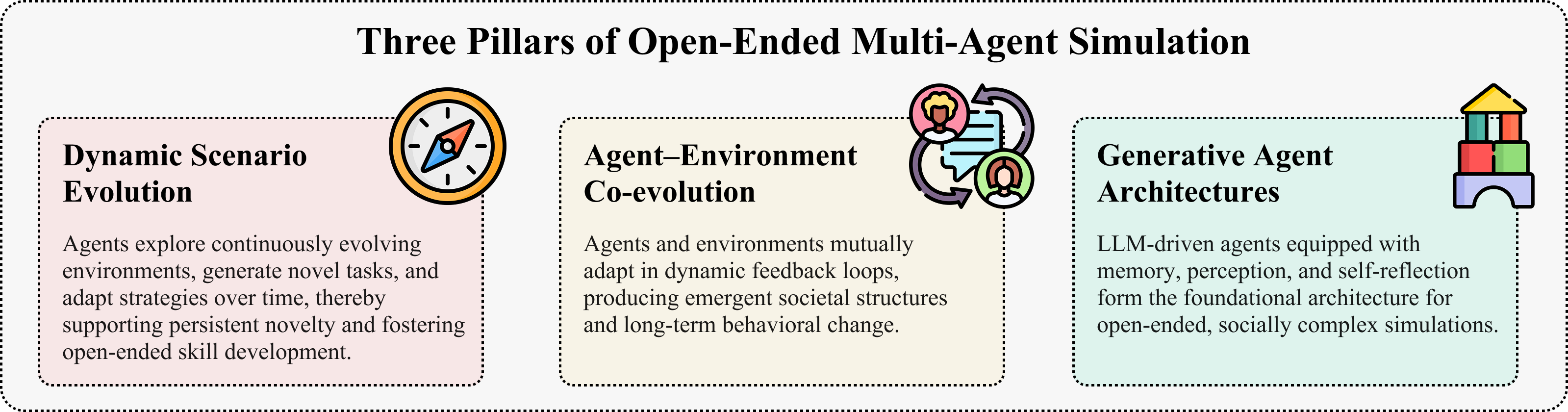
Figure 1: Our proposed taxonomy of open-ended multi-agent simulation: (1) Dynamic Scenario Evolution, (2) Agent–Environment Co-evolution, and (3) Generative Agent Architectures. These pillars support adaptive, socially aligned LLM-driven ecosystems.
Integrating LLMs into Multi-Agent Systems
The integration of LLMs facilitates advanced reasoning and decision-making capabilities. The paper critiques existing LLM-MAS integrations for their focus on performance and predictability at the expense of adaptability and norm emergence. It advocates for architectures that allow agents to update their behaviors and objectives based on social context, thereby supporting continuous open-ended development.
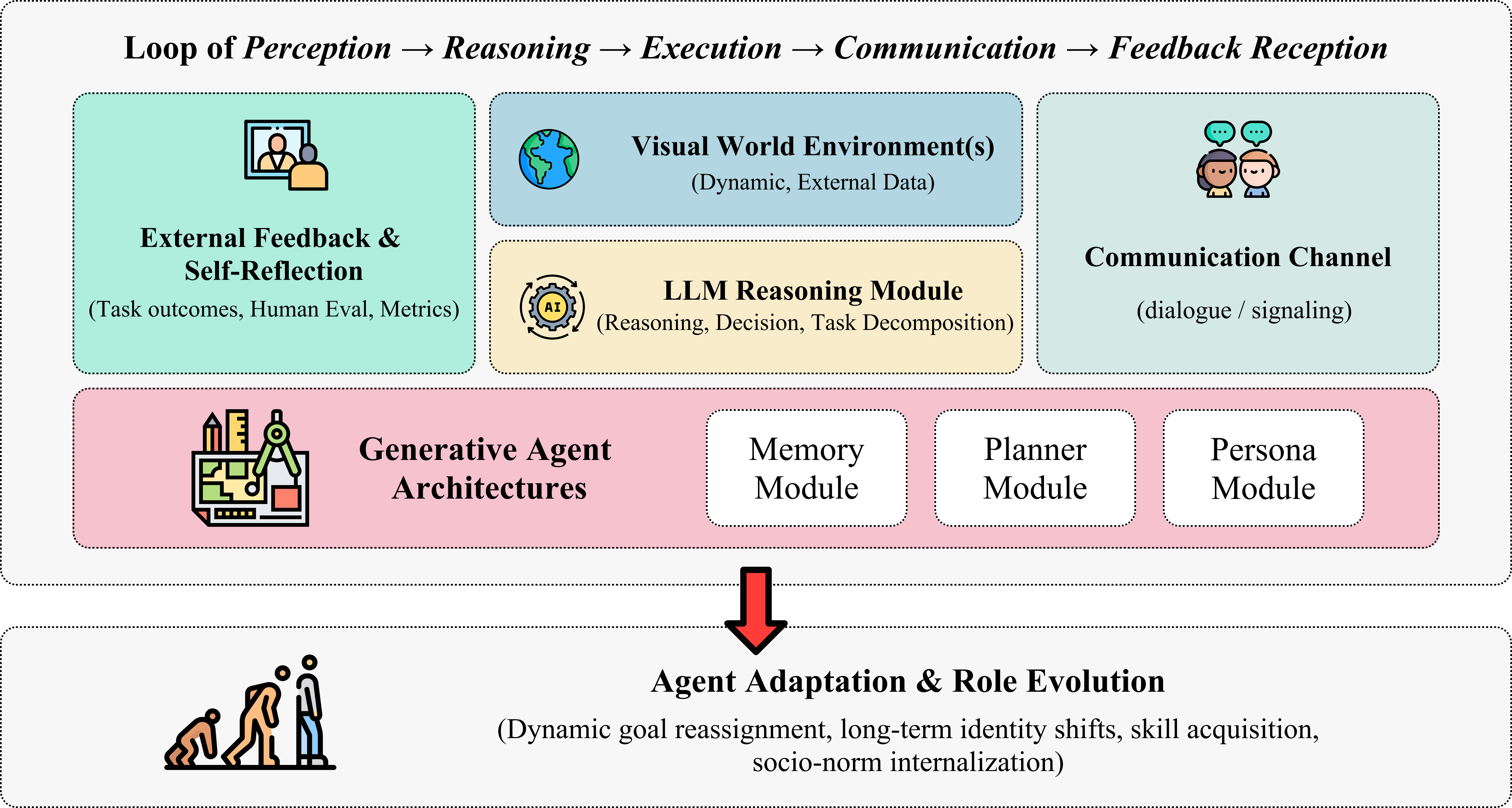
Figure 2: Unified architecture for LLM-driven generative agents in open-ended multi-agent simulations. The upper section depicts the short-term loop: Perception → Reasoning → Execution → Communication → Feedback Reception. The lower section highlights long-term development: Agent Adaptation and Role Evolution. Together, these components support both immediate reactivity and sustained co-evolution.
Key Methodologies and Frameworks
The paper reviews existing frameworks and methodologies, noting that while progress has been made, limitations persist due to scenario-specific tuning and bounded environmental constraints. For instance, frameworks like AI-Economist and TwinMarket illustrate the potential of LLMs to model socio-economic behaviors but remain limited by predefined objectives.
Open-Ended Simulation and Co-evolution
Open-ended simulations aim to capture the ongoing development of both agents and their environments. They prioritize continuous innovation and the emergence of novel behaviors over static task completion. The paper argues for the incorporation of real-world unpredictabilities as design goals, supporting agents in reshaping tasks, interactions, and value systems.
Implications and Future Directions
The paper concludes with a call to action for the research community to prioritize open-ended, co-evolutionary simulations. By embracing unpredictability and focusing on long-term adaptability, LLM-driven multi-agent ecosystems can be developed to more accurately reflect the complexities of societal interactions and adaptations.
Conclusion
"Static Sandboxes Are Inadequate" lays a compelling foundation for the reconceptualization of multi-agent simulations, emphasizing the necessity for adaptability and emergent complexity. The authors provide a roadmap for future research, urging the community to advance beyond static benchmarks towards systems capable of co-evolving with their environments, thus capturing the dynamic nature of real-world societal interactions.

