- The paper introduces tandem training, an RL framework where a strong model generates outputs that a frozen, weaker model can continue, enhancing intelligibility.
- It employs random token handoffs between models, effectively reducing jargon and aligning output language without major loss in accuracy.
- Experiments on GSM8K show that tandem training maintains high accuracy while ensuring handoff robustness across varying skill and language settings.
Tandem Training for LLMs: Operationalizing Intelligibility via Handoff Robustness
Motivation and Problem Statement
As the capabilities of LMs continue to advance, their reasoning and output often become opaque to weaker agents and humans, undermining interpretability and oversight. This paper introduces a formalization of intelligibility based on handoff robustness: a solution is intelligible to a weaker agent if, upon random handoff, the weaker agent can continue the solution without causing failure. The authors propose tandem training, a reinforcement learning (RL) paradigm in which a strong (senior) model is trained to co-generate solutions with a frozen, weaker (junior) model, with random turn-taking. The reward is contingent on the joint success, incentivizing the senior to produce solutions that are both correct and continuable by the junior.
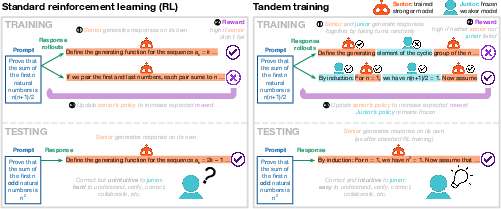
Figure 1: Tandem training encourages the senior model to generate solutions that can be continued by a weaker junior model, operationalizing intelligibility via handoff robustness.
Methodology: Tandem Training Paradigm
Tandem training modifies the standard RL rollout phase by randomly alternating token generation between the senior and junior models. The granularity of handoff (e.g., token, word, sentence) is a design parameter. The senior model is updated using RL (e.g., REINFORCE, PPO, GRPO) based on the success of these tandem rollouts. Notably, the junior model remains frozen, and the reward signal is derived solely from the outcome of the co-constructed solution, without explicit knowledge of the differences between the models.
This approach is architecture-agnostic and can be integrated with any RL algorithm. The stochasticity of turn-taking regularizes the senior model, analogous to dropout, preventing over-reliance on idiosyncratic reasoning patterns and promoting generalizable, intelligible behavior.
Experimental Setup
Experiments are conducted on the GSM8K math word problem benchmark, using Llama-2-7b variants as senior and junior models. Three settings are considered:
- Skill disparity: Senior is a GSM8K specialist (finetuned), junior is a base Llama-2 prompted in English.
- Skill and language disparity: Senior is a GSM8K specialist (English), junior is a base Llama-2 prompted in a non-English language (German, French, Bulgarian, Serbian).
- Language disparity: Both senior and junior are base Llama-2 models, prompted in different languages.
Jargon is operationalized as the use of specialist notation ($) and language mismatches. Tandem training is performed for one epoch using REINFORCE with binary rewards, and the senior is evaluated independently on the test set.
### Results: Suppression of Jargon and Preservation of Accuracy
Tandem training consistently suppresses jargon and adapts the senior's output to the junior's capabilities and language, while maintaining accuracy above the junior baseline.
- **Skill disparity:** Specialist notation ($) drops from 99% to 0% within 20 gradient updates, with senior accuracy remaining at 85% of its original value and 38% above the junior.
- Skill and language disparity: Both notational and linguistic jargon vanish rapidly; the senior model switches to the junior's language within 50–80 updates, with accuracy consistently above the junior.
- Language disparity: The senior model abandons its input language in favor of the junior's, typically within 20 updates. The transition often passes through English as an intermediate lingua franca.
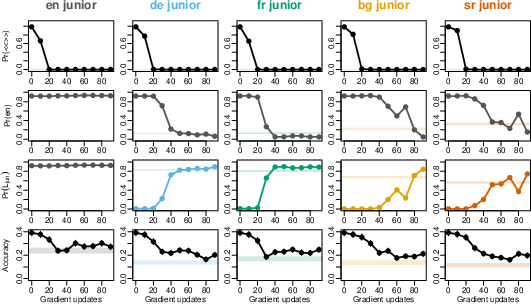
Figure 2: Tandem training reduces senior model jargon and adapts language to the junior, while maintaining accuracy above the junior baseline across skill and language disparity settings.
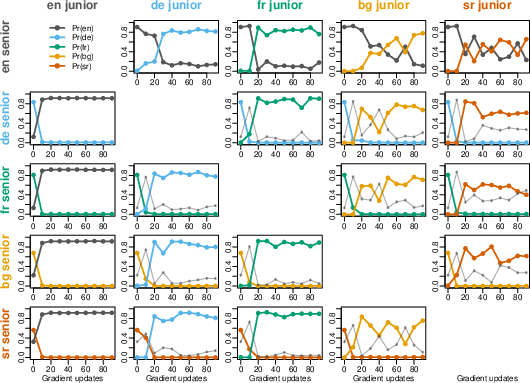
Figure 3: In language disparity settings, tandem training leads the senior to adopt the junior's language, with English often serving as a transitional phase.
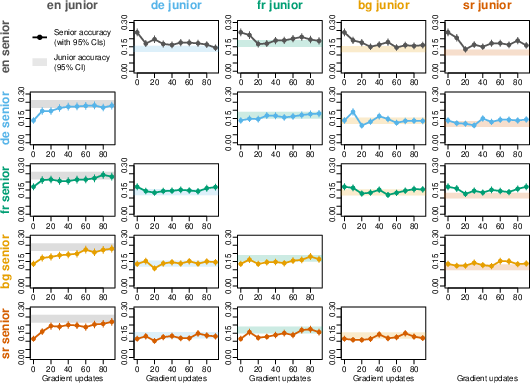
Figure 4: Senior and junior accuracy trajectories in language disparity settings, showing that tandem training preserves or improves senior accuracy relative to the junior.
Ablation experiments confirm that the suppression of jargon is due to tandem training, not RL alone. The results demonstrate that handoff robustness can be induced directly within the RL trajectory, creating pressure for the senior to produce continuable, non-idiosyncratic reasoning traces.
Discussion: Extensions, Limitations, and Implications
The tandem training framework is extensible: co-adaptation (training both models), dynamic junior selection (bandit or curriculum policies), and application to earlier training stages are all feasible. The current implementation uses sequence-level rewards; future work could refine credit assignment via token-level masking, negative example learning, and span-level preference learning.
Limitations include the focus on a single domain (math reasoning), use of a simple RL algorithm, and the assumption of shared tokenizers. The paradigm's generality across domains and RL methods remains to be validated.
Practically, tandem training offers a lightweight mechanism for aligning strong models with weaker collaborators, enhancing auditability and scalable oversight. Theoretically, it operationalizes a robust notion of intelligibility, distinct from post hoc interpretability, by embedding compatibility requirements directly into the solution trajectory.
Conclusion
Tandem training provides a principled RL-based approach to incentivize LLMs to produce solutions that are both correct and intelligible to weaker agents. By making intelligibility a prerequisite for reward, it aligns model behavior toward collaborative, auditable, and continuable outputs. The paradigm is architecture-agnostic, complementary to existing RL pipelines, and holds promise for multi-agent systems and human–AI collaboration.
Future Directions
Key avenues for future research include:
- Extending tandem training to diverse domains and tasks beyond math reasoning.
- Integrating more sophisticated RL algorithms and credit assignment mechanisms.
- Exploring co-adaptation and dynamic junior selection strategies.
- Investigating the impact on human–AI and AI–AI collaboration in real-world settings.
The tandem training paradigm represents a significant step toward building AI systems that remain auditable and compatible with weaker agents, with broad implications for oversight, safety, and collaborative intelligence.

