- The paper formulates a rigorous holographic duality between 4d Maxwell ensembles and 5d BF-type TQFTs using self-dual stabilizer codes.
- It employs quantum stabilizer codes to classify boundary conditions and bulk topologies via Construction A, bridging quantum information and topological field theory.
- In the large-N limit, the ensemble average produces an Eisenstein series reflecting a semiclassical bulk geometric average over moduli spaces.
Holographic Duality for 4d Maxwell Theories and Code-Based Ensembles
Overview and Motivation
This work establishes a precise holographic duality between ensembles of four-dimensional U(1)g Maxwell theories on spin four-manifolds and five-dimensional Abelian BF-type topological quantum field theories (TQFTs) of level N, summed over all five-manifolds with fixed boundary. The boundary ensemble is parameterized by self-dual symplectic codes over ZN, which correspond to topological boundary conditions in the 5d TQFT. The equivalence classes of bulk topologies are similarly classified by orthogonal self-dual codes. This duality is reformulated in the language of quantum stabilizer codes, providing a bridge between quantum information theory and topological field theory.
The construction generalizes the well-known 2d/3d Narain CFT/Chern-Simons duality, extending the correspondence to correlation functions and ensemble averages. In the large-N limit, the boundary ensemble average converges to an integral over the moduli space of gauge couplings, yielding an Eisenstein series of the orthogonal group—a manifestation of the Siegel-Weil formula.
Topological Boundary Conditions and Code Theory
The 5d BF-type TQFT is defined by the action
2πNI=1∑g∫B2I∧dC2I
on a spin four-manifold M4. The Hilbert space depends only on the 2-cohomology of M4, and is isomorphic to the Hilbert space of a 3d Chern-Simons theory compactified on a Riemann surface Σ of genus g.
Topological boundary conditions in the 5d theory are classified by maximal self-dual symplectic codes over ZN of length $2g$. Each code defines a quantum stabilizer state in the Hilbert space, and the set of inequivalent bulk topologies is similarly classified by orthogonal self-dual codes. This correspondence is formalized via the Construction A mapping from codes to lattices, and the resulting states are stabilized by the generalized Pauli group generated by surface operators wrapping 2-cycles in M4.
Holographic Correspondence: Bulk/Boundary Duality
The central holographic relation is
⟨ZMaxwell⟩=topologies∑Z5d CS
where the left side is the ensemble-averaged partition function of boundary Maxwell theories, and the right side is the sum over bulk wavefunctions for all 5d topologies with fixed boundary. For N=1, the ensemble reduces to a single theory and the sum over topologies is trivial. For N>1, the ensemble is nontrivial and parameterized by codes.
The duality extends to correlation functions of U(1) primaries, with each partition function in the boundary ensemble invariant under the 4d modular group O(n,n,Z). The bulk theory inherits an additional Sp(2g,ZN) symmetry, which permutes theories in the ensemble.
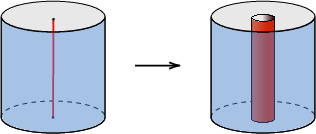
Figure 1: Left: A 2+1 topological system with a defect, where topological boundary conditions at the defect worldline yield a CFT at the cylinder boundary. Right: The defect worldline is fattened into a cylindrical shell, resulting in the sandwich construction.

Figure 2: Schematic illustration of the sum over 3d topologies being equivalent to the sum over topological boundary conditions, including both smooth and singular topologies.
Quantization and Wavefunction Construction
Holomorphic quantization of the 5d theory proceeds via dimensional reduction from a 7d Chern-Simons-type theory. The wavefunctions are constructed as holomorphic functions of boundary data, with explicit dependence on the modular parameters of the underlying geometry. The basis states are labeled by codewords, and the action of the modular and orthogonal groups is implemented via surface operators.
The explicit form of the wavefunctions is given by generalized theta functions, with the partition function for a Maxwell theory on M4 expressed as
Zτ[M4]=Φ5dθ(τ,E,ξ,ξˉ)
where θ is a Siegel-Narain theta function and Φ5d encodes the determinant of Laplacians on M4.
In the large-N limit, the ensemble average over boundary theories becomes an integral over the moduli space of gauge couplings, and the sum over bulk topologies approaches a sum over handlebodies. The resulting average is an Eisenstein series of the orthogonal group, a higher-dimensional analog of the Siegel-Weil formula known from the 2d/3d context.
Correlation Functions and Operator Insertions
The duality extends to correlation functions of local operators. In the 2d/3d case, conformal blocks with operator insertions correspond to bulk path integrals with line operators ending at insertion points. In the 4d/5d case, surface operators in the bulk ending on contours at the boundary compute correlators of Wilson lines in the boundary theory.
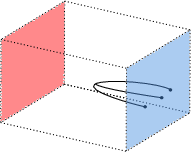
Figure 3: 2d CFT conformal block with operator insertions, realized in the bulk by TQFT on Σ×[0,1] with Wilson lines ending at the conformal boundary.
Gauge Group of 4d N=4 SYM and Bulk Boundary Conditions
The holographic dictionary for 4d N=4 SYM is clarified: the choice of gauge group (U(N) or SU(N)) is determined by the boundary conditions for the bulk TQFT fields B2,C2. Holomorphic quantization yields the U(N) theory, while topological boundary conditions correspond to SU(N) theories. The construction is formalized via the SymTFT approach, and the bulk partition function is shown to evaluate the appropriate boundary theory depending on the quantization scheme.
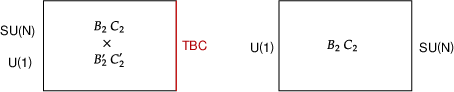
Figure 4: Gauging the center ZN of U(1)×SU(N) theory in the SymTFT construction.
Implications and Future Directions
This work demonstrates that ensemble holography is not restricted to lower dimensions or the absence of dynamical gravitons. The bulk theory is a topological theory of gravity, and both single-theory and ensemble dualities are realized depending on the properties of the bulk TQFT. The connection to quantum stabilizer codes provides a new perspective on anyon condensation and topological boundary conditions in higher-dimensional TQFTs.
In the large-N limit, the bulk sum over topologies becomes semiclassical, including only handlebody geometries. The duality extends to correlators of U(1) primaries and their descendants, and the formalism suggests possible generalizations to Virasoro TQFTs and more general boundary ensembles.
Conclusion
The paper formulates a rigorous holographic duality between ensembles of 4d Maxwell theories and 5d Abelian TQFTs, with the ensemble structure and bulk topology classified by self-dual codes. The duality is exact for partition functions and extends to correlation functions, with the large-N limit yielding a geometric average over moduli spaces described by Eisenstein series. The connection to quantum information theory via stabilizer codes enriches the interpretation of topological boundary conditions and anyon condensation. The results suggest that ensemble holography is a general feature of topological gravity theories in any dimension, and open avenues for further exploration of holographic dualities involving more general symmetry algebras and dynamical gravity.