Effective programming of a photonic processor with complex interferometric structure
Published 21 Aug 2025 in physics.optics and quant-ph | (2508.15741v2)
Abstract: Reconfigurable photonics have rapidly become an invaluable tool for information processing. Light-based computing accelerators are promising for boosting neural network learning and inference and optical interconnects are foreseen as a solution to the information transfer bottleneck in high-performance computing. In this study, we demonstrate the successful programming of a transformation implemented using a reconfigurable photonic circuit with a non-conventional architecture. The core of most photonic processors is an MZI-based architecture that establishes an analytical connection between the controllable parameters and circuit transformation. However, several architectures that are substantially more difficult to program have improved robustness to fabrication defects. We use two algorithms that rely on different initial datasets to reconstruct the circuit model of a complex interferometer, and then program the required unitary transformation. Both methods performed accurate circuit programming with an average fidelity above 98%. Our results provide a strong foundation for the introduction of non-conventional interferometric architectures for photonic information processing.
The paper introduces two algorithms for reconstructing digital models of complex photonic interferometers to program arbitrary unitaries.
It employs global calibration and quadratic crosstalk compensation, achieving an average fidelity of 99.6% across 100 configurations.
Machine learning techniques are explored to enhance calibration, demonstrating robust performance with challenging current-unitary mappings.
Effective Programming of a Photonic Processor with Complex Interferometric Structure
Introduction
The paper addresses the challenge of programming reconfigurable photonic processors with non-conventional interferometric architectures, specifically those incorporating multiport couplers rather than standard Mach-Zehnder interferometer (MZI) meshes. While MZI-based architectures benefit from well-established analytical calibration procedures, architectures with n×n multiport splitters offer improved robustness to fabrication defects but lack straightforward programming methods. The authors present and experimentally validate two algorithms for reconstructing the digital model of a complex photonic interferometer, enabling high-fidelity programming of arbitrary unitary transformations. The work demonstrates average matrix fidelities exceeding 98% and provides a systematic approach to address crosstalk and calibration in complex photonic circuits.
Photonic Chip Architecture and Calibration Challenges
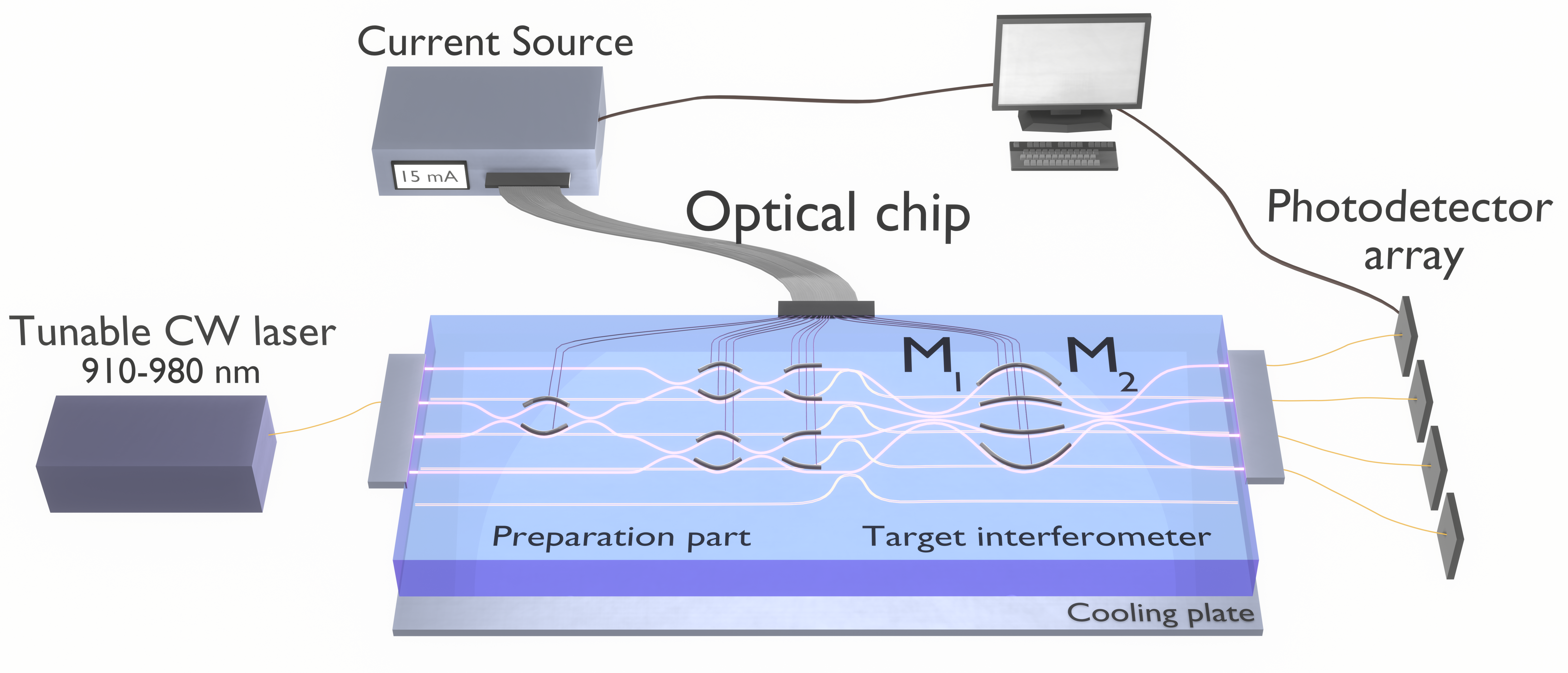
The photonic processor under study is fabricated via femtosecond laser writing (FSLW) in fused silica and comprises a preparation stage (three cascaded MZIs) and a target interferometer (two 4×4 multiport couplers sandwiching three tunable phase shifters). The auxiliary waveguides, written 35 μm below the main plane, enable independent calibration of the preparation interferometer and monitoring of the input state to the target interferometer.
Figure 1: Schematic of the photonic chip, showing the cascaded MZIs, target interferometer, and auxiliary waveguides for calibration.
The calibration of such a device is nontrivial due to the lack of analytical relations between control parameters and the implemented unitary, especially in the presence of significant thermal crosstalk between adjacent phase shifters. Unlike MZI meshes, where each block can be calibrated independently, the multiport architecture requires global modeling and simultaneous parameter estimation.
Modeling and Compensation of Crosstalk
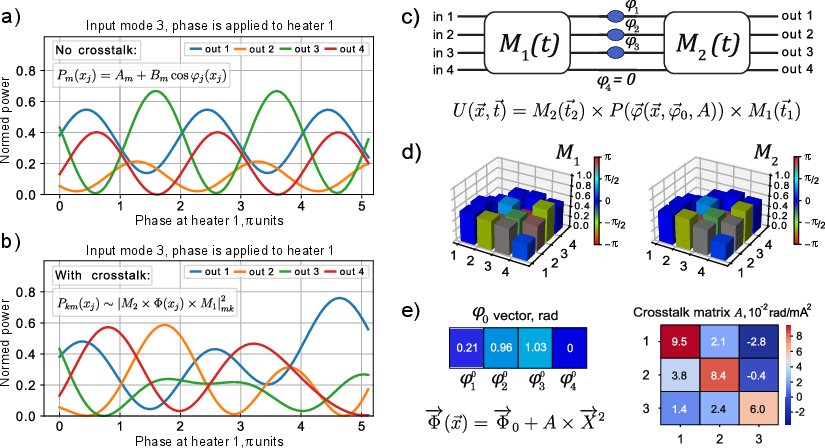
The authors model the phase response of each heater as a quadratic function of the applied current, with a full crosstalk matrix A={αij} capturing the mutual influence between all heaters:
φ(x)=φ0+A⋅x2
This model is validated by comparing the output power dependence on the control current in the absence and presence of crosstalk. In the ideal case, the response is sinusoidal and periodic; with crosstalk, the response becomes non-periodic and complex, necessitating a global fit to all calibration data.
Figure 2: Output power dependence on phase shifter current, illustrating the impact of crosstalk on calibration curves.
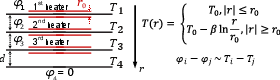
The crosstalk matrix is initially estimated using a physical model based on heater geometry and thermal diffusion, then refined via global optimization over the full calibration dataset. The approach yields a digital model parameterized by 30 real variables: 18 for the two mode-mixing blocks (M1, M2), 3 for bias phases, and 9 for crosstalk coefficients.
Figure 3: Guidelines for estimating the relations between crosstalk elements in the matrix A={αij}.
Digital Model Reconstruction and Validation
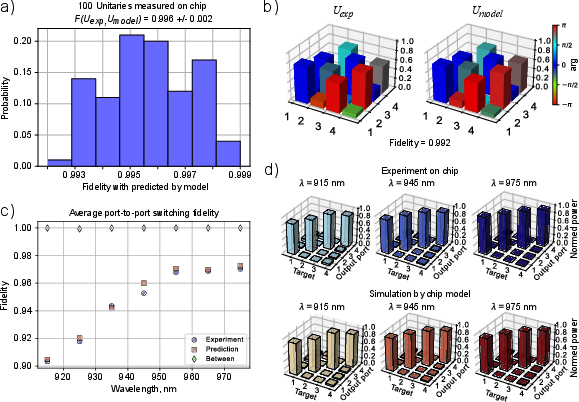
The digital model is constructed by fitting the measured output powers for all combinations of input ports, heaters, and output ports. The model is then used to predict the unitary transformation for arbitrary control settings. The authors validate the model by programming 100 random current configurations, measuring the resulting unitaries via coherent-state tomography, and comparing them to the model predictions using the matrix fidelity metric:
The average fidelity across all tested configurations is 99.6±0.2%, with the lowest observed fidelity at 99.2%.
Figure 4: (a) Matrix fidelity histogram for 100 measured and simulated unitaries; (b) Example of the lowest-fidelity pair; (c) Port-to-port switching fidelities across wavelengths; (d) Output power histograms for one-to-one switching.
The model also accurately predicts the device's behavior under broadband operation, with port-to-port switching fidelities above 0.99 between measured and simulated output distributions, even as the absolute switching fidelity varies with wavelength.
Machine Learning-Based Model Inference
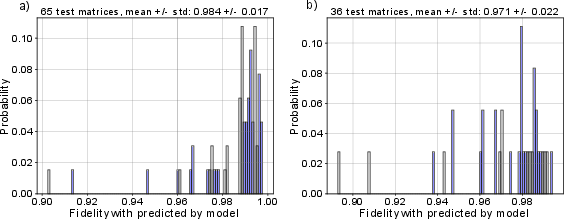
The authors further explore ML approaches for digital model reconstruction, training neural networks on two types of datasets: (1) phase shifts and corresponding unitaries, and (2) raw current settings and corresponding unitaries. The ML models achieve fidelity distributions peaking around 0.99, with no test case falling below 0.90, demonstrating the feasibility of data-driven model inference even without explicit calibration.
Figure 5: Fidelity histograms for ML-based model tests using (a) phase shift-unitary and (b) current-unitary datasets.
The phase shift-unitary dataset requires prior calibration, making it less practical for general use. The current-unitary dataset is more fundamental but requires full unitary tomography, which is experimentally more demanding.
Fabrication and Device Implementation
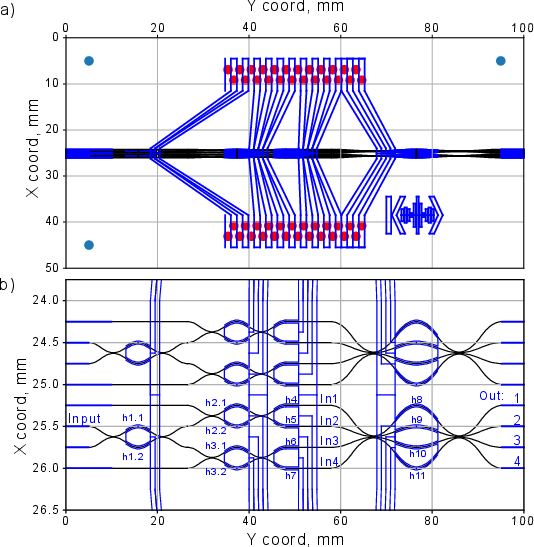
The FSLW process enables three-dimensional waveguide and electrode patterning, with precise alignment achieved via inscribed markers. The chip features low propagation and bending losses, and the electrode design minimizes but does not eliminate crosstalk. The device structure, including electrical and ground connections, is shown in the top-view schematic.
Figure 6: (a) Real-scale schematic of the chip with electrical, ground, and alignment markers; (b) Zoomed view of waveguides and electrodes.
Scalability and Practical Implications
The calibration and programming procedure scales quadratically with the number of modes, as both the number of required measurements and the number of model parameters grow as O(N2). The approach is extendable to universal interferometers with multiple phase shift layers, with each layer calibrated independently. The digital model enables offline optimization of control parameters, reducing device wear and facilitating rapid reconfiguration.
The demonstrated high-fidelity programming of arbitrary unitaries and robust broadband switching highlight the suitability of multiport architectures for photonic information processing, including applications in optical neural networks, quantum information, and high-speed optical switching. The explicit modeling and compensation of crosstalk are essential for scaling to larger, more complex photonic processors.
Conclusion
This work provides a comprehensive methodology for the effective programming of photonic processors with complex interferometric structures, addressing the challenges posed by non-conventional architectures and significant crosstalk. The combination of physically informed modeling, global optimization, and machine learning enables high-fidelity implementation of arbitrary unitary transformations. The results establish a foundation for the deployment of robust, programmable photonic circuits in advanced information processing tasks and suggest clear pathways for scaling and further automation, including the integration of AI-driven calibration and control.
“Emergent Mind helps me see which AI papers have caught fire online.”
Philip
Creator, AI Explained on YouTube
Sign up for free to explore the frontiers of research
Discover trending papers, chat with arXiv, and track the latest research shaping the future of science and technology.Discover trending papers, chat with arXiv, and more.