- The paper introduces the STAMP framework that leverages dual-branch transformer-based encoding and multi-pattern attention to improve STAS detection in histopathology images.
- Experimental results on three multi-center datasets demonstrate superior performance, with higher AUC, accuracy, and F1-scores than ten state-of-the-art MIL methods.
- Ablation studies reveal that dual-token embedding and feature-level attention aggregation are critical for capturing diverse STAS patterns and enhancing diagnostic reliability.
Multi-pattern Attention-aware MIL for STAS Diagnosis in Multi-center Histopathology Images
Clinical Context and Diagnostic Challenges
Spread Through Air Spaces (STAS) represents a distinct invasive pattern in lung adenocarcinoma (LUAD), correlated with increased recurrence risk and diminished survival. The pathological detection of STAS, based on whole-slide images (WSIs), is hindered by institutional resource disparities, pronounced subjective diagnostic variation, and laborious annotation protocols. Missed and incorrect diagnoses are prevalent, notably in centers without advanced pathology resources. Figure 1 illustrates these systemic diagnostic barriers.
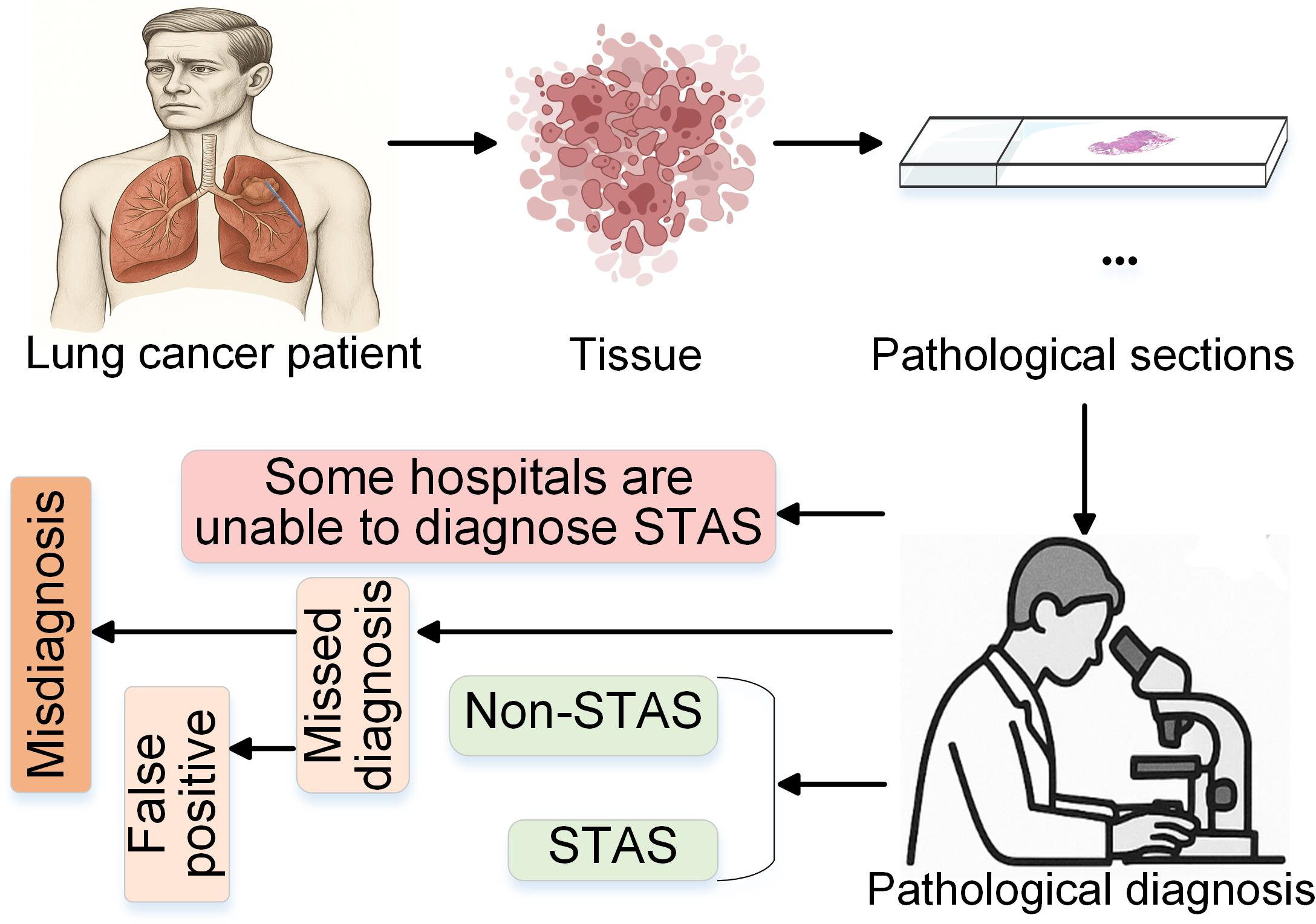
Figure 1: The challenges of STAS diagnosis include the unavailability of diagnostic results in some hospitals, a high risk of missed or incorrect diagnoses, and the labor-intensive nature of the diagnostic process.
STAS manifests in diverse morphologies: micropapillary clusters, individually disseminated cancer cells, and solid nests. These heterogeneous features predominantly appear outside the main tumor bulk, undermining detection reliability and complicating the standardization of computational pathology tasks. Figure 2 highlights the three characteristic STAS patterns observed in histopathology.
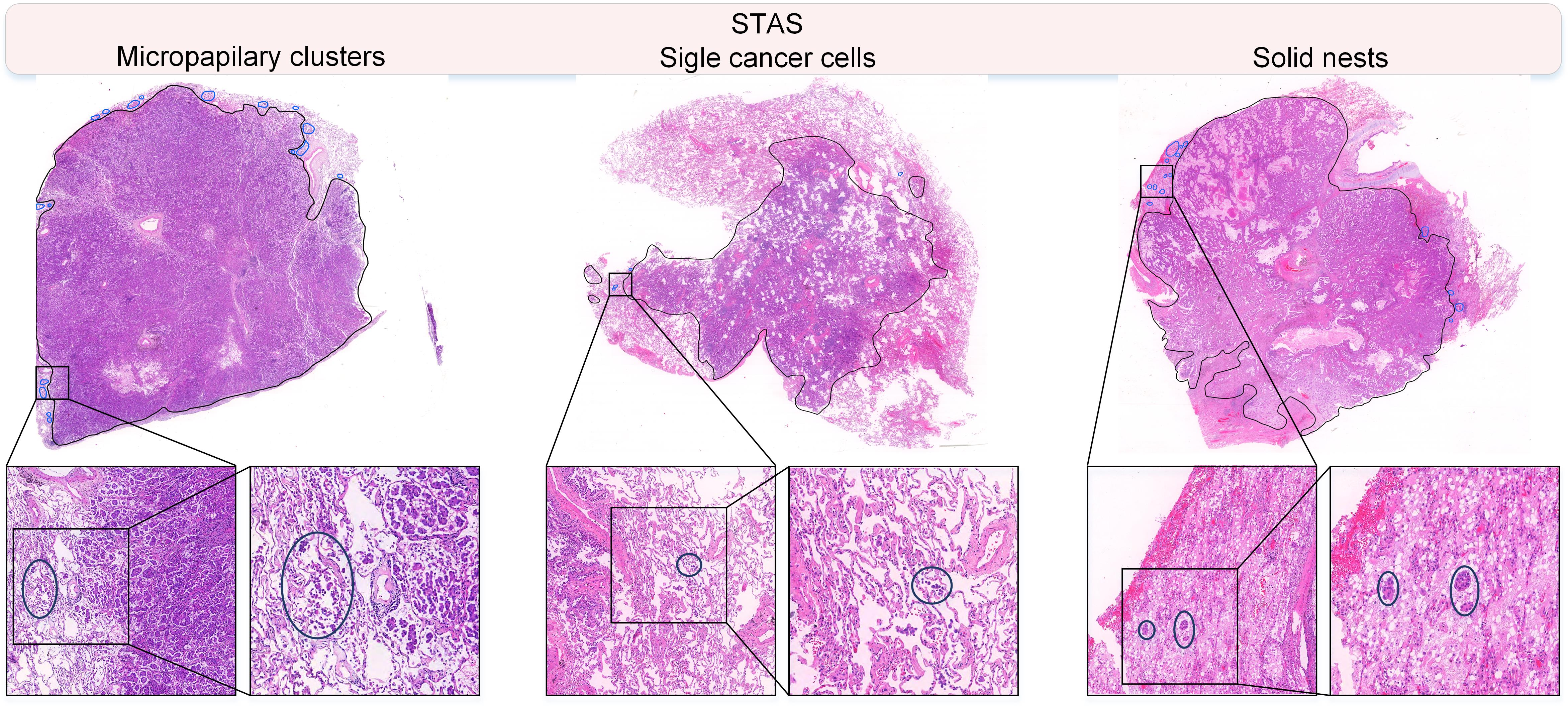
Figure 2: STAS is mainly distributed outside the tumor body with the pathological features of micropapillary clusters, single cancer cells and solid nests.
STAMP Framework: Multi-pattern Attention-aware MIL
To address the inherent challenges in STAS diagnosis, the paper introduces the STAMP framework, a dual-branch multi-pattern attention-aware multiple instance learning strategy. The pipeline commences from WSI annotation and digitization, proceeds through patch-level segmentation, feature extraction using transformer-based encoders, and concludes with MIL-based classification enhanced via regularized similarity constraints. The workflow is depicted in Figure 3.
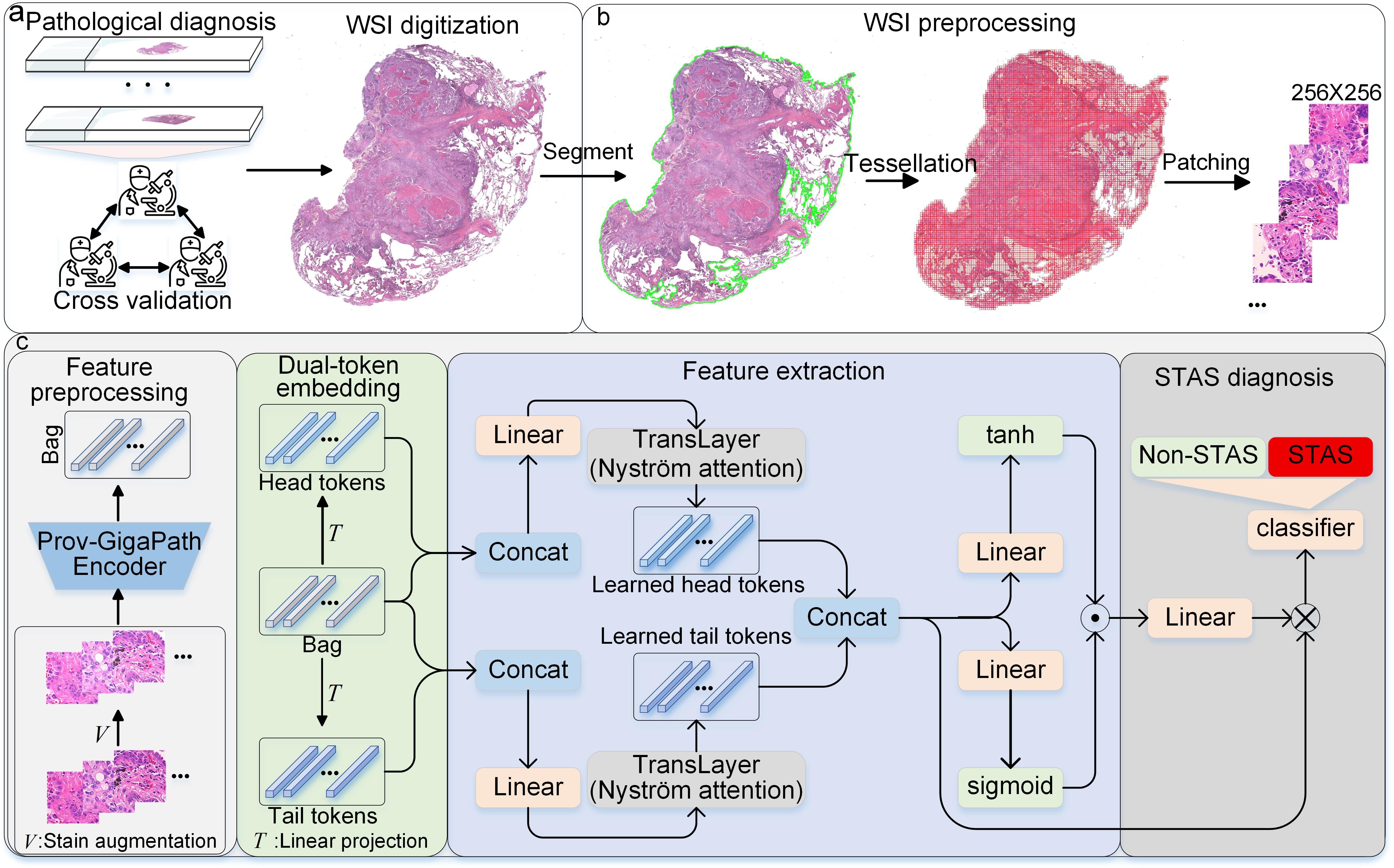
Figure 3: End-to-end workflow for STAS diagnosis from histopathological images: Annotation, preprocessing, feature extraction, attention aggregation, classification.
Dual-token Embedding & Instance Encoding
STAMP's architecture employs two learnable token sets (head and tail branches) representing distinct semantic perspectives. Independent transformer instance encoders (leveraging Nyström Attention for scalability) project patch sequences into discriminative feature spaces. Concatenated branch tokens capture pattern-specific semantic information, optimizing WSI-level representation for diagnostic inference.
Multi-pattern Attention Aggregation
STAMP introduces a composite attention module, integrating gated and content-aware mechanisms at the feature level. Dynamic region selection promotes the prioritization of morphologically relevant lesion evidence while suppressing background noise, enhancing global representation discriminability. Learned pattern tokens are aggregated via softmax-weighted fusion and subsequently classified with a cross-entropy loss augmented by an inter-token cosine similarity regularization, preventing representational collapse.
Experimental Framework and Benchmark Results
Three high-quality, pathologist-curated multi-center datasets—STAS-SXY, STAS-TXY, and STAS-TCGA—form the backbone of empirical evaluation. Cross-validation annotation ensures accurate ground truth establishment. Comparative benchmarking is performed against 10 state-of-the-art MIL methods (MaxPooling, MeanPooling, ABMIL, DSMIL, ILRA, WIKG, CLAM-SB, CLAM-MB, TransMIL, SMILE), reporting metrics including AUC, accuracy, precision, recall, and F1-score.
Comparative Analysis
On STAS-SXY, STAMP achieves the highest AUC (0.8058), accuracy (0.7449), and F1-score (0.7376), surpassing both clinical routine and MIL method baselines. STAS-TXY results are similarly robust (ACC = 0.8124, F1 = 0.7623), with AUC (0.8017) marginally below CLAM-SB but with better overall balanced metrics. On the heterogeneous STAS-TCGA cohort, STAMP maintains highest F1 (0.6962) and AUC (0.7928) across all tested approaches.
Ablation Studies
Ablations systematically investigate the contribution of the number of latent patterns, dual-branch architecture, token embedding strategies, and feature-versus-prediction level attention aggregation. Results substantiate that three pattern tokens in dual-branch mode maximize classification metrics, post-attention embedding outperforms pre-attention, and feature-level aggregation is superior to prediction-level fusion. These findings demonstrate that the multi-pattern attention mechanism and double-branch encoding are critical for capturing STAS-relevant heterogeneity.
Implications and Future Directions
STAMP's robust performance not only exceeds clinical pathologist benchmarks but also identifies limitations in single-branch and naive instance aggregation MIL methods. The attention-based pattern selection is specifically suited for the pathological complexity of STAS, showcasing potential for scalable, generalizable computational pathology workflows. Notable shortfalls remain; expert-dependent dataset curation restricts automation and scalability, and center-to-center generalization still lags optimal transfer, especially for rare STAS-positive cases.
Prospective research should address: (a) automatic quality control models for artifact-laden WSIs, (b) enrichment of positive-case datasets, (c) enhanced domain adaptation for cross-institutional deployment, and (d) alignment of model-derived attention maps with expert annotations for improved interpretability and trust.
Conclusion
The STAMP framework represents a significant advancement in weakly supervised MIL architectures for complex histopathology-based STAS diagnosis. By integrating dual-branch embeddings, transformer-based instance encoding, and multi-pattern feature-level attention aggregation, STAMP robustly identifies clinically critical STAS patterns across multi-center datasets. Its demonstrated diagnostic accuracy and cross-center consistency recommend STAMP as a computational pathology benchmark, with clear avenues for future improvement via automated quality control, data enrichment, and interpretable model-pathologist integration.