- The paper shows that oxygen vacancies initially reduce the metal-insulator transition temperature before inducing a Mott-Anderson insulating state.
- The paper employs pulsed laser deposition and X-ray absorption spectroscopy to precisely characterize oxygen vacancy distribution and its impact on electronic transport.
- The paper reveals that tunable oxygen vacancy engineering in high-entropy oxides holds promise for advanced electronics and neuromorphic computing applications.
Summary of "Janus-faced influence of oxygen vacancy in high entropy oxide films with Mott electrons"
Introduction to High-Entropy Oxides
High-Entropy Oxides (HEOs) are an innovative class of materials characterized by multiple cations sharing the same crystallographic site, providing a potential for tunable functionalities through cationic disorder. This disorder disrupts local symmetry and induces local structural distortions, impacting electronic interactions and offering unique advantages over traditional oxides. The paper "Janus-faced influence of oxygen vacancy in high entropy oxide films with Mott electrons" explores the role of oxygen vacancies (OVs) in tailoring the electronic properties of HEOs, focusing on the perovskite structure of [La0.2Pr0.2Nd0.2Sm0.2Eu0.2]NiO3 (LPNSE)NO3−δ.
Traditionally, OVs in similar materials such as VO2 and V2O3 show a monotonic influence on the Metal-Insulator Transition (MIT), but the study reveals a distinct, non-monotonic effect in LPNSE)NO3−δ. As OV concentration increases, there is initially a reduction in the MIT temperature, followed by suppression of the metallic phase, attributable to the combined effects of correlation energy scales, electron doping, and disorder.
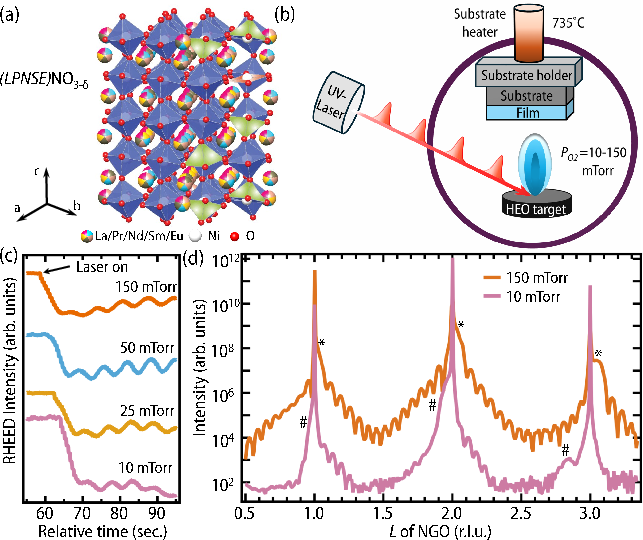
Figure 1: Oxygen-deficient (LPNSE)NO3−δ structure depicting the schematic of OV impact.
Experimental Methods
Single-crystalline thin films were synthesized using Pulsed Laser Deposition (PLD), where the oxygen content was varied through control of dynamic oxygen pressure during growth. X-ray absorption spectroscopy (XAS) was utilized to determine the oxidation state and extent of electron doping, confirming the presence of OVs and their random distribution across the films.
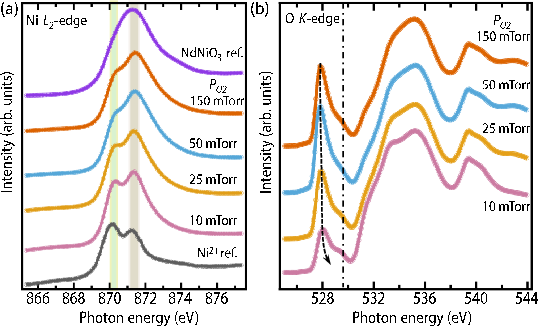
Figure 2: XAS spectra indicating electronic structure changes with varying PO2.
Electronic Transport Properties
A remarkable finding of the study is the Janus-faced nature of OVs, contributing to a complex electronic phase diagram. Initial OV doping decreases the MIT temperature and quenched disorder affects the hysteresis width. However, further OV increases result in a Mott-Anderson-like insulating state. These variations are evident in sheet resistance measurements taken across different temperatures and doping levels.
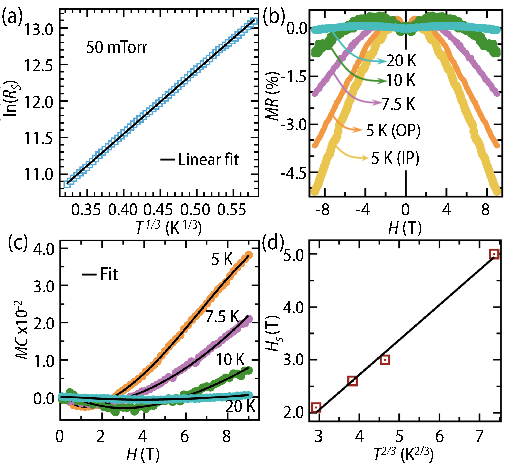
Figure 3: Sheet resistance exemplifying the temperature-dependent behavior under variable OV conditions.
Low-Temperature Magnetotransport and Impact of Disorder
The low-temperature transport behavior is consistent with Mott Variable Range Hopping (VRH) and weak localization scenarios, with magnetoresistance (MR) data supporting the role of exchange-correlation and orbital interference effects. The spin-alignment field Hs exhibits temperature-dependent behavior, validating the quantum interference model.
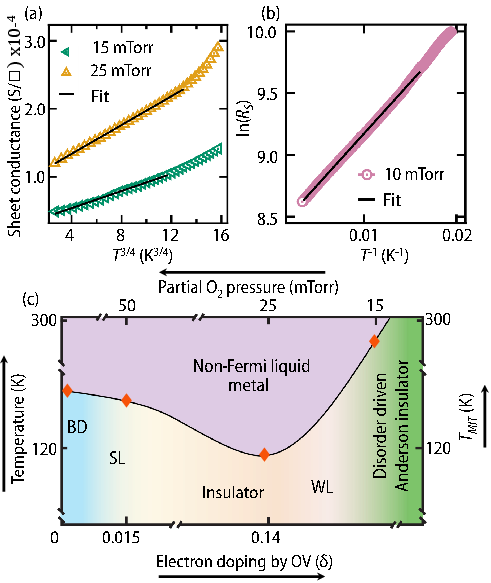
Figure 4: Conductance as a function of T3/4 highlighting different electronic phases.
Implications and Future Prospects
HEOs with tunable electronic properties through OV manipulation present promising applications in electronics, optoelectronics, and neuromorphic computing. The study's findings mark a significant step in understanding and exploiting the unique characteristics of HEOs for device technologies, particularly in the field of transport-based applications.
Conclusion
The study successfully demonstrates how oxygen vacancy engineering in high-entropy oxide films can be leveraged to alter their electronic phase behavior in a non-monotonic fashion. The potential of HEOs in developing advanced electronic devices through quantum transport phenomena and structural disorder is clearly illustrated, emphasizing the need for further exploration in this domain. The implications of these findings pave the way for novel applications and advancements in material science and engineering.