- The paper demonstrates that spatial decoherence in a quantum particle coupled to a thermal bath leads to the emergence of viscous hydrodynamics analogous to Navier-Stokes behavior.
- It uses a Taylor series expansion of the nearly diagonal density matrix to derive transient hydrodynamic equations and identifies a gapless mode ensuring probability conservation.
- The study draws parallels with quark-gluon plasma simulations, highlighting implications for modeling heavy-ion collisions and small open quantum systems.
Emergent Viscous Hydrodynamics from a Single Quantum Particle
Introduction
The paper "Emergent Viscous Hydrodynamics From a Single Quantum Particle" (2506.06618) examines the onset of hydrodynamic behavior in an open quantum system. Specifically, it investigates a single quantum particle linearly coupled to a thermal bath of harmonic oscillators, as described by the Caldeira-Leggett model. The study explores how spatial decoherence can lead to hydrodynamics in late-time, long-wavelength regimes.
Position-Space Decoherence and Emergent Hydrodynamics
The research demonstrates that the reduced density matrix of the system, influenced by decoherence, becomes nearly diagonal at late times. This allows for a Taylor series expansion in powers of the off-diagonal spatial components. Truncating this expansion yields hydrodynamic equations resembling those used to describe quark-gluon plasma in ultrarelativistic heavy-ion collisions. The Navier-Stokes equations naturally emerge in the asymptotic limit, indicating hydrodynamic behavior. The transport coefficients are determined by the damping constant γ, which describes the environment's influence.
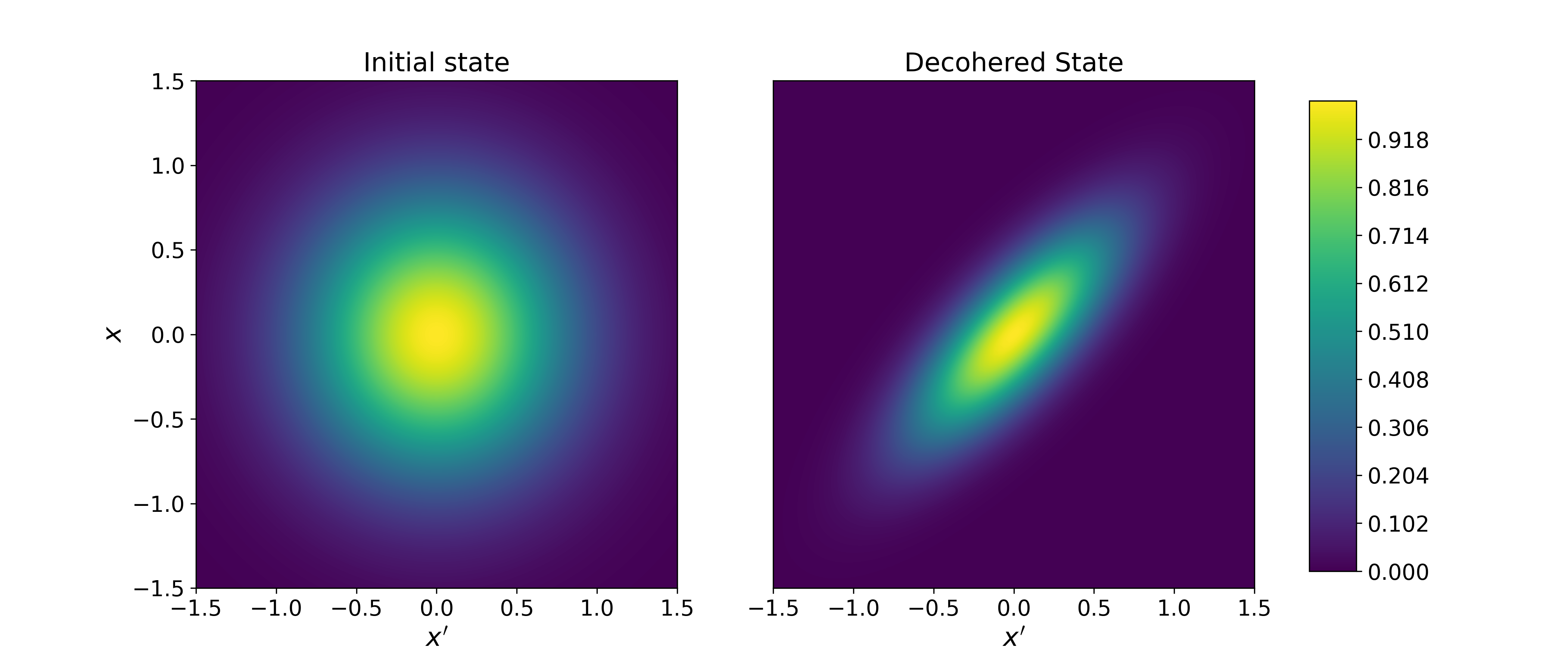
Figure 1: Illustration of decoherence for a density matrix representing a Gaussian wave packet. As one moves from left to right, the spatial coherence length diminishes due to environmental interactions.
Hydrodynamic Reduction and the Role of Decoherence
Decoherence, resulting from system-bath interactions, exponentially suppresses the off-diagonal elements of the density matrix. This behavior is depicted through a Gaussian wave packet's evolution, highlighting its reduction to a quasi-classical probability distribution along the diagonal (Figure 1). The study connects this behavior to a position-space expansion scheme, consistent with an effective field theory approach that integrates out short-range quantum fluctuations.
Hydrodynamic and Non-Hydrodynamic Modes
The derived transient hydrodynamic equations are akin to those found in non-relativistic limits within quark-gluon plasma simulations. The momentum equation includes a damping term from the bath, emphasizing the role of decoherence. Hydrodynamic modes are obtained through linearization, revealing a gapless mode related to probability conservation (Figure 2).
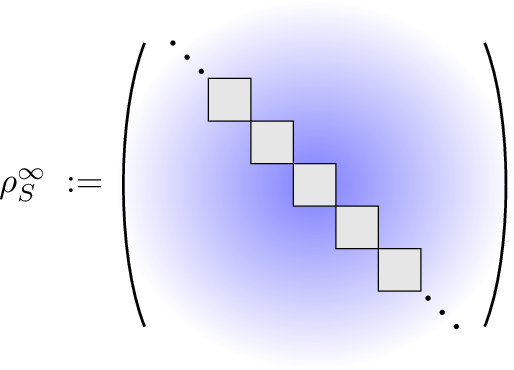
Figure 2: Hydrodynamics of the density matrix. The gray squares represent the diagonal elements, and the purple regions represent the off-diagonal elements, illustrating a hydrodynamic-like behavior.
Implications and Future Directions
This work underscores how quantum systems with minimal degrees of freedom exhibit hydrodynamic characteristics due to environmental interactions. The findings suggest potential applications in understanding small quantum systems and simulating heavy-ion collisions. Future research could extend to other open quantum systems, further elucidating hydrodynamic properties in quantum regimes.
Conclusion
The paper provides a robust framework for understanding hydrodynamic emergence in quantum systems governed by dissipation and decoherence. It highlights the continuity between quantum and classical hydrodynamic phenomena, offering a comprehensive view of how environmental interactions lead to emergent properties analogous to those observed in macroscopic fluids.
The study of emergent hydrodynamics in quantum systems presents a fascinating avenue for exploring the boundaries between quantum mechanics and classical fluid dynamics. It opens possibilities for future investigations into the universality of hydrodynamic principles across diverse quantum systems.
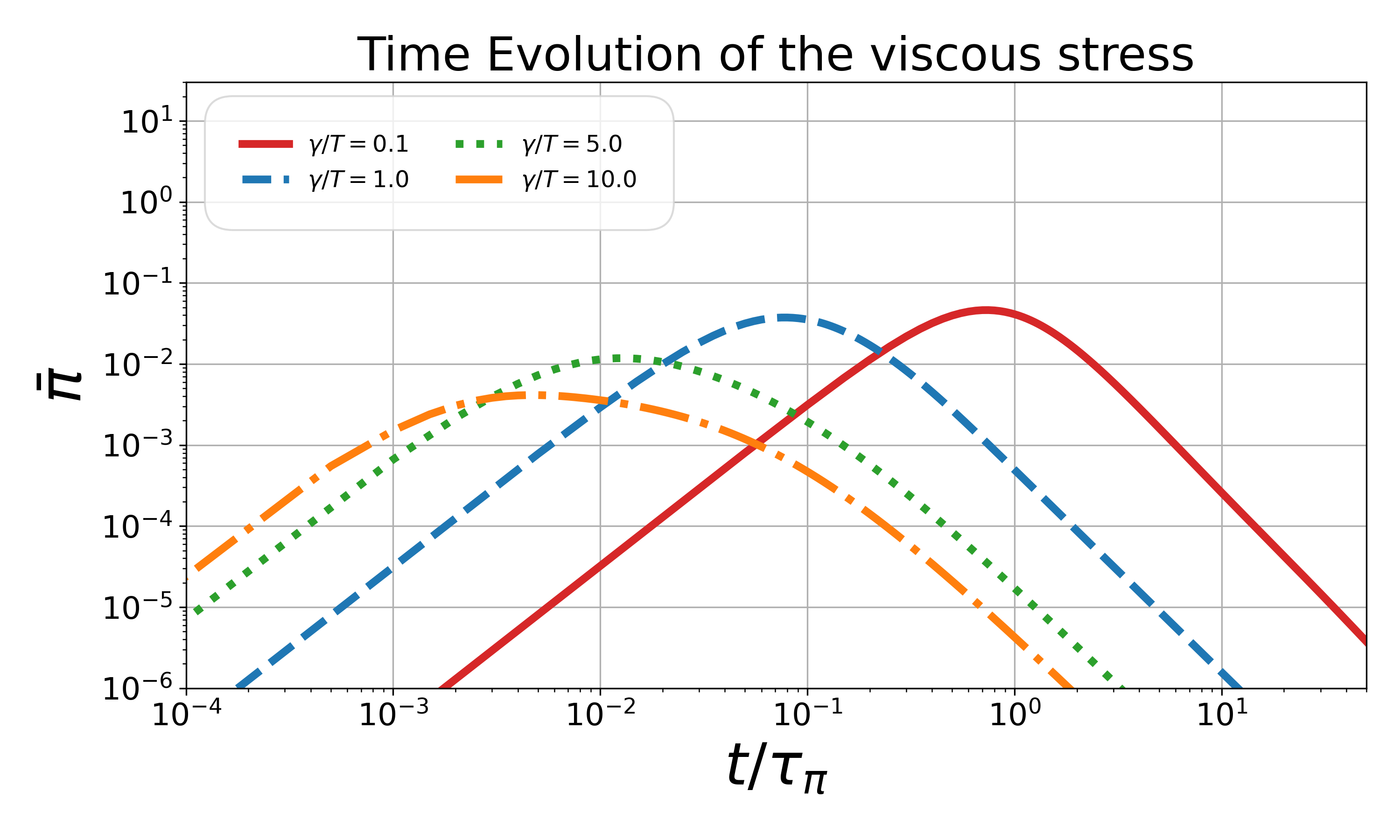
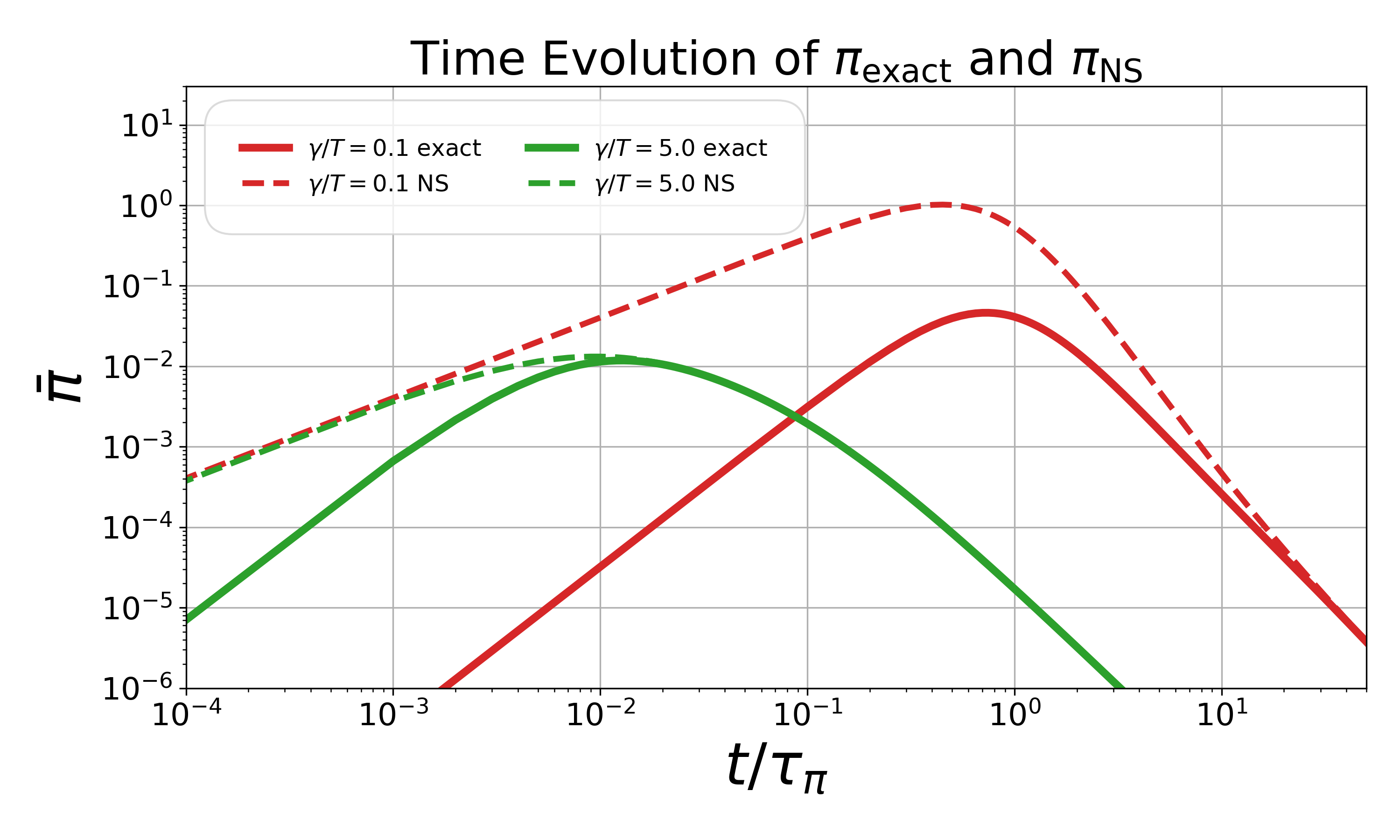
Figure 3: The left panel shows the time evolution for the trace of the viscous stress for different values of gamma. The analysis illustrates the dynamics of shear and bulk flow as the system approaches equilibrium.

