- The paper establishes that Fourier phases of the noise average converge to the template’s phases, elucidating model bias in template matching.
- It shows that the mean squared error of phase differences decreases as 1/M, proving the convergence rate in both low and high-dimensional regimes.
- Applications to cryo-EM are examined, cautioning researchers to account for noise-induced bias in low SNR data analysis.
Statistical Analysis of "Einstein from Noise"
Introduction to the EfN Phenomenon
The paper "Einstein from Noise" addresses a statistical anomaly known as the "Einstein from Noise" (EfN) phenomenon. This refers to a situation where a set of observations is believed to contain noisy, shifted versions of a template signal (e.g., an image of Einstein), when in reality, the observations consist solely of pure noise. Despite the lack of a coherent signal in the observations, the process of aligning and averaging the noise yields an output structurally similar to the imagined template. The paper aims to provide a comprehensive statistical analysis of this counterintuitive outcome.
Main Contributions
The main contributions of the paper include establishing that the Fourier phases of the EfN estimator converge to those of the template signal. This convergence explains the structural similarity observed between the EfN estimator and the template image, highlighting the implications of model bias—a crucial consideration in the adoption of template matching techniques across various scientific fields.
Convergence and High-Dimensional Regimes
The authors demonstrate that, as the number of noise observations M increases, the mean squared error (MSE) of the Fourier phase differences between the EfN estimator and the template image decreases as $1/M$. Moreover, in high-dimensional regimes, the convergence rate of these Fourier phases is inversely proportional to the square of the Fourier magnitudes of the template signal. This implies that even in high-dimensional cases, where the signal's dimension also diverges, the EfN estimator's magnitudes approach a scaled version of the template magnitudes.
Cryo-Electron Microscopy (Cryo-EM) Context
The paper draws connections between the EfN problem and its implications in single-particle cryo-EM. Cryo-EM is highlighted as a domain where understanding such biases is essential due to the inherently low signal-to-noise ratios (SNRs) present. The work stresses the necessity of proper validation frameworks to prevent misleading results in the structural biology field.
Theoretical Analysis and Proof Outlines
The theoretical contributions include rigorous proofs of convergence properties in both finite and infinite-dimensional spaces. The paper establishes conditions under which the EfN estimator's Fourier phases align with the template's phases.
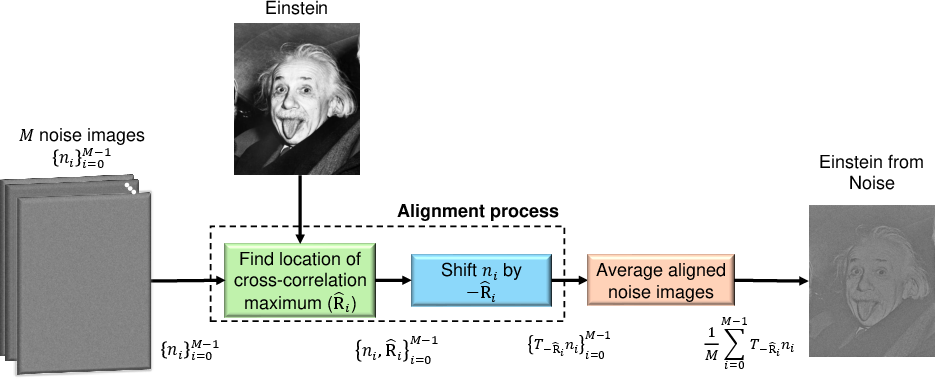
Figure 1: Einstein from Noise. The EfN estimator consists of three stages: (1) finding the index of the maximum of the cross-correlation ($\hat{#1{R}_i$) between the i-th noise signal (ni) and the template signal (e.g., Einstein's image); (2) cyclically shifting the noise signal by $-\hat{#1{R}_i$; (3) averaging the shifted noise signals.
Additionally, empirical validations show how these theoretical aspects translate into observed similarities, even amidst configurations that might seem too noisy to allow for meaningful alignment.
Implications and Future Directions
The results provide a statistical foundation for understanding the emergence of apparent signals from pure noise. This understanding is particularly pertinent to fields like cryo-EM, where template matching plays a critical role. The insights from this paper advocate for adopting strategies that reduce the potential for bias by ensuring that post-processing phases are statistically sound. Moreover, awareness of such phenomena may inform the development of algorithms that factor in the high susceptibility to model biases.
Conclusion
The paper fills a significant gap in the theoretical exploration of the EfN effect, cautioning against over-reliance on template matching without rigorous validation. By proving convergence properties theoretically and showcasing them through empirical demonstrations, the authors bolster the understanding of why structurally misleading signals might emerge from noise under certain mathematical treatments. This understanding paves the way for both enhancing template-matching reliability and further theorizing about statistical anomalies in different scientific domains.

