Weinstein presentations for high-dimensional antisurgery
Abstract: In this paper, we give an algorithm for describing the Weinstein presentation of Weinstein subdomains obtained by carving out regular Lagrangians. Our work generalizes previous work in dimension three and requires a novel Legendrian isotopy move (the ``boat move") that changes the local index of Reeb chords in a front projection. As applications, we describe presentations for certain exotic Weinstein subdomains and give explicit descriptions of P-loose Legendrians.
- On the intersections of projected Hamiltonian orbits in cotangent bundles (2026)
- Cerf Diagrams and Hatcher-Wagoner Invariants for Barbell Maps (2026)
- Invariants of Legendrian knots in thickened convex surfaces (2026)
- Equivariant Quotients of Derived Symplectic Spaces and Legendrian Intersection Theorem (2026)
- Weinstein manifolds as cotangent buildings (2026)
- Lengths of Reeb chords and Viterbo restriction (2026)
- The Arnol'd chord conjecture for $ST^*T^3$ (2026)
- Contact cosmetic surgery on Legendrian knots in integer homology sphere $L$-spaces (2026)
- Handle decompositions and the 1-dimensional inputs skein lasagna module (2026)
- Deeply Slice Knot Detection via Immersed Curves (2026)
Summary
- The paper presents an algorithm to transform high-dimensional antisurgery procedures for Weinstein domains into explicit Weinstein presentations, involving a specific set of Legendrian geometric operations including but no limited to handle slides, boat moves and Reeb chords deductions.
- The paper shows applications of the algorithm to the construction of P-loose Legendrians previously characterized only indirectly, highlighting how geometrical observances like Reeb chords and Morse indices are mirrored in the graphical representations of the handles and thus the antisurgery of the Lagrangian subspaces.
- The algorithm is demonstrated through computing computable examples and finding that the ordered completion of boat move and handle slide compute explicitity of th $P$-loose legendrians and their quantified connectivity algebras.
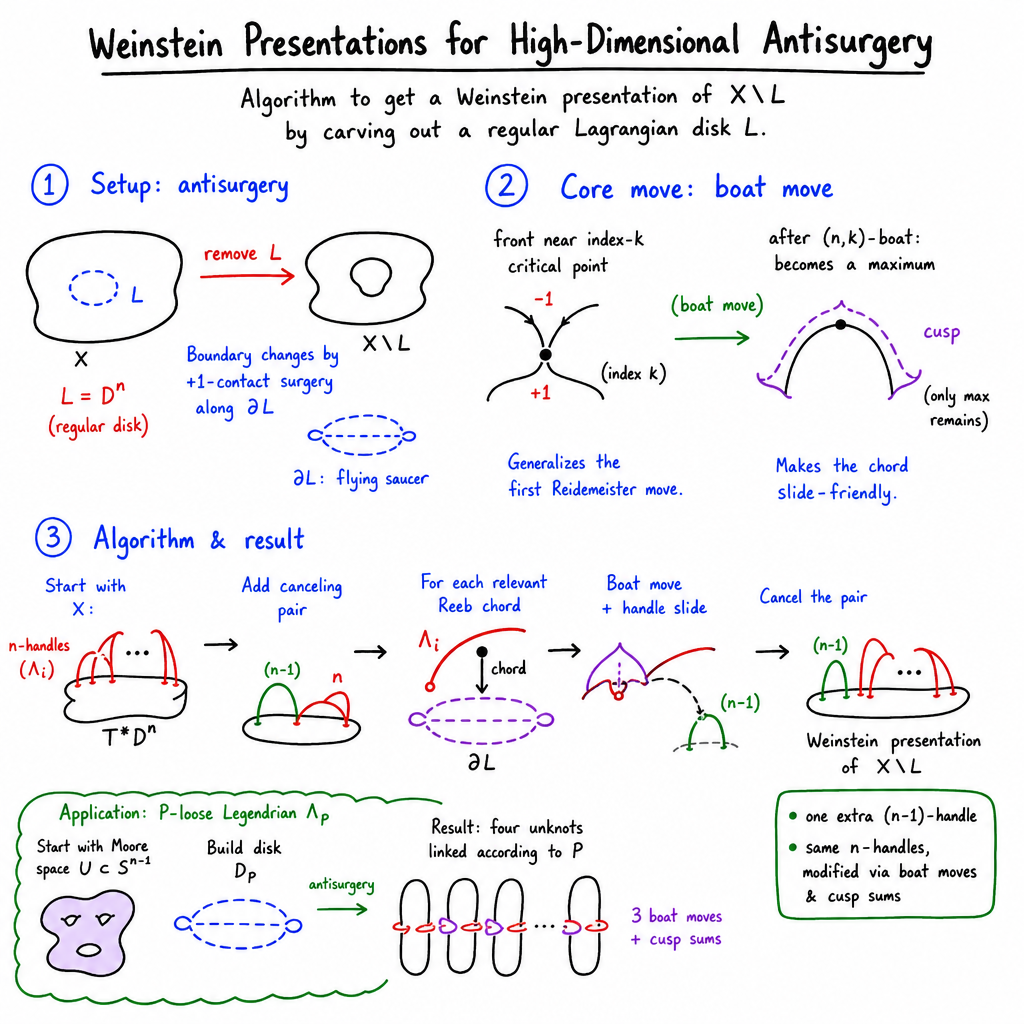
Weinstein subdomains obtained by carving out regular Lagrangian disks are geometrically natural but have generally lacked explicit handle presentations. “Weinstein presentations for high-dimensional antisurgery” addresses this problem by converting antisurgery into a diagrammatic procedure on Legendrian attaching spheres. Its principal contribution is an algorithm that starts with a Weinstein presentation of a domain X compatible with a regular Lagrangian disk L and produces a Weinstein presentation of the subdomain X∖L. The construction is controlled by Reeb chords between the attaching Legendrians of the critical handles of X and the Legendrian boundary of L.
The essential new ingredient is the higher-dimensional boat move: a compactly supported Legendrian isotopy that changes the local Morse index of a Reeb-chord endpoint while preserving the Legendrian isotopy class. This move permits the authors to eliminate the obstructions to the handle slides required to realize antisurgery. The resulting procedure gives explicit fronts for subdomains previously described only indirectly, including the P-loose Legendrians arising from carving Moore-space Lagrangian disks.
Antisurgery and the presentation problem
Let X2n be a Weinstein domain and let L⊂X be a regular Lagrangian disk. Regularity is the relevant compatibility condition: it ensures that L can be incorporated into a Weinstein presentation in which the disk is represented by the zero-section in a cotangent-ball piece,
X≃T∗Dn∪⋃iHin,
with the critical handles L0 attached away from the Legendrian boundary of the zero-section. The subdomain L1 is obtained by carving out L2, equivalently by antisurgery along the Legendrian sphere L3 in the contact boundary.
At the level of contact surgery, antisurgery is a L4-surgery along L5. A direct surgery diagram therefore contains both the original critical attaching spheres and a surgery component representing the boundary of the carved disk. Since L6-surgery does not itself correspond to Weinstein handle attachment, the principal geometric task is to replace this diagram by one involving only L7-surgeries, together with an additional subcritical handle. The paper accomplishes this replacement through a controlled sequence of handle additions, Legendrian isotopies, boat moves, and handle slides.
The relevant interaction data are Reeb chords from each attaching sphere L8 to the standard Legendrian unknot L9. Only chords whose front projections lie in the region bounded by the flying-saucer front of X∖L0 enter the construction. After a generic perturbation, these chords are finite in number and correspond to nondegenerate critical points of a local height-difference Morse function. Their local Morse indices determine which boat moves must be applied.
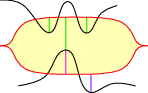
Figure 1: Reeb chords bounded by the flying-saucer front and their local Morse indices determine the required boat moves.
The paper explicitly allows the relevant Reeb chords to be arranged generically. A X∖L1-small Legendrian perturbation makes the Lagrangian projections transverse and arranges the local branches near chord endpoints as graphs of Morse functions. This genericity is not restrictive at the level of the construction, although perturbing a degenerate chord can increase the number of chords that must be treated.
The boat move
The boat move is constructed by suspending a lower-dimensional Legendrian Reidemeister 1 isotopy over a disk. Given a Legendrian isotopy of an X∖L2-dimensional disk, the authors form its X∖L3-suspension using a radial bump function on the parameter disk X∖L4. The resulting Legendrian is isotopic to the original product relative to its boundary. This suspension framework is then applied to a graphical Legendrian whose front is the graph of a Morse function with an index-X∖L5 critical point.
An X∖L6-boat replaces that local graphical piece by the X∖L7-suspension of an X∖L8-dimensional first Reidemeister move. The effect is to convert the specified critical point into a maximum, while introducing cusp singularities whose tangent planes are arranged not to be parallel to the front base. The resulting front has, away from its nonsmooth locus, a unique component containing a critical point, and that component has only a maximum.
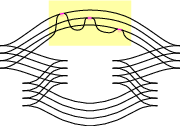
Figure 2: A low-dimensional slice of a X∖L9-loose Legendrian showing the local boat moves and cusp connected sums.
The construction interpolates between familiar operations. When X0, the X1-boat is the ordinary X2-dimensional first Reidemeister move. When X3, it has no effect. For intermediate X4, it changes an index-X5 critical point into a maximum by suspending a Reidemeister 1 move in the complementary directions.
This distinction is crucial for handle slides. A handle slide over a X6-surgery component can remove a Reeb chord represented by a suitable maximum, but sliding directly over a chord at a different Morse index can create additional Reeb chords. The boat move changes the local index without creating new Reeb chords, after which the handle slide removes the intended chord. The paper therefore establishes a local two-step mechanism:
- apply an appropriate boat move to convert the obstructing critical point into a maximum;
- perform the handle slide over the resulting Reeb chord.
The authors also address grading concerns. Although the local Morse index changes under a boat move, the relevant Maslov index of the Reeb chord remains unchanged because the cusp singularities in this construction do not induce the usual rotation of Lagrangian planes. Thus the move is compatible with the grading data needed for Legendrian contact homology.
The antisurgery algorithm
The central theorem gives a Weinstein presentation of X7 from a compatible presentation of X8. Its three structural conclusions are:
- the new presentation contains exactly one additional X9-handle;
- the index-L0 handles remain in one-to-one correspondence with those of L1;
- each original attaching sphere L2 is modified independently according to the Reeb chords from L3 to L4.
If a chord L5 has local index L6, the corresponding attaching sphere undergoes an L7-boat move and a cusp connected sum with a Legendrian passing once through the newly introduced L8-handle. Thus the modification is local in the front but globally records how the attaching sphere interacts with the carved disk.
The proof begins by representing antisurgery through a diagram containing the original L9-surgery data, a P0-surgery component P1 for P2, and a cancelling pair consisting of an P3-handle and a critical handle represented by P4. The components P5 and P6 are initially parallel except for their linking with the original attaching spheres. The authors then apply the boat-move-and-slide procedure to remove all obstructing Reeb chords from the original attaching link. Once the linking patterns of P7 and P8 agree, the two components cancel. What remains is a diagram containing only P9-surgery curves and one additional X2n0-handle.
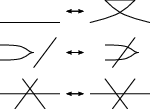
Figure 3: The local Legendrian moves used in the construction, including Reidemeister moves, boat moves, and handle slides.
The order of operations is determined by increasing Reeb-chord height. At each stage, the shortest remaining chord is treated first. This ordering ensures that the isotopy of X2n1 toward X2n2 does not cross unresolved obstructions. Index-zero critical points can be handled directly; all other indices are first converted to maxima by boat moves. This yields an algorithm rather than merely an existence argument.
The theorem also applies when subcritical handles are present, although the statement must then be formulated using Legendrian subsets with boundary rather than only closed attaching spheres. The authors emphasize that the assumption that all handles other than the cotangent-ball piece have index X2n3 is made for simplicity and can be weakened.
Explicit X2n4-loose Legendrians
A major application concerns the X2n5-loose Legendrians introduced in earlier work. Let X2n6 be a codimension-zero neighborhood of a X2n7-Moore space, and let X2n8 be the Lagrangian disk obtained as the graph of X2n9 inside a cotangent ball, where L⊂X0 is negative on L⊂X1 and positive outside a larger neighborhood. The Legendrian boundary L⊂X2 is the L⊂X3-jet of L⊂X4. It can be viewed as a negative Reeb pushoff on a smaller region inside L⊂X5 and a positive pushoff outside a larger region.
For L⊂X6, the authors choose a neighborhood of the CW complex L⊂X7. Its Morse function has three critical points: one of index L⊂X8, one of index L⊂X9, and one of index L0. Applying the antisurgery theorem therefore requires exactly three boat-move/handle-slide stages. After these stages, the added flexible handle is used to cancel the L1-handle, leaving an explicit Legendrian representative in the standard contact sphere.
The resulting L2 consists of four loose Legendrian unknots that are parallel outside a bounded region. Inside that region they may be linked according to L3, and they are joined by three boat moves and cusp connected sums. This description is especially significant because the original construction of L4-loose Legendrians proceeded indirectly through carving and flexible-handle attachment; the present work supplies a front-level realization of the final Legendrian.
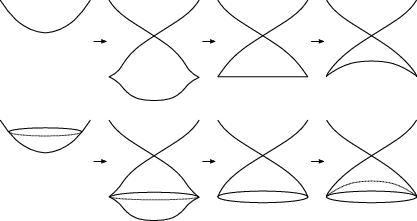
Figure 4: The three boat moves and handle slides used to construct the explicit L5-loose representative.
The construction is compatible with the algebraic behavior expected of L6-loose Legendrians. For a Legendrian L7, connected summing with L8 yields a Chekanov–Eliashberg DGA identified with a localization,
L9
and hence the DGA vanishes with X≃T∗Dn∪⋃iHin,0 coefficients. The geometric presentation does not itself compute this algebraic localization, but it provides an explicit handle diagram to which such computations can be applied.
The paper also clarifies special cases. If X≃T∗Dn∪⋃iHin,1, the resulting Legendrian is loose. If the perturbation region is a disk, the construction produces the standard Legendrian unknot in a domain with one subcritical handle rather than a loose representative. If the perturbation region is disconnected and contains a disk component, the final Legendrian acquires a loose chart. These examples show that the topology and Morse data of the carved region are reflected directly in the resulting front.
Examples and geometric consequences
The simplest example takes X≃T∗Dn∪⋃iHin,2 to be a disk with a Morse function having a single index-zero critical point. The algorithm then performs one effective handle slide. After cancellation, the resulting attaching sphere is a standard Legendrian unknot in the complement of the additional X≃T∗Dn∪⋃iHin,3-handle. This case demonstrates that carving out a Lagrangian disk need not produce a loose attaching sphere; the output can remain a standard nonloose Legendrian in a subcritical enlargement.
For a disconnected region X≃T∗Dn∪⋃iHin,4, the critical points arising from X≃T∗Dn∪⋃iHin,5 can first be removed through boat moves and handle slides, after which the disk component contributes a loose chart. The final attaching sphere is therefore loose. This explicitly realizes the relation between connected-sum operations on the Lagrangian disk and flexibility on the Legendrian boundary.
When X≃T∗Dn∪⋃iHin,6, the relevant Moore space is a sphere. The associated graph Lagrangian is Hamiltonian isotopic to a cotangent fiber, and the carved complement is a subcritical domain. The resulting Legendrian passes once through the subcritical handle and is consequently loose. The authors illustrate this process in low dimension, where a maximum and a saddle are treated by a direct slide and a boat move respectively.
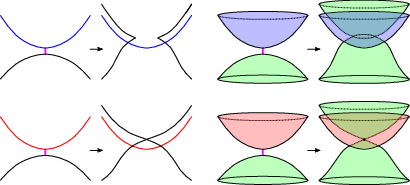
Figure 5: A low-dimensional instance of the algorithm, showing the treatment of a maximum and a saddle before cancellation.
These examples substantiate the paper’s main geometric claim: the combinatorics of a Morse function on the region used to construct the Lagrangian disk can be translated into a sequence of explicit Legendrian modifications. The number and indices of critical points determine the boat moves, while the resulting passages through the additional subcritical handle control properties such as looseness.
Limitations and open questions
The theorem is stated under a convenient presentation hypothesis: the ambient Weinstein domain is expressed as X≃T∗Dn∪⋃iHin,7 together with critical handles, and the relevant Reeb chords are assumed to be nondegenerate and Morse-generic. The authors explain how to remove or weaken these restrictions, but the resulting formulation involves Legendrian subsets with boundary and potentially more complicated perturbation data. In particular, resolving degenerate chords can increase the number of local moves.
The explicit X≃T∗Dn∪⋃iHin,8-loose front is also not a direct “push-through” construction analogous to the standard local construction of a loose Legendrian. It is obtained through the composite process of creating the Lagrangian disk, carving it out, introducing a cancelling pair, applying three boat moves, attaching a flexible handle, and cancelling the subcritical handle. Whether a X≃T∗Dn∪⋃iHin,9-loose Legendrian can instead be produced by directly pushing a L00-Moore space through a suitably chosen region remains open.
A second question concerns Legendrian DGAs. The wrapped Fukaya category of a carved complement is known to be obtained by localization at the carved Lagrangian. The paper supplies explicit attaching fronts for the complement, but does not derive the corresponding DGA localization directly from the boat-move presentation. Establishing such a derivation would connect the geometric algorithm more tightly to the Ganatra–Pardon–Shende localization formula.
Conclusion
The paper establishes a practical high-dimensional antisurgery calculus for Weinstein presentations. Its key innovation, the boat move, converts arbitrary Morse-index Reeb-chord obstructions into handle-slide-compatible maxima without changing the Legendrian isotopy class or the relevant grading data. This yields a precise presentation theorem: carving out a regular Lagrangian disk adds one L01-handle, preserves the collection of critical handles, and modifies their attaching spheres through explicitly prescribed boat moves and cusp connected sums.
The construction gives the first explicit front-level descriptions of the L02-loose Legendrians arising from Moore-space Lagrangian disks, including the four-unknot, three-boat-move model for L03. It also demonstrates how looseness and nonlooseness emerge from the topology of the carving region. The remaining questions concern whether these fronts admit more direct geometric descriptions and whether their Legendrian invariants can provide an independent proof of categorical localization.
Paper to Video (Beta)
Whiteboard
Paper Prompts
Sign up for free to create and run prompts on this paper.
Top Community Prompts
Open Problems
We haven't generated a list of open problems mentioned in this paper yet.
Continue Learning
- How does the Weinstein presentation provided by the algorithm handle nondegenerate and degenerate Reeb chords differently?
- What are the specific conditions under which the boat move can be applied to effectively eliminate obstructions in handle slides?
- How does the new presentation theorem for subdomains compare with previous methods of constructing Weinstein presentations in high dimensions?
- In what scenarios does the resulting presentation allow the formation of not standard ‘loose’ enities?
- Find recent papers about the applications of the algorithm in string theoretical considerations of manifold structures.

