- The paper introduces a minimal SU(5) GUT that integrates vectorlike fermions to resolve fermion mass discrepancies.
- It employs two-loop RGEs and a type-II seesaw mechanism with dual 15H Higgs fields to generate neutrino masses and achieve gauge unification.
- The model predicts observable proton decay channels and lepton flavor violation, offering clear targets for experimental validation.
Minimal SU(5) GUTs with Vectorlike Fermions
Introduction
The paper "Minimal SU(5) GUTs with Vectorlike Fermions" explores the minimal renormalizable SU(5) Grand Unified Theories (GUTs) with minimal representations, focusing on incorporating Vectorlike Fermions (VLFs) to address the shortcomings of classic GUT models. Such models aim to resolve discrepancies in fermion mass predictions, neutrino mass generation, and matter-antimatter asymmetries within a unifying SU(5) framework.
Model Overview
The researchers propose an SU(5) model including a pair of vectorlike fermions in the 5F+5F representations and two copies of 15H Higgs fields. The model achieves:
- Correct Mass Predictions: The addition of VLFs enables the correction of incorrect mass ratios between down-type quarks and charged leptons.
- Neutrino Mass Generation: Utilizing type-II seesaw mechanisms with 15H Higgs fields facilitates neutrino mass acquisition within experimental observations.
- Matter-Antimatter Asymmetry: The model accommodates leptogenesis, crucial for explaining the observed baryon asymmetry of the universe.
Implementation Details
Fermion Mass Matrices
The mass matrices for charged fermions are derived from the Yukawa interactions, with VLFs introducing additional terms to resolve GUT-related mass prediction issues. The essential parameter for these models involves a careful phenomenological fitting to match Standard Model (SM) parameters at the GUT scale.
Gauge Coupling Unification
The authors utilized two-loop renormalization group equations (RGEs) to analyze gauge coupling unification, a critical element for model viability. Specific masses for the hypercharges and color octets were varied to optimize the GUT scale, achieving values compatible with current proton decay constraints.
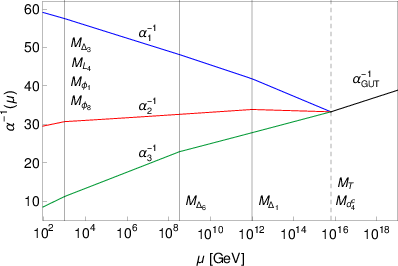
Figure 1: Example for gauge coupling unification at two-loop and a GUT scale of 6.15×10¹⁵ GeV.
Predictions and Phenomenological Implications
Proton Decay
Proton decay remains a crucial test for GUT models. The model predicts specific decay channels, notably p→π0e+ and p→K+νˉ, with rates potentially observable in upcoming experiments like Hyper-Kamiokande.
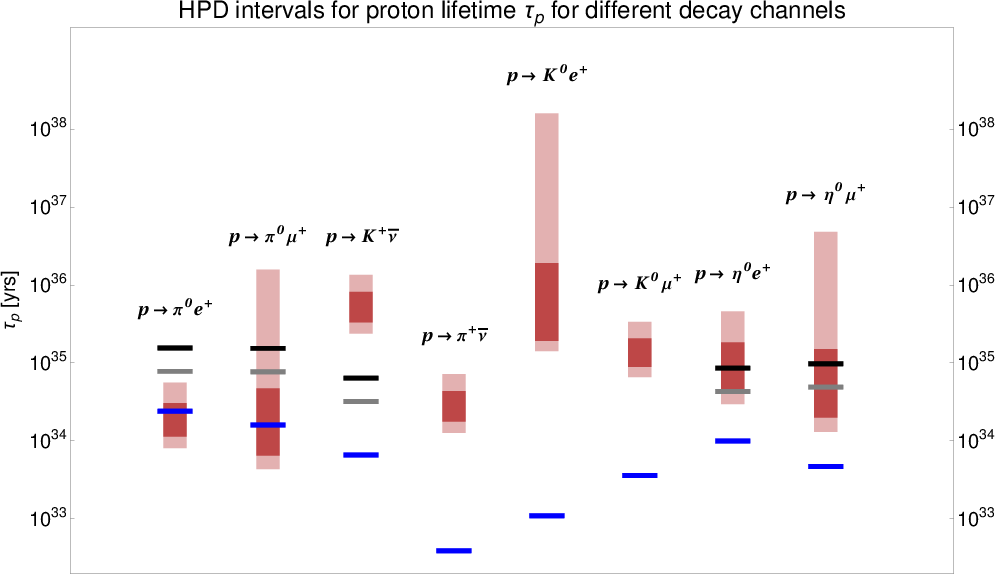
Figure 2: 1σ (dark) and 2σ (light) HPD intervals of partial proton lifetimes for various decay channels.
Flavor Violations
Flavor-violating processes, such as μ→eγ and τ→3μ, are expected outcomes of these models. The model provides specific predictions for these processes, correlating them with experimentally viable regions.
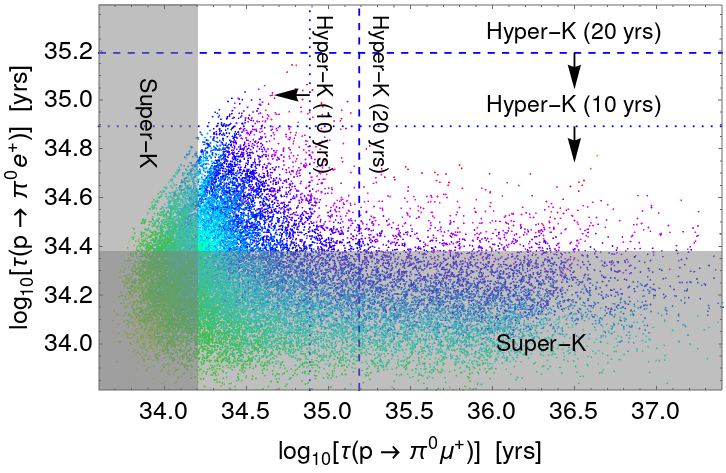
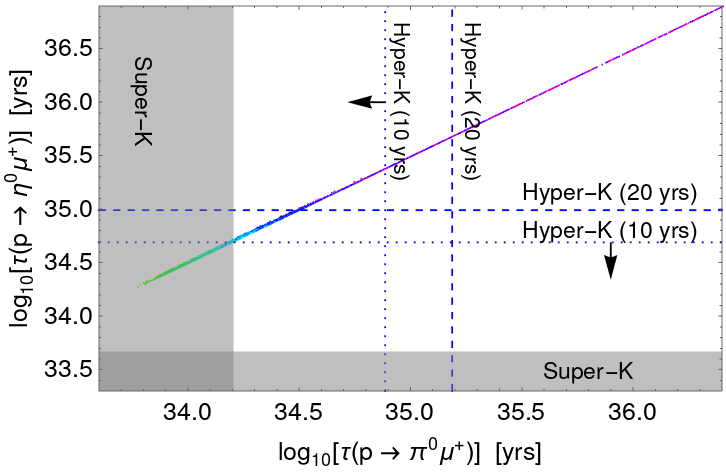

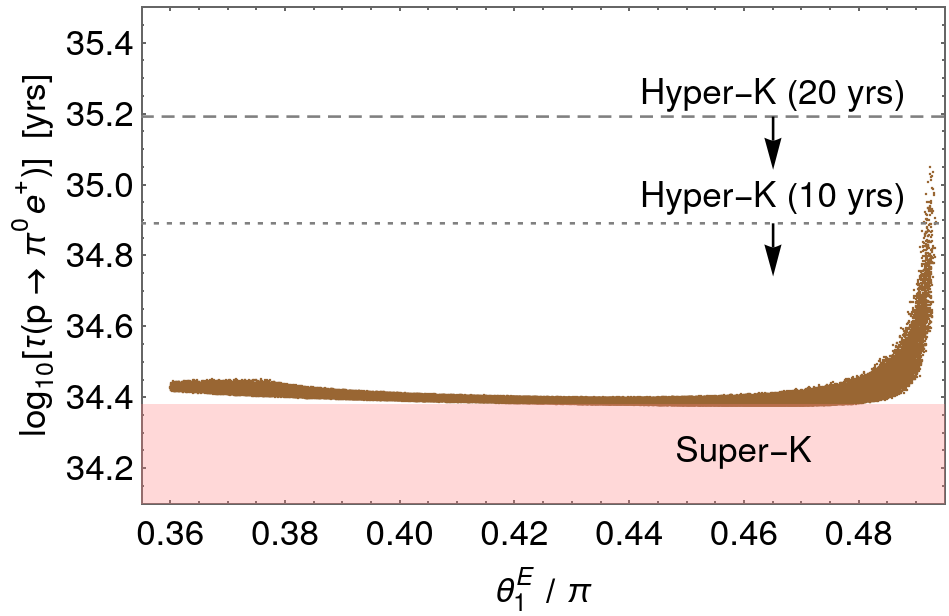
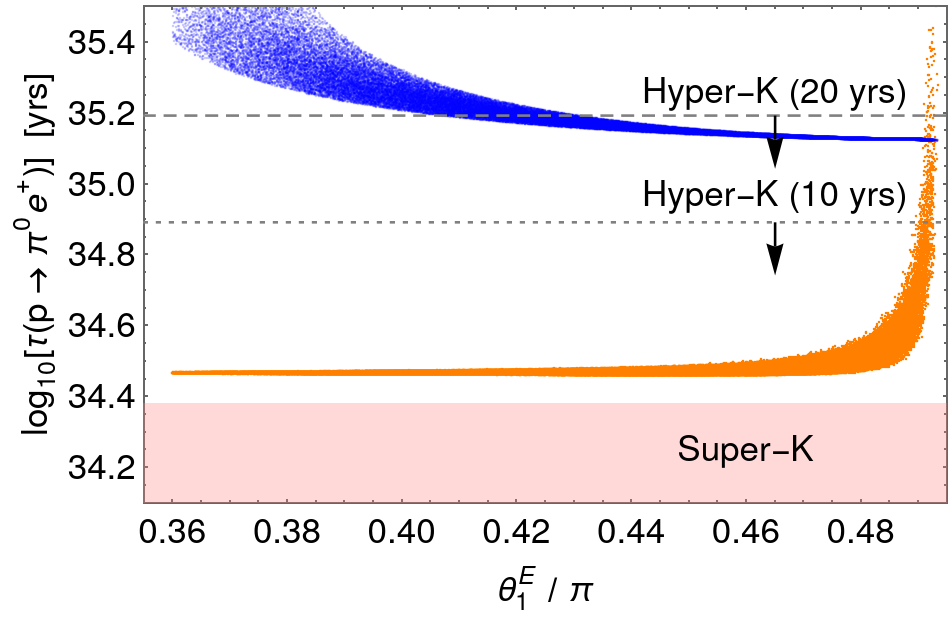
Figure 3: Relation between flavor violating processes ℓ→3ℓ′ and μ→e conversion.
Alternative Models
The study also explores alternatives with 10F+10F or 15F+15F representations. However, these alternatives exhibit a parameter space that remains challenging for experimental probes due to extended proton lifetimes predicted.
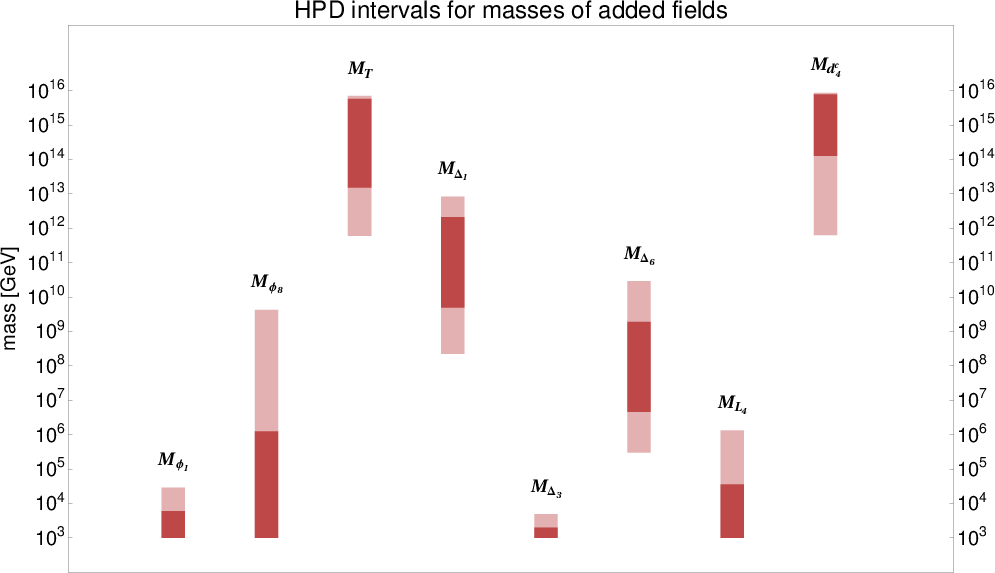
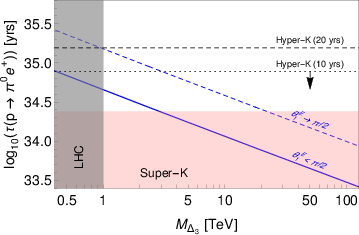
Figure 4: The maximal GUT scale as a function of the smallest mass of intermediate-scale particles for alternative VLF scenarios.
Conclusion
These minimal SU(5) models with vectorlike fermions provide a structurally simple yet phenomenologically rich framework. The presented models are poised for experimental testing, especially regarding proton decay and rare flavor processes. Future experiments, particularly in the field of proton decay observation and flavor physics, are pivotal in validating or constraining these proposals. These GUT constructions could potentially confirm novel unification mechanisms and enhance our understanding of fundamental interactions.