- The paper proposes an extended SU(5) model featuring a 35_H scalar and vector-like fermions that resolve down-type quark and lepton mass discrepancies.
- It demonstrates a one-loop mechanism for generating Majorana neutrino masses, predicting one massless neutrino with normal ordering.
- The model reduces parameter space by linking quark-lepton mass relations to neutrino masses and predicts four light scalar multiplets below 120 TeV.
Towards a Minimal SU(5) Model
This essay examines the theoretical framework and implications of the paper "Towards a minimal SU(5) model" (2206.06036). The paper explores the proposition of a minimalist unified model extending the original Georgi-Glashow SU(5) GUT, addressing its features and potential for parameter space viability. This exploration is pivotal in the search for a comprehensive understanding of fundamental interactions, particularly given the challenge of unifying different forces within particle physics.
Model Description
This study extends the classical Georgi-Glashow SU(5) model by proposing the inclusion of a $35$-dimensional scalar representation, 35H, and a set of vector-like fermions (15F, 15F). The corresponding particle content now encompasses scalar, fermion, and gauge boson representations, specified as 5H, 24H, 35H, 5Fi, 10Fi, and 24V for i=1,2,3. Such an extension aims to address the discrepancies identified, especially in handling the differences in masses between down-type quarks and charged leptons— a noted limitation in the Georgi-Glashow model.
Further, the model articulates its capacity for neutrino mass generation. Critical to this aspect, the model integrates three mechanisms that facilitate Standard Model fermion mass generation — traditional scalar vacuum expectation values, loop-level corrections, and mixing between chiral and vector-like representations. The dynamics and predictions of the Majorana neutrino masses are demonstrated via the leading order Feynman diagrams illustrating such interactions both at the SU(5) and Standard Model levels.
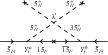
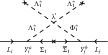
Figure 1: The Feynman diagrams of the leading order contribution towards the Majorana neutrino masses at the SU(5) (left panel) and the Standard Model (right panel) levels.
A Calculus of Neutrino Masses
The model's theoretical framework stands out for its minimalist approach to the neutrino mass generation mechanism. It links this process to the observed mass disparity between down-type quarks and charged leptons. This unification via a one-loop level mechanism predicts neutrino masses strictly of the Majorana type, maintaining that one remains massless with a normal ordering.
Moreover, the model operates with a reduced number of parameters in comparison to existing SU(5) counterparts, facilitating calculations and evaluations based on a practical yet constrained parameter space.
Experimentally, the model posits four scalar multiplets, predicted to be light, with a mass at or below $120$ TeV if these multiplets are degenerate. The scalar interactions involve (1,3,0), (8,1,0), (3,3,−2/3), and (6,2,1/6) states under the SU(3)×SU(2)×U(1) gauge group, with couplings to the SM fields (Figure 1).
Figure 1: The Feynman diagrams of the leading order contribution towards the Majorana neutrino masses at the SU(5) (left panel) and the Standard Model (right panel) levels.
In the context of scalar field roles, 24H not only plays a part in breaking SU(5) to SU(3)×SU(2)×U(1) but is crucial in explaining down-type quark and charged lepton mass discrepancies. The model's capacity to minimize parameter usage by linking the generation of neutrino masses and the quark-lepton mass relationship highlights its elegance and efficiency. The interrelation of these parameters ensures neutrino mass ordering follows the normal heirarchy, positing that one neutrino remains massless and the effective neutrino mass scale m0 is governed by still uncertain parameters of MΦ1, MΣ1, and λ′.
Figure 1: The Feynman diagrams of the leading order contribution towards the Majorana neutrino masses at the SU(5) (left panel) and the Standard Model (right panel) levels.
Experimental and Theoretical Implications
Analysis of parameter space, which considers gauge coupling unification, determines that for the largest feasible MGUT, certain conditions are needed, such as the lightness of four specific scalar multiplets, while vector-like fermions need to be mass degenerate. The exploration of these constraints guides the viability of minimal SU(5) models, enables a more precise determination of gauge coupling unification (), and informs ongoing investigations into the neutrino mass domain.
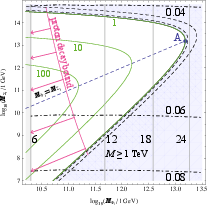
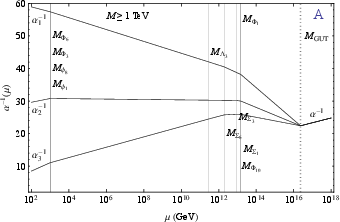
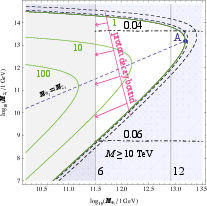
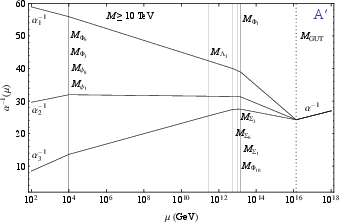
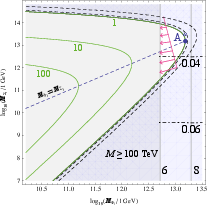
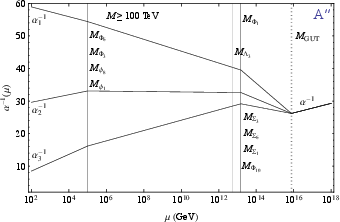
Figure 2: Experimentally viable parameter space of the model (left panels) and the gauge coupling unification for the unification points A, A\prime, and A$<sup>{\prime\prime</sup></p></p>
<p>Conclusion</p>
<p>The "Towards a minimal $SU(5)$ model" presents a compelling exploration into generalized $SU(5)$ frameworks, extending the Georgi-Glashow model with additional scalar and fermionic content to provide a minimal yet viable explanation for known particle masses. Through the integration of vector-like fermions, the model elucidates the mass disparity between down-type quarks and charged leptons and maintains a cohesive framework for neutrino mass generation. It proposes that neutrinos are purely Majorana particles, with a specific mass hierarchy and structural predictions. One notable consequence is the demand for the presence of four light scalar multiplets if consistency with grand unification and proton decay limits are imposed, thereby offering tangible directions for future experimental exploration in the search for physics beyond the Standard Model. The results hold significant implications for later studies on model parameter spaces involving gauge coupling unification and phenomenologically viable neutrino mass scales.