- The paper introduces the SQL-PaLM framework, which uses few-shot prompting and instruction fine-tuning to reliably translate natural language into executable SQL commands.
- It employs diversified training with synthetic data augmentation and database content integration to enhance model generalization and SQL accuracy.
- Experimental results on Spider and BIRD benchmarks demonstrate significant improvements in handling complex SQL queries and efficient column selection strategies.
SQL-PaLM: Improved LLM Adaptation for Text-to-SQL
Introduction
The paper introduces SQL-PaLM, an advanced framework designed to enhance the performance of LLMs in the field of Text-to-SQL conversion. The goal is to adeptly translate natural language queries into precise Structured Query Language (SQL) commands that can be executed on databases. This transformation is key to making data-driven decision-making accessible to non-expert users.
Framework Overview
The SQL-PaLM framework utilizes a multifaceted approach to refine the adaptation of LLMs for Text-to-SQL tasks. It focuses on two primary learning regimes: few-shot prompting and instruction fine-tuning. Within these regimes, the framework emphasizes several critical components:
- Diversified Training: Incorporating a wide variety of training data sources to improve LLM generalization capabilities.
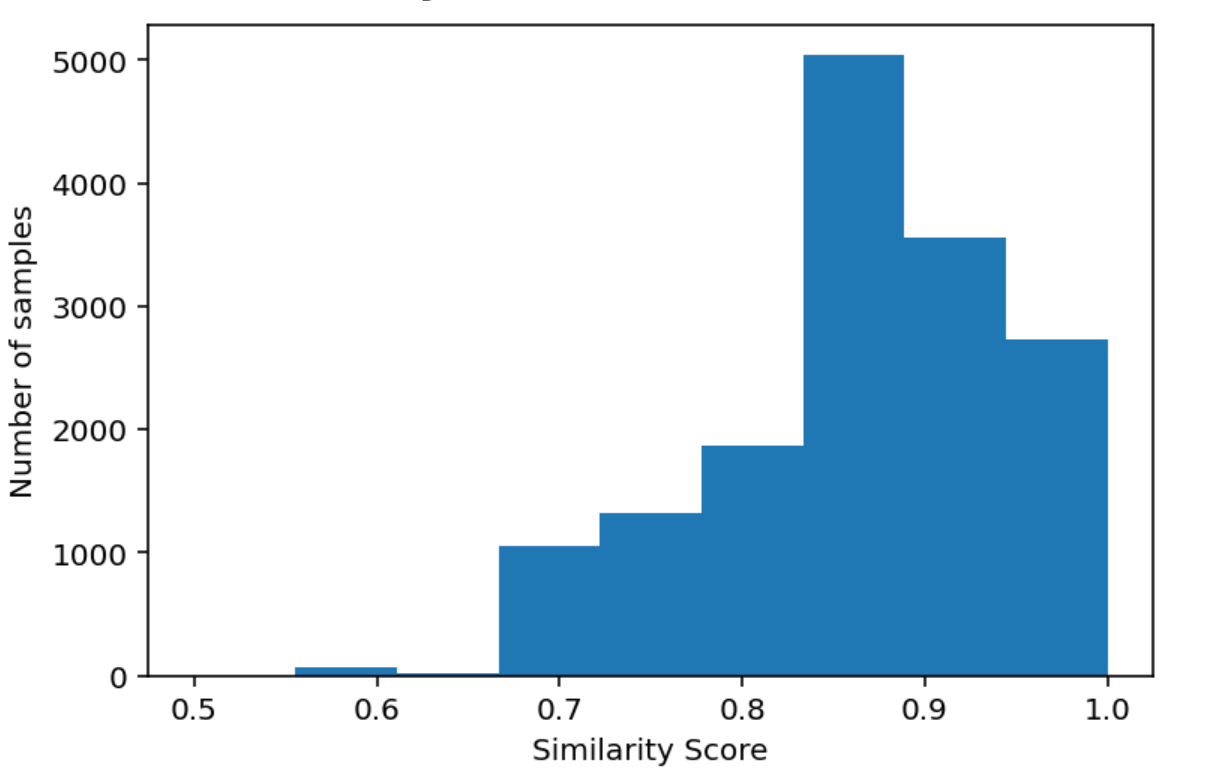
- Synthetic Data Augmentation: Utilizing synthetic SQL data generated by LLMs to expand the training dataset without relying solely on real-world data. This is illustrated by the histogram of synthetic data similarity scores, which demonstrates the diversity and accuracy of SQL generation.

Figure 1: Histogram plot of synthetic data similarity scores.
- Database Content Integration: Incorporating database-specific content to enhance the model's contextual understanding and accuracy in SQL generation.
- Efficient Database Navigation: Implementing strategies for efficient column selection and navigation through complex databases with extensive tables and columns.
Implementation Approach
Few-Shot Prompting
The approach starts with standard few-shot prompting strategies, using demonstrations to guide LLMs in generating SQL outputs. This method is further refined through execution-based consistency decoding, where multiple outputs are sampled and the most accurate is selected based on execution feedback.
Instruction Fine-Tuning
For instruction fine-tuning, the framework addresses real-world challenges by enriching LLMs with expanded and diverse training data, synthetic augmentation, and tailored input representations. Fine-tuning allows models to learn nuances in SQL generation that are not captured by prompting alone. Factors like training data diversity and size, synthetic data, and column selection strategies are systematically analyzed to optimize performance.
The SQL-PaLM framework demonstrates significant improvements in Text-to-SQL performance across multiple public benchmarks, including Spider and BIRD. Key findings highlight the effectiveness of combining training paradigms, utilizing synthetic data, and integrating database content in increasing SQL query accuracy.
Experimental results show superior performance in SQL generation, reflecting improvements in handling complex and varied SQL queries. The framework's ability to navigate large-scale databases efficiently is evaluated through various column selection strategies, with program-aided and retrieval-based methods improving accuracy and computational efficiency.
Conclusion
SQL-PaLM represents a comprehensive advancement in the adaptation of LLMs for Text-to-SQL applications. By leveraging diverse learning methods and dataset enhancements, SQL-PaLM achieves superior performance in transforming natural language into SQL queries efficiently. Future work will explore further scaling of database size and enhancing the robustness of LLMs in Text-to-SQL conversion.