- The paper provides a comprehensive review of current AIOps methodologies integrating AI into cloud IT operations.
- It evaluates challenges such as remote monitoring and data quality issues while recommending advanced incident detection and anomaly methods.
- The analysis highlights future research directions, including deep reinforcement learning and full automation for enhanced operational efficiency.
Introduction
The paper "AI for IT Operations (AIOps) on Cloud Platforms: Reviews, Opportunities and Challenges" (2304.04661) explores the integration of AI within IT operations, specifically focusing on cloud infrastructures. The primary aim of AIOps is to leverage AI to maximize system availability by processing the vast amounts of data generated by IT operations. This paper reviews current AIOps methodologies, highlights under-explored topics, and suggests avenues for future research, particularly emphasizing the role of AI techniques in enhancing operational efficiency.
AIOps Overview
AIOps combines machine learning and big data analytics to automate IT operations processes, including event correlation, anomaly detection, and causality determination (Figure 1). The advent of AIOps emerged from the necessity to maintain high availability and operational efficiency without human intervention. As modern software evolves into cloud-based services like SaaS and microservices, traditional operational practices face scalability challenges, necessitating the adoption of AI-driven solutions.
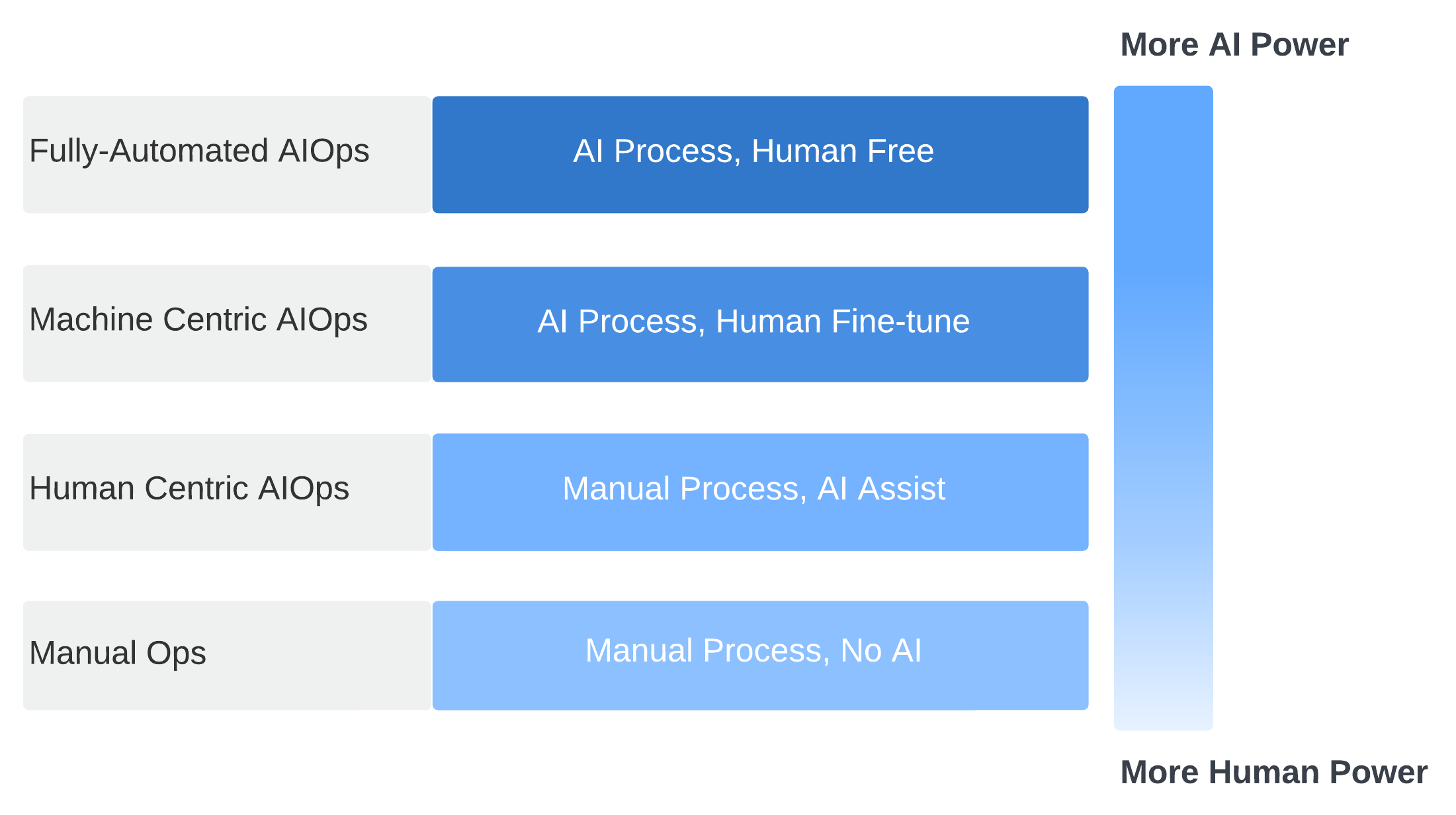
Figure 1: AIOps Transformation. Different maturity levels based on adoption of AI techniques: Manual Ops, human-centric AIOps, machine-centric AIOps, fully-automated AIOps.
Challenges in Cloud IT Operations
Cloud platforms present unique operational challenges. Unlike on-premise systems, cloud infrastructure requires remote monitoring due to lack of direct access to physical hardware. Therefore, cloud-based operations rely on telemetry data such as metrics, logs, and traces for which specialized monitoring, logging, and query systems have been developed (Figure 2). AIOps aims to address these challenges by automating these processes, potentially enabling systems to achieve ambitious availability targets, such as 99.99% uptime.
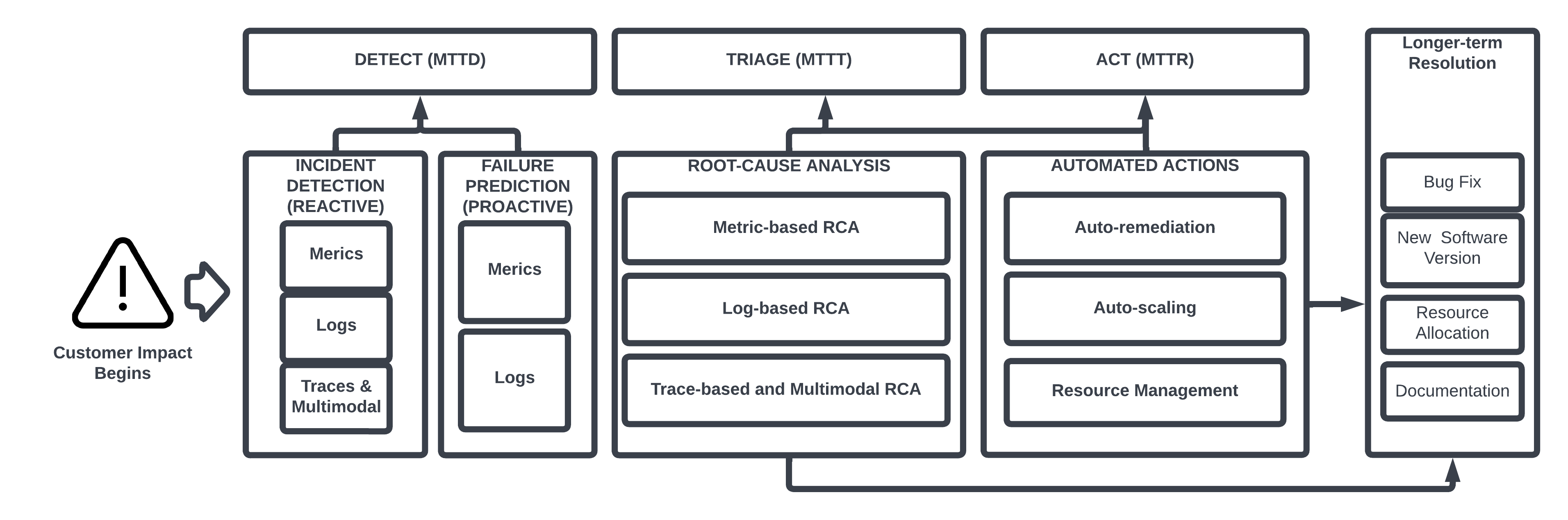
Figure 2: AIOps Tasks. In this survey, we discuss a series of AIOps tasks, categorized by which operational stages these tasks contribute to, and the observability data type it takes.
Research Directions
The paper identifies multiple research scopes and opportunities within AIOps. It emphasizes the need for improved data quality in terms of labeled anomaly datasets, which are crucial for training effective AI models. Additionally, the paper advocates for developments in online learning capabilities and intrinsic anomaly detection methods, given the non-stationary nature of telemetry data.
Another significant future direction is the full automation of IT operations. Transitioning from manual to fully automated systems supported by AI could revolutionize operational efficiency, reducing human error and effectively scaling resource management tasks (such as auto-scaling and automated remediation).
AI Techniques in AIOps
Current research in AIOps extensively uses AI models for incident detection, failure prediction, root cause analysis (RCA), and automated actions. Several machine learning techniques have been employed across different aspects of AIOps, including statistical models, tree models, and deep learning models. The paper particularly highlights the potential of deep reinforcement learning and causal inference in advancing the field.
Moreover, the paper suggests potential AI methodologies to enhance AIOps operations, such as leveraging human-in-the-loop workflows, implementing streaming anomaly detection models, and utilizing graph neural networks for trace analysis.
Conclusion
AIOps represents a promising domain that integrates AI into IT operations to ensure high system availability and operational efficiency, especially in cloud-based environments. The paper provides a comprehensive review of the current methodologies, challenges, and opportunities in this space, suggesting several research directions that could profoundly impact the future of IT operations through AI. As the field progresses, the implementation of standardized, AI-driven operations could lead to significant advancements in the scalability and reliability of cloud services.