- The paper introduces fractal codimension as a coordinate-free invariant quantifying the degeneracy of nilpotent contact points in slow-fast systems.
- It employs Minkowski dimension analysis to rigorously bound limit cycle bifurcations, supported by strong numerical evidence.
- The methodology overcomes normal form theory limitations and opens algorithmic approaches for analyzing complex singular perturbation bifurcations.
Introduction and Motivation
The analysis of limit cycle bifurcations near nilpotent singularities of planar slow-fast systems is a central theme in singular perturbation theory, with direct implications for the classification of canard phenomena and the study of Hilbert’s 16th problem in the slow-fast context. Traditional techniques, notably normal form theory applied to the slow-fast Hopf (or singular Hopf) points, face significant challenges due to their reliance on coordinate-dependent transformations and the computational intractability of eliminating higher-order terms. This paper introduces an intrinsic, coordinate-free notion—fractal codimension—which quantifies the degeneracy and bifurcation capacity of contact points via fractal geometric analysis, sidestepping the need for normal form reductions and expanding the toolkit available for practitioners in geometric singular perturbation theory.
Fractal Codimension: Definitions and Main Concepts
The central object is a family Xϵ,λ of C∞ planar slow-fast vector fields, depending smoothly on a small parameter ϵ≥0 (singular perturbation) and a parameter vector λ. The local model for a nilpotent contact point, i.e., a slow-fast Hopf point of Liénard type, is given by systems of the form:
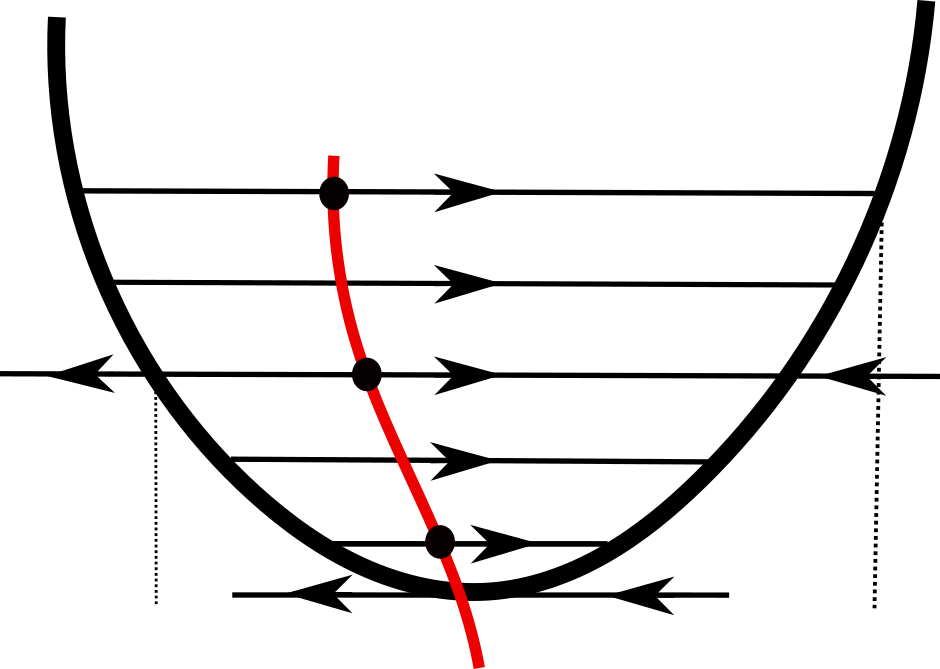
Figure 1: Dynamics of the model slow-fast Hopf vector field near the origin, with a depicted transversal section and accumulation of a fractal sequence at the contact point.
The paper generalizes the concept of classical codimension by introducing the fractal codimension: an algebraic invariant defined via the Minkowski (box) dimension of fractal sequences—countable sequences of points on a chosen transversal section accumulating at the nilpotent contact point. These points are generated by the so-called entry-exit relation, rooted in the slow divergence integral along the critical manifold. Unlike the classical notion, the fractal codimension is coordinate-free and does not require reduction to a normal form.
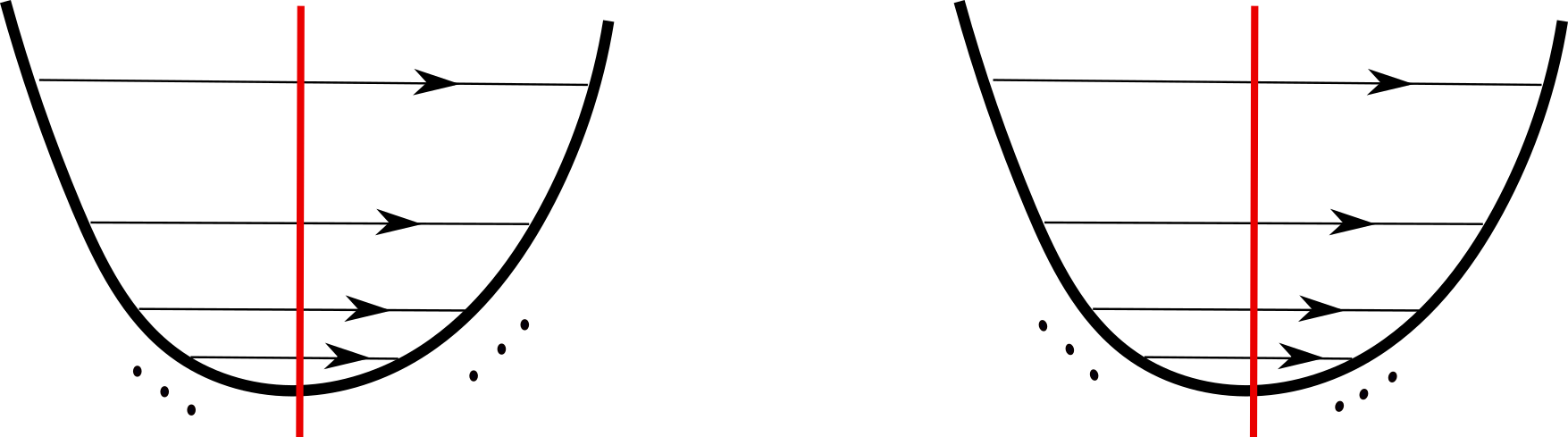
Figure 2: Construction of a fractal sequence near the contact point using the entry-exit relation and slow divergence.
Let n denote the (even) order of tangency (contact order) at the contact point, and m the (odd) singularity order, under the constraint m≤2(n−1) for finiteness of the divergence integral. The main result quantifies the Minkowski dimension of the fractal sequence S via
dimBS∈{n+2j+12j+1:j∈N0}∪{1}
and defines the fractal codimension as (p)=j+1 if dimBS<1, or infinite otherwise.
Intrinsic Construction and Independence
Essentially, the paper shows that this construction is intrinsic: the Minkowski dimension does not depend on the section or starting point for the fractal sequence (see Theorem 3.4 and its proof), nor on the chart or Riemannian structure, due to the invariance under bi-Lipschitz changes. This coordinate-free treatment is possible by expressing all essential quantities (critical curve, contact order, singularity order, slow divergence) intrinsically in terms of the geometric data of the slow-fast system.
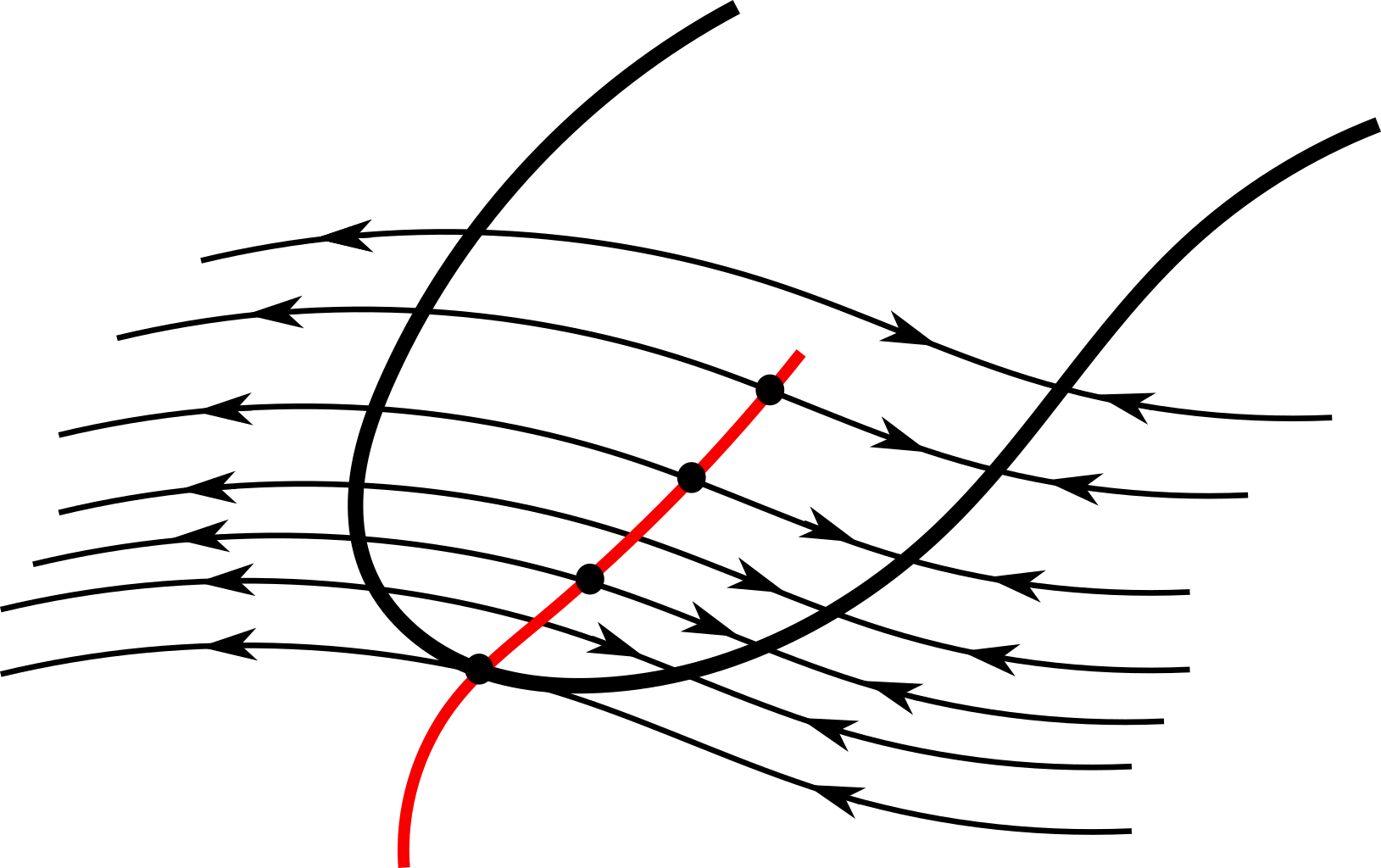
Figure 3: Section σ transverse to the fast foliation, decomposition into regions, and construction of fractal sequences for different sections.
The entry-exit relation is specifically realized via the slow divergence integral I(y,y~) along segments of the critical manifold, which determines the recursion yielding the fractal sequence. The sign of the slow divergence also governs the stability and branch convergence of this sequence.
Applications to Hopf Bifurcation and Limit Cycles
The fractal codimension robustly recovers the classical codimension of slow-fast Hopf points in the Liénard normal form setting (as established by Dumortier and Roussarie), but is also valid in degenerate, higher-order, and non-analytic contexts. For analytic systems or those reducible to Liénard normal forms, the maximal number of limit cycles bifurcating near the contact point does not exceed the fractal codimension, and any finite codimension bounds the cyclicity (i.e., the highest possible number of limit cycles).
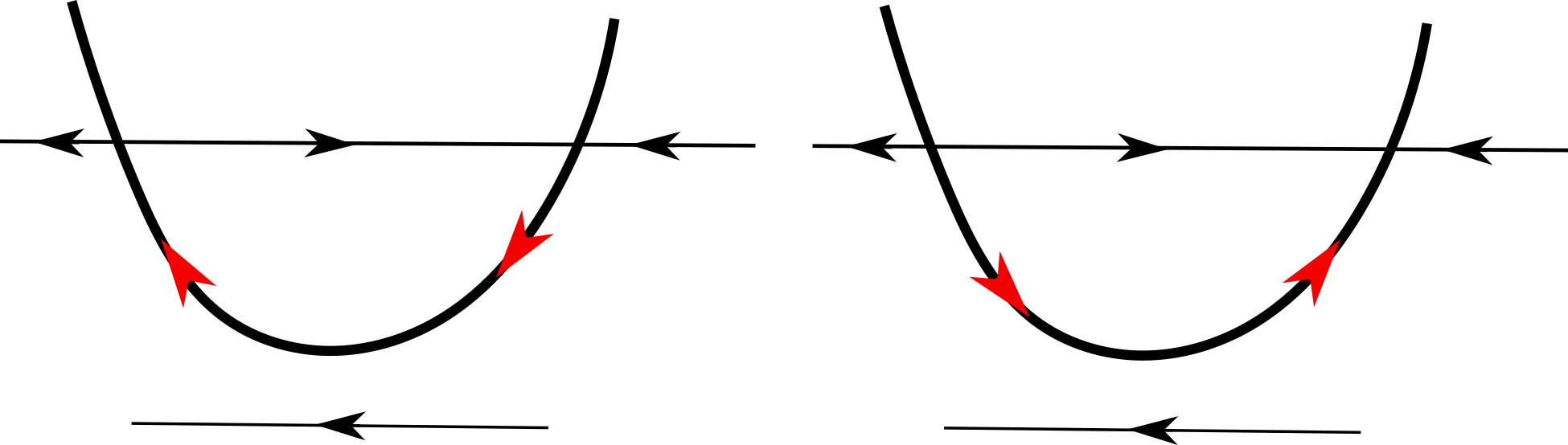
Figure 4: Phase portraits for different slow dynamics, indicating stability or repulsivity at the contact point according to the sign of the singularity order.
Strong numerical results (as detailed in Section 6) corroborate the theoretical formula for dimBS and the correlation between fractal codimension and cyclicity, across several prototypical models including classical Liénard equations, the two-stroke oscillator, and systems with general nilpotent orders. The fractal codimension is shown to exhaust the set of possible values for the density of fractal sequences and is invariant with respect to perturbations of secondary parameters, so long as structural assumptions hold.
Implications and Perspectives
The primary theoretical consequence is that fractal codimension offers an explicit, closed-form, and computation-friendly invariant that captures the complexity of nilpotent singularities in slow-fast systems without the machinery of normal form theory. Not only does this connect the analytic invariants of limit cycle bifurcations to fractal geometric concepts, but it also opens the way for the fractal analysis of more intricate degenerate bifurcations (such as Bautin bifurcations, higher-order tangencies, and contact points with infinite codimension).
Practically, the formulation is amenable to algorithmic and symbolic evaluation, as evidenced by the provided Matlab implementations, and can be adapted to more extensive classes of planar slow-fast systems, possibly extending to higher dimensions or more general phenomena like canard explosion and mixed-mode oscillations.
Conclusion
This paper establishes a rigorous, coordinate-free approach to quantifying the degeneracy and bifurcation capacity of nilpotent contact points in planar slow-fast systems via the notion of fractal codimension. The approach relies on the Minkowski dimension of dynamically defined fractal sequences, providing a direct link between fractal geometry and the qualitative theory of singular perturbations. The results yield tight bounds on the cyclicity of slow-fast Hopf points and sidestep traditional obstructions related to normal form theory, thereby enriching the analytical toolbox for singular perturbation theorists and supporting further fractal geometric analysis of non-hyperbolic bifurcations in slow-fast dynamics.
(End of essay.)