- The paper introduces an innovative architecture that integrates episodic memory to enable efficient continual learning and experience-based recall.
- The design leverages neuro-inspired structures like the hippocampal formation to store, index, and retrieve sensory-derived feature vectors effectively.
- The approach outlines practical implications for reducing learning time and enhancing context-aware reasoning through efficient memory retrieval mechanisms.
Essay on "A Proposal for Intelligent Agents with Episodic Memory"
Introduction
The concept of episodic memory in artificial agents has gained traction due to its potential to significantly enhance learning capabilities. The paper "A Proposal for Intelligent Agents with Episodic Memory" (2005.03182) addresses the need for AI agents to have an episodic memory to facilitate continual learning and interaction with humans and other agents. Unlike traditional memories employed in Deep Reinforcement Learning (DRL), the authors propose a memory system inspired by mammalian episodic memory that allows agents to "relive" experiences, comprehend their past actions, and communicate insights drawn from their experiences.
Architecture Supporting Storage and Retrieval of Episodic Memory
The authors propose an architecture that integrates insights from the mammalian hippocampal formation and advances in ANNs to create an episodic memory system for AI agents. The hippocampal formation of mammals, part of the Medial Temporal Lobe (MTL), is instrumental in associating objects and their relationships, allowing retrieval of complete experiences from partial cues. The proposed architecture emulates this functionality, as depicted in the simplified diagram.
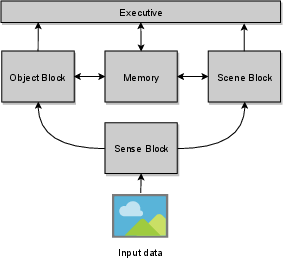
Figure 1: Simplified diagram of the proposed architecture.
The architecture involves components such as the sensory block, object block, and scene block. These blocks together maintain the agent's belief about the world by extracting and storing sensory-derived feature vectors. The episodic memory then tracks changes in this belief, thus enabling storage efficiency and effective memory retrieval. The recall process allows the system to regenerate sensory experiences from stored beliefs, aligning with Tulving's notion of mental time travel.
Memory Organization
For effective memory storage and retrieval, the proposed system requires storing an accurate record from a single exposure, retrieving complete memories from partial cues, and managing a substantial memory volume. The architecture utilizes mechanisms akin to computer science approaches, employing tree sets and hash tables for memory organization. These systems use disentangled representations to enable efficient search and retrieval; similar memory elements are stored in proximity within the feature space, allowing queries to retrieve memories even with underspecified features.
The comprehensive design of the memory system (Figure 2) supports robust episodic memory, with an emphasis on storing and indexing memories through a structured, efficient approach that mitigates the computational demands often associated with memory searches in ANNs.
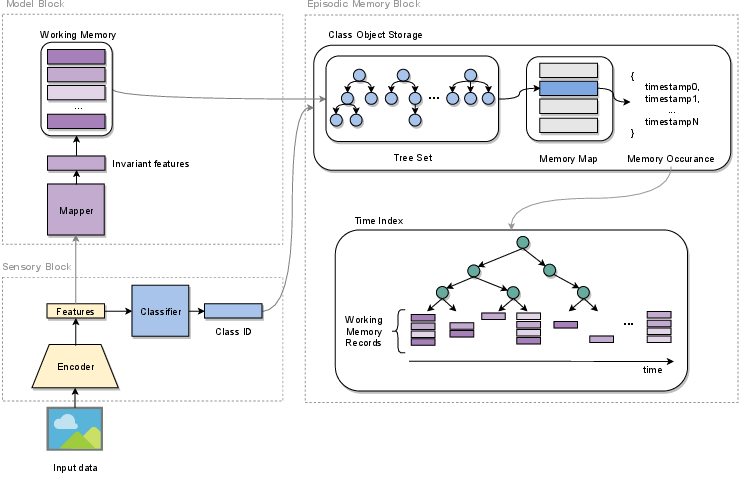
Figure 2: High-level diagram of the proposed system, showing the subset for objects. The Sensory block produces a disentangled feature vector which is passed on to the Model block which produces a feature vector invariant to the agent's viewpoint ϕinv.
Discussion on Practical and Theoretical Implications
The integration of episodic memory in AI agents poses significant implications for both practical applications and theoretical advancements. Practically, it could revolutionize how agents adapt and interact over prolonged durations, possessing context-aware reasoning abilities and reducing the learning time for new tasks by leveraging past experiences. Theoretically, it extends the boundaries of current AI paradigms, particularly in the field of continuous learning and memory organization inspired by cognitive sciences.
Furthermore, the constraints of disentanglement and invariance, while challenging, promise to simplify the memory architecture, aligning neural network function with established neuropsychological principles. The authors suggest that achieving disentanglement may require inductive biases in the model and data, a proposition that represents an intersection of AI with proposals from cognitive neuroscience.
Conclusion
The paper presents a novel proposal that translates a rich body of research from the cognitive sciences into actionable strategies for constructing AI systems with episodic memory. By leveraging insights from the structure and functions of the MTL and integrating these with advanced neural architectures, the proposed design aims to inaugurate a new generation of AI systems capable of context-sensitive learning and human-like memory recall capabilities. Future research will likely focus on refining these architectural components, addressing the challenges of feature representation, and further exploring the potential intersections of imagination and memory in artificial agents.