- The paper establishes that hot Jupiters exhibit intrinsic temperatures up to 700 K, challenging the canonical 100 K assumption.
- It employs advanced 1D radiative-convective models to quantitatively link incident flux, equilibrium temperature, and intrinsic heat flux using empirical calibrations.
- The study finds that higher intrinsic temperatures shift the radiative-convective boundary from deep kilobar levels to near 1 bar, with significant implications for heating mechanisms and atmospheric dynamics.
The Intrinsic Temperature and Radiative-Convective Boundary Depth in Hot Jupiter Atmospheres
Introduction and Motivation
The study systematically reinvestigates the lower boundary conditions for hot Jupiter atmospheres, with particular focus on the intrinsic temperature (Tint) and the depth of the radiative-convective boundary (RCB). Traditional models have adopted Jupiter-like values for Tint (∼100 K), resulting in an assumed RCB pressure near 1 kbar. However, observational constraints imposed by the inflated radii of many hot Jupiters indicate that their interiors exhibit significantly elevated entropies and thus much higher Tint values. This discrepancy implies that canonical assumptions dramatically underestimate the intrinsic heat flux and misplace the RCB.
The paper presents a comprehensive derivation of the equilibrium relationship between incident flux, equilibrium temperature (Teq), and Tint, leveraging models of planetary inflation and population constraints. The consequences for the RCB depth are explored using 1D radiative-convective atmosphere models.
Methodology
The analysis parametrizes the planetary intrinsic flux via Tint, anchored to the observed radii of hot Jupiters using heating efficiency calibrations from prior studies [Thorngren et al. 2019]. The equilibrium configuration is computed under the assumption that the interior heating and cooling fluxes are balanced at steady state, tying Tint to Teq through:
Tint=(4σFϵ(F))1/4
where F is the incident flux and ϵ the heating efficiency. The models utilize detailed atmospheric grids spanning a range of gravity and composition to capture the response of the RCB to varying Teq and Tint.
Critically, the 1D atmosphere simulations account for radiative, convective, and thermochemical equilibrium, and include depletion of key molecular species via condensation, with solar and supersolar (10×) metallicity cases. The boundary of the convective interior is robustly determined as the transition from adiabatic to subadiabatic thermal gradients.
Main Results
Derived Tint values for hot Jupiters span several hundred Kelvin, with some cases approaching 700 K for highly irradiated planets. This is in stark contrast to the commonly used 100 K assumption.
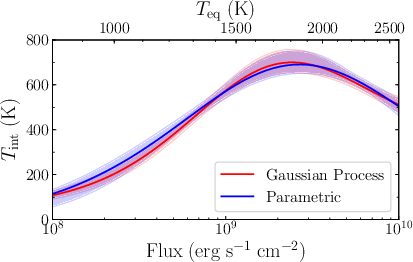
Figure 1: The equilibrium Tint of hot Jupiters, derived from heating models, rises steeply with Teq and incident flux, reaching up to 700 K in extreme cases.
The implied interior entropies ($8$–11kB/baryon) are verified as consistent with these Tint estimates, with higher-mass planets exhibiting enhanced heat loss through their more compact atmospheres.
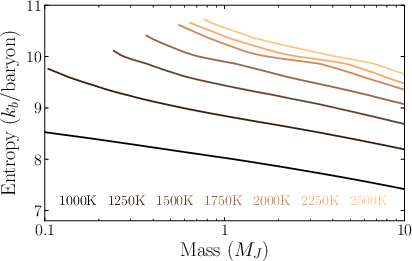
Figure 2: The equilibrium entropy as a function of mass and Teq, illustrating the elevated entropies required for inflated radii at high Tint.
Atmospheric model grids reveal that, at these substantially higher intrinsic temperatures, the RCB retreats drastically upward in the atmosphere. For Teq exceeding 1800 K, the RCB is located at pressures near 1 bar—two to three orders of magnitude shallower than the canonical 1 kbar. Even at the lower threshold of planetary inflation (Teq≈1000 K), the RCB only sinks to ∼100 bars. The parameter dependence includes a secondary trend: higher gravity increases RCB pressure, while high atmospheric metallicity drives it to lower pressures due to larger opacities.
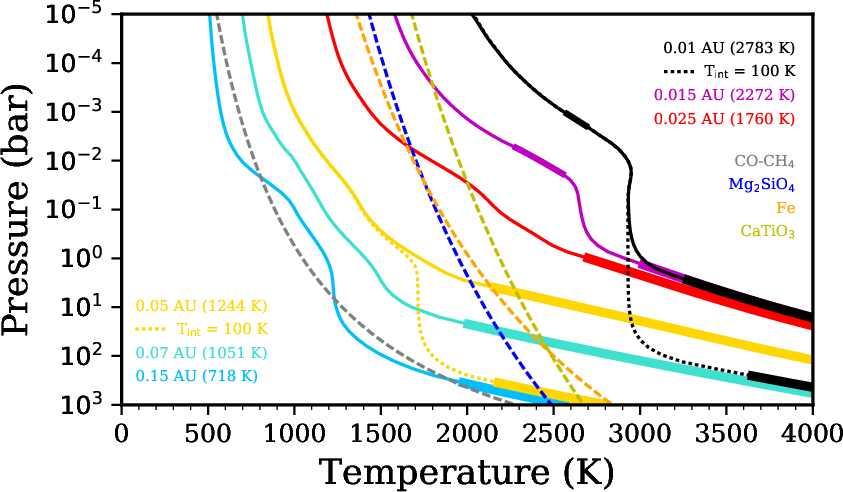
Figure 3: Pressure-temperature profiles for enhanced metallicity atmospheres, tracing the influence of Tint and Teq on the location of convective and radiative zones. Convective regions are highlighted, and cloud condensation curves are annotated.
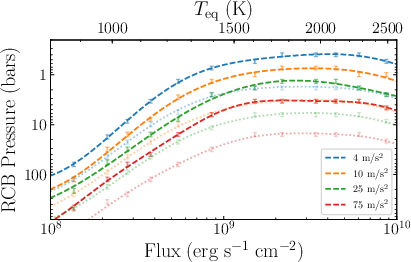
Figure 4: The RCB pressure for various surface gravities and metallicities as a function of incident flux, demonstrating the pronounced reduction in RCB depth with increasing Teq and atmospheric metallicity.
Implications for Exoplanetary Physics
The results present a paradigm shift in the understanding of hot Jupiter thermal structure. The shallow RCB is inconsistent with the classical view that most of the atmospheric column is deep and convective, having significant consequences for several domains:
- Heating Mechanisms and Inflation: Shallow RCBs raise the efficiency of any anomalous heating mechanism (such as Ohmic dissipation), as more energy can be deposited at relevant depths for inflation.
- Cloud Formation and Cold Traps: Elevated Tint prevents cloud-forming species (e.g., forsterite, iron) from condensing at high pressures, eliminating deep cold traps and favoring upper atmospheric cloudiness. This is compatible with recent detections of neutral and ionized metals in transmission spectra of highly irradiated planets.
- Circulation Modeling: The new boundary conditions demand revision of input parameters in GCMs due to enhanced intrinsic flux and accessible entropy, affecting large-scale atmospheric flows and day-night energy transport.
- Observational Prospects: The high intrinsic flux should produce measurable near-IR enhancements on planetary night sides and alter anticipated spectral features—testable by transmission/emission spectroscopy and with JWST-class instrumentation.
Discussion and Future Developments
The findings necessitate a reassessment of standard practices in modeling giant exoplanet atmospheres; fixed, Jupiter-like Tint values introduce severe biases. Adoption of Tint–Teq scaling derived here enables more accurate interior and atmosphere coupling and better population synthesis. The potential detection of reinflated giants and precise measurement of intrinsic fluxes with future missions will further constrain the nature of interior heating and RCB pressures.
Key avenues for expansion include systematic coupling of these boundary conditions into 3D GCMs, mapping the consequences for chemical disequilibrium phenomena (e.g., CO–CH4 quenching), and exploring links between interior entropy, observed thermal emission, and magnetic phenomena (as Tint is tied to dynamo strength).
Conclusion
This work establishes that hot Jupiters typically possess much higher intrinsic temperatures and drastically shallower radiative-convective boundaries than previously assumed. These results demand significant reinterpretation of hot Jupiter atmospheric dynamics, chemistry, and observational diagnostics. Adoption of the empirical scaling between Tint and Teq should become standard in 1D and 3D atmospheric models, informing future observational strategies and theoretical explorations of extra-solar giant planets.
(1907.07777)