Squashing the Boundary of Supersymmetric AdS$_5$ Black Holes
Published 6 Sep 2018 in hep-th and gr-qc | (1809.02149v3)
Abstract: We construct new supersymmetric black holes in five-dimensional supergravity with an arbitrary number of vector multiplets and Fayet-Iliopoulos gauging. These are asymptotically locally AdS$_5$ and the conformal boundary comprises a squashed three-sphere with $\text{SU}(2)\times \text{U}(1)$ symmetry. The solution depends on two parameters, of which one determines the angular momentum and the Page electric charges, while the other controls the squashing at the boundary. The latter is arbitrary, however in the flow towards the horizon it is attracted to a value that only depends on the other parameter of the solution. The entropy is reproduced by a simple formula involving the angular momentum and the Page charges, rather than the holographic charges. Choosing the appropriate five-dimensional framework, the solution can be uplifted to type IIB supergravity on $S5$ and should thus be dual to $\mathcal{N}=4$ super Yang-Mills on a rotating, squashed Einstein universe.
The paper presents new supersymmetric AdS5 black hole solutions in FI gauged supergravity with an arbitrary number of Abelian vector multiplets and squashed S3 boundaries.
It employs a coupled nonlinear system solved via near-horizon and near-boundary expansions, confirming a robust attractor mechanism linking conserved charges to fixed horizon geometry.
Numerical integration shows that UV squashing governs boundary deformations without altering the IR microstate counting or computed Page charge entropy.
Summary: Squashing the Boundary of Supersymmetric AdS5 Black Holes
Introduction and Motivation
The paper "Squashing the Boundary of Supersymmetric AdS5 Black Holes" (1809.02149) addresses the construction of new supersymmetric black hole solutions in five-dimensional Fayet-Iliopoulos (FI) gauged supergravity with arbitrary numbers of Abelian vector multiplets. A core motivation is to clarify the microscopic interpretation of black hole entropy in AdS5, especially concerning boundary deformations (squashing) and matter content beyond minimal supergravity. Previous asymptotically AdS5 black holes mostly considered round S3 boundaries and minimal matter couplings; here, the boundary is generically squashed and the bulk contains (nV+1)U(1) gauge fields and nV scalar fields.
Framework and Supersymmetry Conditions
The authors focus on N=2 five-dimensional gauged supergravity with FI gauging, encoding U(1) isometries of the scalar manifold and R-symmetry. The bosonic sector consists of the metric, (nV+1) Abelian vectors, and nV scalars constrained via a cubic relation involving the totally symmetric tensor CIJK. Black hole ansätze with (SU(2)×U(1))×U(1) isometry are considered; one U(1) isometry is interpreted as time, others generate squashed three-sphere submanifolds at the boundary.
The supersymmetry conditions reduce, after imposing symmetry and a specific ansatz for the scalars (parametrizing deviations from the AdS vacuum via qI directions orthogonal to XˉI), to a coupled nonlinear system for the radial functions: a(ρ) (squashing/warp factor) and H(ρ) (amplitude of the nontrivial scalar deformation). All additional fields (metric functions, XI, vector fields) are determined by a and H, making the ODE system closed, yet highly nontrivial. No analytic solutions were found except in limiting cases; the analysis thus proceeds via near-horizon, near-boundary expansions, and numerical interpolation.
Near-Boundary and Near-Horizon Analysis
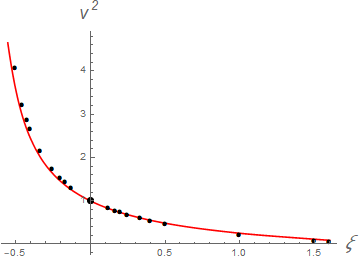
The near-boundary solution corresponds to the geometry approaching a squashed S3 fibered over time, with a(ρ) diverging exponentially and the squashing parameter v2 encoding deviation from conformal flatness. Free parameters include v2, a normalization a0, subleading terms, and the amplitude of the scalar deformation H.
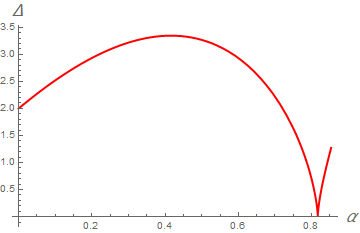
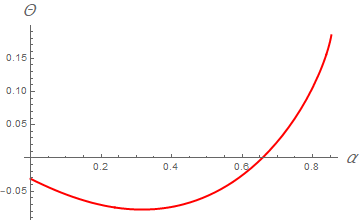
The near-horizon expansions reveal regular event horizons for a subset of parameter space: for fixed H (or equivalently, the "running" scalar amplitude determined by qI), the horizon geometry is governed by a distinct parameter α. The squashing parameter v2 does not affect the horizon cross-section, demonstrating a bulk attractor mechanism: independent of asymptotic squashing, the IR geometry stabilizes to fixed values set by charges and angular momentum.
Figure 1: The two functions Δ(α) and Θ(α) whose positiveness is necessary for a regular horizon, with Δ positive except at the cusp α=2/3.
Numerical Construction and Parameter Space
Numerical integration between horizon and boundary confirms that the black hole solutions exist and are globally regular for
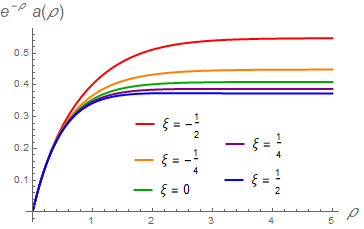
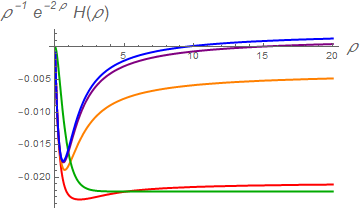
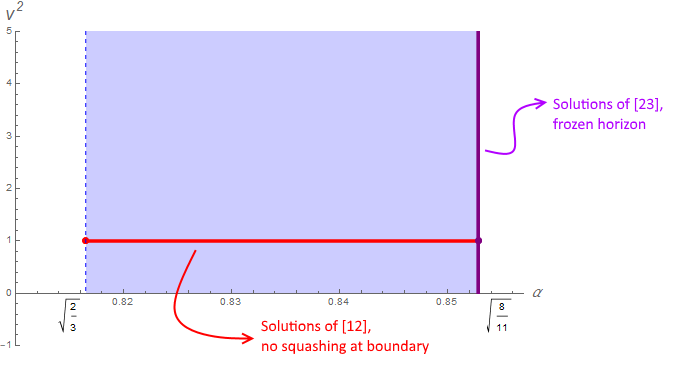
2/3<α≤8/11. For each fixed α, there is a permissible interval of ξ (related to nonsingular squashing), over which the asymptotically locally AdS solution remains smooth and free of CTCs. The deformation parameter ξ directly controls the boundary squashing but leaves the horizon geometry—and thus the entropy—unaffected.
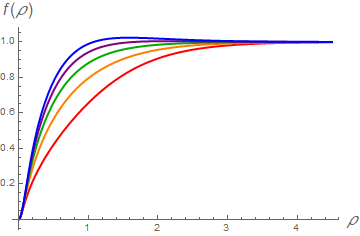
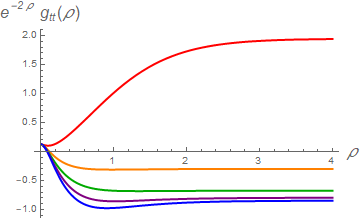
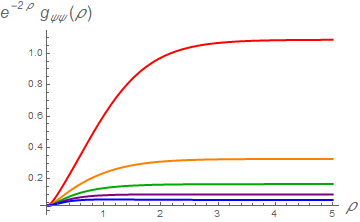
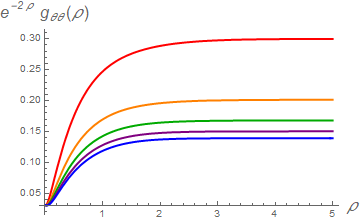
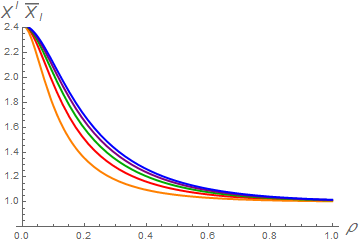
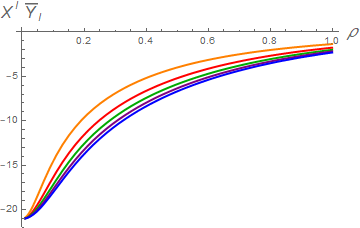
Figure 2: Relevant functions and metric components gμν for different ξ, demonstrating regularity and squashing dependence.
The space of solutions thus forms a two-dimensional moduli space labeled by (α,ξ), interpolating between the previously known minimal supergravity black holes (constant scalars, round S3) and new phases with squashed boundaries and running matter.
Figure 3: Numerical relation between the near-horizon deformation ξ and boundary squashing v2, showing one-to-one mapping for fixed α.
Physical Quantities: Page Charges, Holography, and Entropy
The black holes constructed admit precise computations of Page charges and Komar angular momentum from generalized first integrals of the equations of motion. Holographic renormalization (via Fefferman-Graham expansion) yields the SCFT one-point functions for the stress tensor, U(1)R current, flavor currents, and the relevant Δ=2 operator built from the scalars. An explicit prescription for all counterterms is provided, even in the presence of nontrivial background flavor fields and D-term sources.
The entropy, computed from horizon area, is found to obey the same functional relation as the asymptotically AdS black holes of [Gutowski-Reall], but crucially, in terms of Page charges (those relevant for IIB uplift and quantization) rather than the holographic (QFT) charges:
S=2πℓ23CIJKXˉIPJPK−κ24π2ℓJ
With PI the Page charges and J the Komar angular momentum. The entropy is \textbf{independent of the boundary squashing}: the UV squashing decouples from the IR microstate counting. The squashing, however, modifies the asymptotic geometry and thus the dual field theory background, consistent with a computation in N=4 SYM on a squashed, rotating Einstein universe.
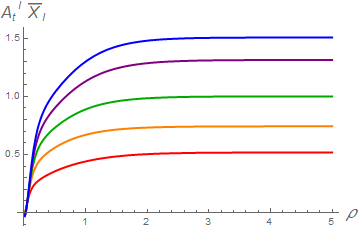
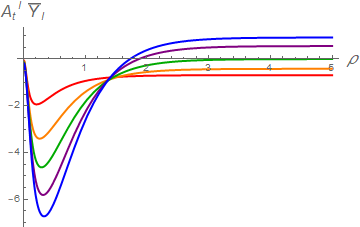
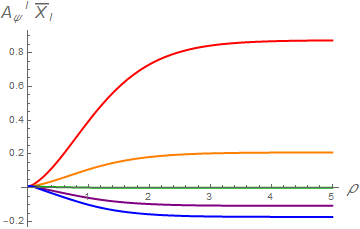
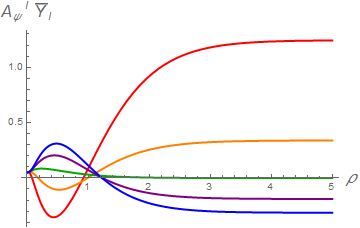
Figure 4: Components of the gauge fields AI and scalar fields XI illustrating their flow from boundary to horizon.
Theoretical Implications
The main theoretical implication is the demonstration of a robust attractor flow in five-dimensional gauged supergravity, now including both metric squashing and matter deformations: for arbitrary UV squashing (encoded in v2 or ξ), the horizon geometry and entropy remain fixed by conserved charges. This generalizes previous results for minimal supergravity and highlights that the dual CFT background (as for partition function or index computations) can be deformed without affecting the microscopic counting relevant for extremal entropy.
This strongly supports the conjectured holographic extremization principles for AdS5 black holes: the entropy is determined by extremizing a functional of chemical potentials conjugate to Page charges and angular momentum, and the squashing parameter does not enter this functional—a situation reminiscent of non-renormalization theorems for partition functions on curved backgrounds with supersymmetric localization [cf. "Holographic duals to black holes and deformed backgrounds"].
Outlook and Future Directions
Potential extensions include relaxing the ansatz for scalar deformations to obtain more general multi-parameter black holes (with less symmetry or more scalar moduli), considering higher-dimensional analogs (e.g., AdS7), and clarifying the precise role of squashing in dual SCFT indices (e.g., supersymmetric Casimir energy and its relation to the black hole entropy). The interplay between Page and holographically defined charges also deserves further investigation, especially in relation to anomaly-corrected superconformal algebras in curved space.
Figure 5: Schematic of the two-parameter solution space, with boundaries corresponding to known limits: minimal gauged supergravity and previously constructed hairy solutions.
Conclusion
This work establishes the existence and properties of two-parameter families of supersymmetric AdS5 black holes with arbitrary boundary squashing and nontrivial matter content. The solutions provide concrete gravity duals to N=4 SYM on squashed, rotating geometries, and demonstrate that the IR (horizon) data, including entropy, is governed by conserved charges unaffected by squashing—validating attractor and holographic extremization frameworks. The approach opens the path for further systematic exploration of AdS black holes in deformed, higher-derivative, or less symmetric contexts.