- The paper demonstrates that nonlinear coupling among three harmonic modes is essential for effective collective curvature radiation.
- It employs Fourier analysis and numerical integration to reveal that triplet harmonic interactions yield 2.5 times greater wave amplification than single-mode models.
- The derivation of the dielectric permittivity tensor, recovering the BGI result, underscores the significance of multiparametric plasma effects in pulsar magnetospheres.
Collective Curvature Radiation in Pulsar Magnetospheres
Introduction and Theoretical Background
This paper analyzes the mechanism of collective curvature radiation as a source for coherent radio emission in pulsar magnetospheres. The authors critically examine common analogies between curvature and cyclotron plasma radiation, emphasizing that direct substitution of curvature radius for cyclotron radius in existing formulae is fundamentally flawed due to the unidirectional character of the particle distribution function along magnetic field lines in the curved geometry, as opposed to the isotropic distribution encountered in cyclotron resonance. The investigation focuses on the dielectric response, polarizations, and electromagnetic wave amplification within a relativistic pair plasma streaming along curved field lines.
The key assertion is that a wave with a single cylindrical harmonic exp{isϕ} does not capture the physical processes underlying curvature radiation, which has significant implications for previous theoretical treatments based solely on such a modal basis.
Polarization Structure of Curvature Radiation
The analysis begins with the classic derivation of the electromagnetic potentials and fields produced by a charge moving along a circular trajectory. Fourier analysis of the potentials demonstrates that the radiated field is a superposition of three adjacent harmonics s, s±1 rather than a single s-mode. This triplet structure is essential for achieving the finite interaction time characteristic of curvature (bremsstrahlung) radiation, as opposed to the unbounded synchronism and subsequent Cherenkov emission in the single-harmonic case.
This insight invalidates approaches that seek collective curvature radiation instability by analyzing only a single azimuthal mode, as they inherently yield Cherenkov-type resonance with negligible amplification.
Nonlinear Wave Coupling and Collective Amplification
Addressing the collective effect, the study models a cold plasma stream flowing azimuthally in a toroidal magnetic field, corresponding to the geometry relevant in pulsar magnetospheres. By incorporating three coupled harmonics (s, s±1) and evaluating the Maxwell and fluid equations, the authors demonstrate that nonlinear coupling—mediated by a static electrostatic mode with s=1—substantially enhances wave amplification when compared to the single-mode case.
Numerical integration of the coupled equations reveals that when the s±1 amplitudes are initialized twenty times larger than the central s-mode, the resulting intensity of the collective wave, ∣E∣2, is approximately 2.5 times that of the linear scenario where coupling is neglected.
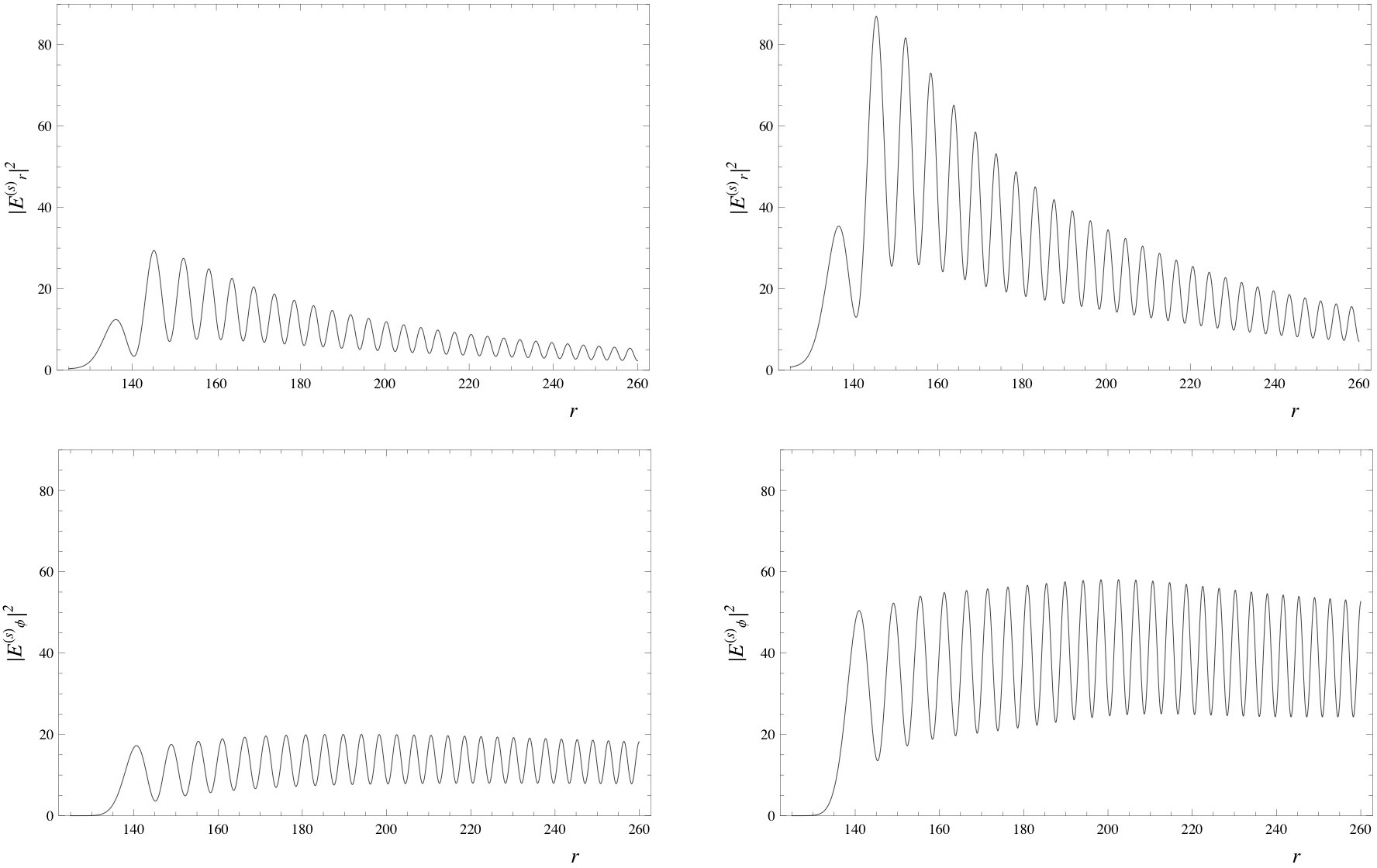
Figure 1: Model calculations of two cases, s0, s1 GHz, s2, s3. Nonlinear interaction between s4, s5 harmonics significantly amplifies the radiated wave compared to the linear case.
This result underscores that efficient collective curvature radiation and associated instabilities require accounting for at least the minimal harmonic triplet, not just a single eigenmode.
Permittivity Tensor Derivation
The microscopic response of the streaming pair plasma is encapsulated via the general dielectric permittivity tensor s6. The authors rigorously derive the tensor by summing the plasma response over all cylindrical harmonics and performing a transformation to Cartesian coordinates. The kernel is shown to satisfy the necessary symmetry properties and is appropriate in the limit of large curvature radii and slow spatial variation (the geometric optics regime).
The asymptotic form of the tensor recovers the so-called BGI (Beskin-Gurevich-Istomin) result, explicitly highlighting nonlocality due to finite formation length of the radiation:
s7
where s8.
The off-diagonal components and s9 are directly responsible for modified wave polarization and for enabling negative work by the wave electric field on the particle current—a condition for excitation and instability. In contrast, setting these components to zero (recovering the single s±10-mode case) leads to vanishing longitudinal field and prohibits wave growth.
Implications and Theoretical Conclusions
The findings challenge prevailing approaches that attribute pulsar radio emission to curvature-driven collective instabilities modeled with a single cylindrical harmonic. The results emphasize the necessity of including at minimum three mode coupling, and more generally, a full summation over harmonics and self-consistent evaluation of the permittivity tensor for assessing linear and nonlinear wave excitation.
The analysis reveals that what is often labeled "curvature-drift instability" in the literature is, in fact, dominated by Cherenkov resonance on the drift motion, with curvature effects secondary or absent unless the complete mode structure is considered. Strong magnetic fields suppress drift and Cherenkov resonance, while the true curvature mechanism is unmodified by field strength but depends on the geometry and multi-harmonic coupling.
The theoretical framework presented here is directly applicable to pulsar magnetospheric plasma, providing criteria for the onset of coherent instability and its observable signatures, and it informs the requirements for kinetic and nonlinear plasma modeling in astrophysical contexts.
Conclusion
This work establishes that single-mode analyses are insufficient for describing collective curvature radiation. The true instability mechanism resides in the nonlinear and multi-harmonic coupling intrinsic to the curved plasma geometry. The systematic derivation of the BGI permittivity tensor within this context offers a foundational basis for future modeling of coherent emission processes in pulsar magnetospheres and can inform both astroplasma theory and interpretation of radio observations. Future developments should extend the analysis to include kinetic effects, anisotropic particle distributions, and global magnetospheric structure to enable predictive models of pulsar radio emission physics.

