Papers
Topics
Authors
Recent
2000 character limit reached

FILIC: Dual-Loop Force-Guided Imitation Learning with Impedance Torque Control for Contact-Rich Manipulation Tasks (2509.17053v1)

Published 21 Sep 2025 in cs.RO

Abstract: Contact-rich manipulation is crucial for robots to perform tasks requiring precise force control, such as insertion, assembly, and in-hand manipulation. However, most imitation learning (IL) policies remain position-centric and lack explicit force awareness, and adding force/torque sensors to collaborative robot arms is often costly and requires additional hardware design. To overcome these issues, we propose FILIC, a Force-guided Imitation Learning framework with impedance torque control. FILIC integrates a Transformer-based IL policy with an impedance controller in a dual-loop structure, enabling compliant force-informed, force-executed manipulation. For robots without force/torque sensors, we introduce a cost-effective end-effector force estimator using joint torque measurements through analytical Jacobian-based inversion while compensating with model-predicted torques from a digital twin. We also design complementary force feedback frameworks via handheld haptics and VR visualization to improve demonstration quality. Experiments show that FILIC significantly outperforms vision-only and joint-torque-based methods, achieving safer, more compliant, and adaptable contact-rich manipulation. Our code can be found in https://github.com/TATP-233/FILIC.
Summary

  • The paper presents a dual-loop framework (FILIC) that integrates a Transformer-based imitation learning policy with high-frequency impedance torque control.
  • The paper demonstrates that sensorless force estimation using joint torque readings and kinematic information significantly improves task success, achieving 90% in simulation.
  • The paper highlights the use of vibro-haptic and VR-based feedback to enhance demonstration quality and operator perception in robotic manipulation.

FILIC: Dual-Loop Force-Guided Imitation Learning with Impedance Torque Control for Contact-Rich Manipulation Tasks

Introduction

This paper introduces FILIC, a novel framework designed to enhance robotic manipulation capabilities, especially for tasks involving contact-rich interactions where precise force control is essential. FILIC employs a dual-loop architecture that integrates imitation learning with impedance torque control to achieve compliant manipulation without the need for expensive hardware or additional force/torque sensors. By leveraging multimodal sensory inputs and real-time force estimation, FILIC enables adaptable, force-informed manipulation for robots, significantly outperforming vision-only and joint-torque methods.

FILIC Architecture

FILIC's architecture is centered around a dual-loop structure:

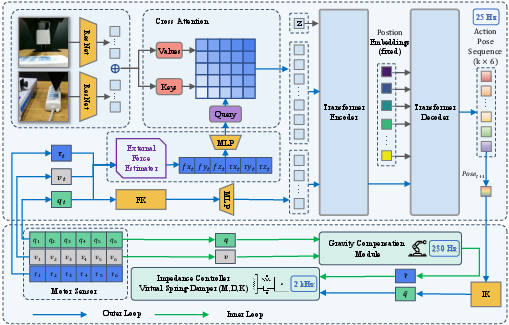
  • Outer Loop: Utilizes a Transformer-based imitation learning policy, which processes visual and estimated force data to predict end-effector poses at 25 Hz. The model fuses visual inputs from dual ResNet backbones with force estimations using cross-attention, enhancing the perception capabilities for contact-rich tasks.
  • Inner Loop: Implements an impedance controller operating at 2 kHz to ensure compliant torque control. The controller translates high-level pose commands into joint torques, compensating for gravitational forces at 250 Hz to maintain stability. Figure 1

    Figure 1: Detailed architecture of FILIC. Outer loop predictions guide the inner loop impedance control to execute compliant manipulation.

External Force Estimation

FILIC introduces a sensorless method to estimate end-effector forces using joint torque readings and the robot's kinematic information. This approach, based on the Jacobian matrix and supported by a high-fidelity digital twin in the MuJoCo simulator, allows for robust and cost-effective force estimation, crucial for real-time feedback in manipulation tasks.

Demonstration Data Frameworks

Data collection for training the imitation learning model incorporates two innovative feedback mechanisms:

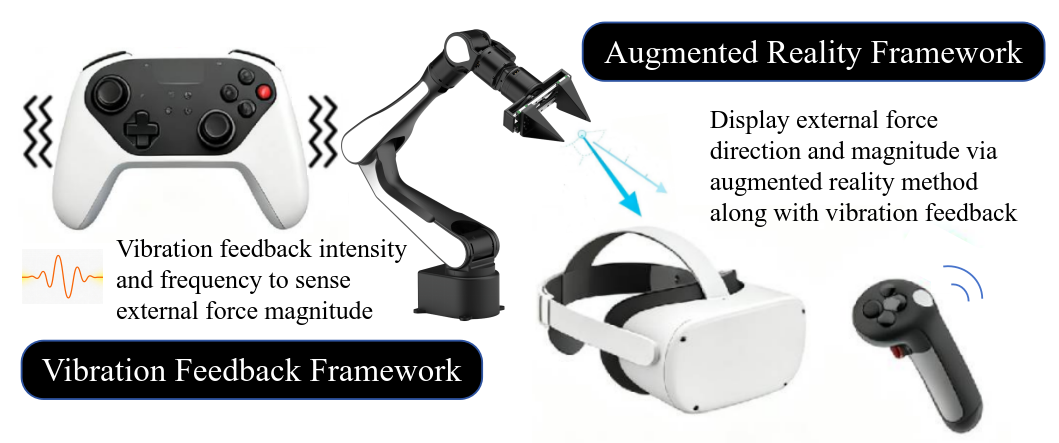
  • Vibro-haptic Feedback: Utilizes handheld controllers that convert estimated force data into vibrotactile cues, improving the operator's perception of contact during demonstrations.
  • VR-based Visual Feedback: Employs VR headsets to display real-time force vectors, providing operators with clear visual cues of force direction and magnitude to refine their demonstration quality. Figure 2

    Figure 2: Two frameworks of demonstration with force feedback enhancing data collection for training FILIC.

Experimental Evaluation

The paper evaluates FILIC through extensive experiments, both in simulation and on physical hardware, comparing it against vision-only and joint-torque-based methods.

  • Simulation Results: FILIC achieved a 90% success rate in tasks such as peg-in-hole insertion, highlighting the impact of accurate force perception on task performance.
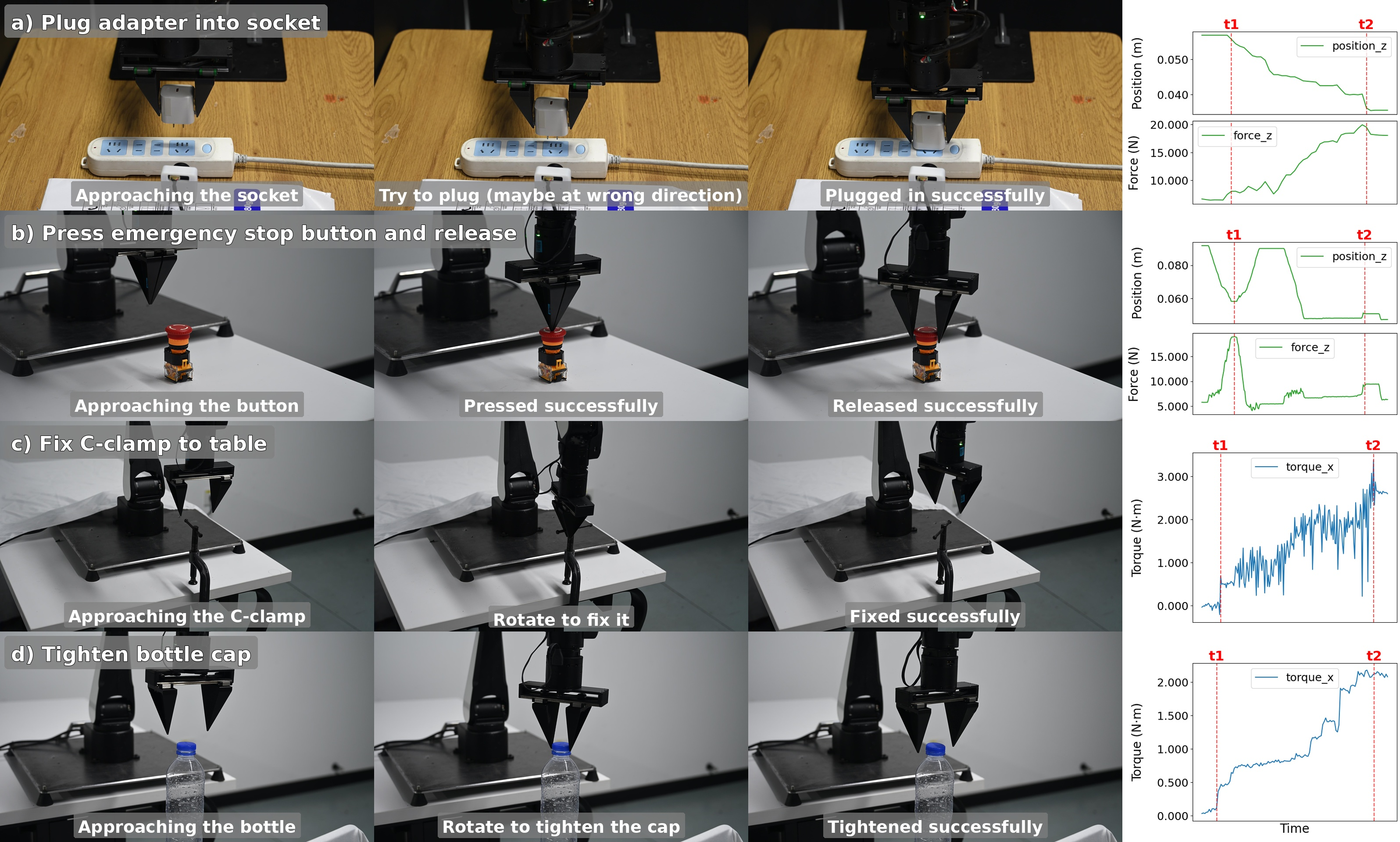
  • Real-World Performance: When tested with a 6-DOF robotic arm on tasks like socket insertion, FILIC demonstrated superior performance when using estimated end-effector forces compared to raw joint torques, achieving 80% success.

These findings underscore the superiority of force-aware manipulation over purely vision-guided approaches, especially in complex, contact-rich environments. Figure 3

Figure 3: Simulation scene setup and step-by-step process of the peg-in-hole task.

Conclusion

FILIC represents an effective integration of imitation learning and impedance control, addressing the limitations of force perception in robotic manipulation. By offering a sensorless yet precise force estimation method, FILIC enables safer and more reliable manipulation, broadening the scope of tasks robots can perform autonomously. Future work will focus on extending FILIC to more complex, multi-DOF scenarios, enhancing its adaptability and utility in diverse real-world applications.

Whiteboard

Open Problems

We haven't generated a list of open problems mentioned in this paper yet.

Collections

Sign up for free to add this paper to one or more collections.