- The paper demonstrates that autonomous research agents dynamically integrate LLMs with web-based evidence to overcome static knowledge limitations.
- It details a four-stage deep research pipeline—planning, question development, web exploration, and report generation—addressing key technical challenges and optimization strategies.
- The survey outlines future directions to enhance factual consistency, multimodal integration, and personalized research workflows.
Deep Research: A Survey of Autonomous Research Agents
The paper "Deep Research: A Survey of Autonomous Research Agents" (2508.12752) systematically explores the nascent domain of autonomous research systems, which leverage LLMs augmented by agentic capabilities to conduct complex online research. The paper highlights the limitations inherent to current LLMs constrained by their internal knowledge boundaries and introduces deep research paradigms that actively engage with external knowledge sources to produce comprehensive analytical reports grounded in web-based evidence. This survey provides an in-depth examination of each core stage of the deep research pipeline, analyzes technical challenges, delineates representative methods, and discusses open challenges alongside promising directions for future research.
Overview of Deep Research Systems
Deep research systems aim to extend beyond passive content retrieval, involving active interaction with dynamic knowledge sources. These systems are defined by intricate workflows organized into four fundamental stages: planning, question development, web exploration, and report generation. Across these stages, agents perform complex interactions with external sources, coordinating synthesis to produce structured, evidence-grounded outputs. The convolution of agentic search and reasoning facilitates more adaptable and goal-driven data acquisition, optimizing LLM capabilities for complex research workflows.
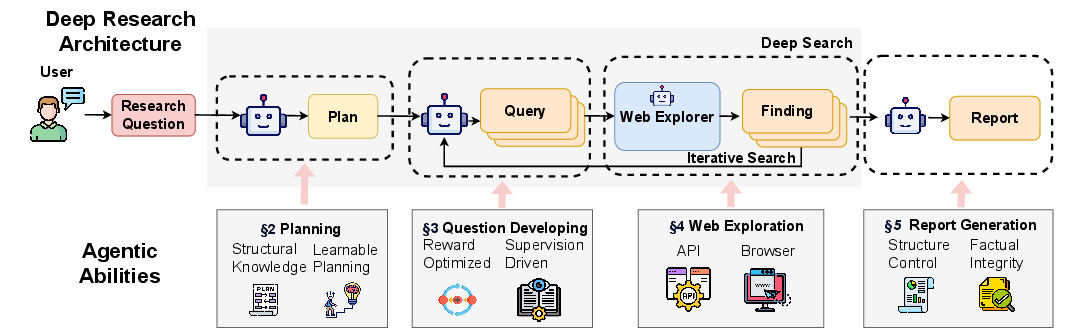
Figure 1: Overview of the deep research system.
Core Stages and Technical Challenges
Planning
Planning in deep research systems involves decomposing high-level research questions into structured sub-goals, articulating an explicit roadmap of actions before retrieval or generation commences. This stage confronts challenges in task decomposition under ambiguous goals, requiring interpretable and flexible planning mechanisms. Systems such as WebPilot and Qiao et al. integrate structured world knowledge models to guide foresightful decision-making, enhancing downstream execution efficiency.
Question Developing
Question developing demands adaptive generation of diversified queries to capture evolving subgoals, contrasting static question formulation methods. RL-based approaches like DeepResearcher employ reward-optimized strategies to refine query effectiveness via interaction with search environments, supplementing precision and broadness of retrieval objectives. Alternatively, supervision-driven methods leverage multi-agent systems and task-specific heuristics to guide question generation in deterministic or structured workflows.
Web Exploration
The web exploration process orchestrates retrieval from vast, heterogeneous information, deploying autonomous browser-based agents or API-integrated frameworks. While agents such as WebGPT and WebVoyager dynamically navigate web interfaces, API-based systems expedite access to indexed material from search engines and specialized databases like Google and CNKI. Efficient retrieval hinges on adaptability and reliability, though challenges persist in covering sparse evidence and real-time verification.
Report Generation
Report generation synthesizes retrieved fragments into coherent analytical outputs, emphasizing structure control and factual integrity. Planning-based generation frameworks such as LongWriter integrate hierarchical outline planning for layout consistency, while constraint-guided generation methods enforce formatting and coverage requirements during decoding. Faithful models like RAGSynth enhance factual alignment with high-confidence evidence spans, addressing inter-source conflict resolution and factuality evaluations with metric-driven benchmarks.
Optimization Techniques
Optimization in deep research systems encompasses reinforcement learning, contrastive learning, and curriculum training to align large model behaviors across the pipeline. RL methods, prevalent in single-agent architectures, leverage reward signals for integrated end-to-end training, optimizing agent decision processes in retrieval and generation. Multi-agent systems benefit from modular training and feedback, fostering flexibility and coordination in complex research tasks.
Benchmark and Evaluation
Benchmarks such as DeepResearch Bench and WebArena assess the comprehensiveness and accuracy of agents across core modules. Evaluation metrics range from task success rates in search-oriented benchmarks to structured output reliability in research-oriented frameworks. Benchmarks delineate the efficacy of methodological approaches and provide standardized measures to guide advancements in the field.
Future Directions
Despite progress, significant limitations remain in multi-tool integration, factual consistency, multimodal expansion, workflow design, and personalization. Addressing these areas entails developing robust frameworks with richer tool orchestration, explicit grounding mechanisms, multimodal reasoning capabilities, adaptive workflow models, and scalable user-centered personalization strategies to fully realize the potential of deep research agents.
Conclusion
"Deep Research: A Survey of Autonomous Research Agents" provides a systematic exploration of the expanding role of deep research systems in augmenting LLMs for enhanced analytical report generation. By dissecting core challenges and outlining future directions, the paper charts a roadmap toward developing more capable and trustworthy autonomous research agents, aiming to integrate complex reasoning and interaction faculties into diverse real-world applications.

