- The paper presents a detailed analysis of quasinormal modes in charged black holes within a perfect fluid dark matter environment using both analytical and numerical techniques.
- It demonstrates that variations in magnetic charge and PFDM parameters significantly impact black hole stability and QNM frequency spectra, with implications for gravitational wave detection.
- EHT shadow data is used to constrain the PFDM parameter space, providing a theoretical framework to differentiate between competing black hole models.
Testing Black Holes in Perfect Fluid Dark Matter Environments Using Quasinormal Modes
This paper presents a detailed analysis of quasinormal modes (QNMs) in charged black holes within a perfect fluid dark matter (PFDM) environment, employing data from the Event Horizon Telescope (EHT) regarding the M87* black hole shadow. Utilizing constraints derived from this observational data, the research systematically examines how variations in magnetic charge and PFDM parameters impact the stability and dynamical response to perturbations in black holes, applying both analytical and numerical methods to extract QNM frequencies and assess potential effects on gravitational wave detections.
Introduction to Black Hole Perturbation
Black holes serve as key experimental platforms for probing the predictions of general relativity and testing gravitational theories. Recent observations by LIGO and EHT have confirmed both gravitational wave emissions and visual imaging of the M87* black hole, offering insights into the complex structure of spacetime in strong gravitational fields. Understanding the oscillatory nature of perturbed black holes, through QNMs, provides a means for accurate measurement of black hole parameters like mass, angular momentum, and charge, as dictated by the no-hair theorem (Konoplya et al., 2011).
PFDM Spacetimes and Effective Potential
The research adopts a spherically symmetric metric derived from coupling GR with nonlinear electrodynamics, characterizing charged black holes within PFDM surroundings. The paper effectively describes the influence of PFDM on spacetime geometry, revealing nuanced deviations from classical Schwarzschild solutions (Figure 1 and 2).
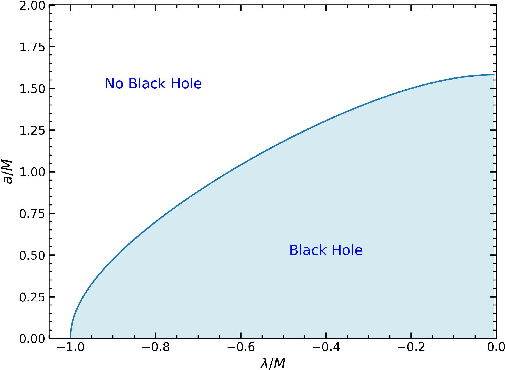
Figure 1: Parameter space (a/M, lambda/M) representing a charged black hole surrounded by PFDM. Blue solid line corresponds to extreme black holes.The blue region represents the range of parameter values where black holes exist.
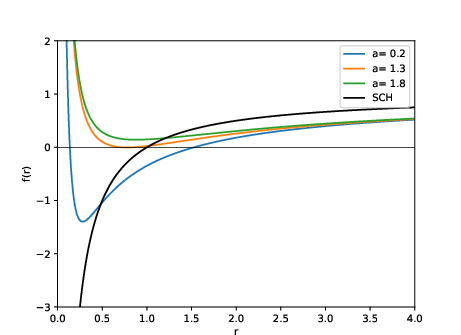
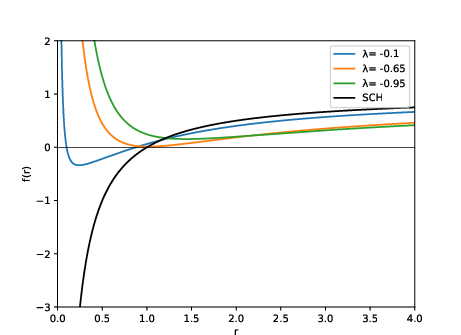
Figure 2: The horizons of a charged black hole surrounded by PFDM for different a and lambda parameter values. Black curve is the Schwarzschild black hole horizon, with extreme black hole horizon parameters approximately near the green curve parameters.
Methods for QNM Calculation
This study employs the sixth-order WKB method and time-domain analysis to ascertain QNMs, offering panoramic insights into oscillation frequencies and decay rates. Key boundary conditions are set, ensuring pure ingoing waves at event horizons and pure outgoing waves at spatial infinity.
Constraints from Black Hole Shadows
Utilizing EHT observational data, the paper delineates the feasible parameter space for charged black holes as M87* candidates, highlighting the growing range of permissible PFDM parameter values with increased magnetic charge (Figure 3).
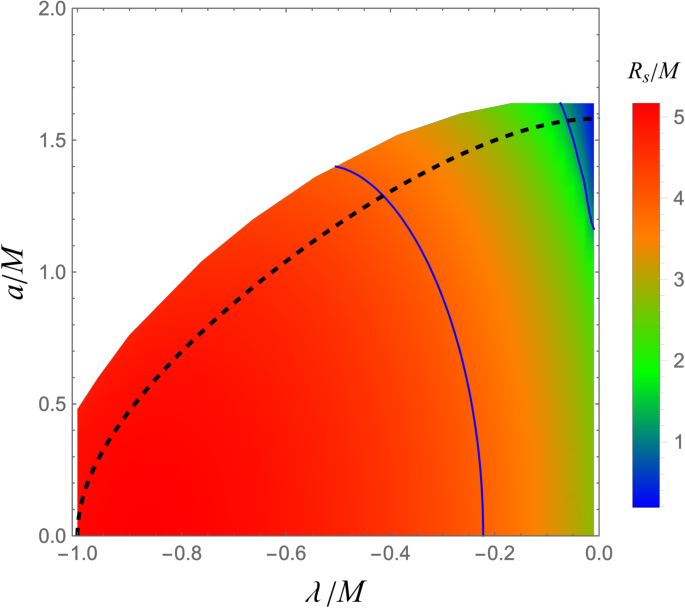
Figure 3: The parameter space constrained by EHT data for charged black holes as M87
candidates in a PFDM background. The black dashed line represents extreme black holes, with the region below the dashed line representing the parameter range where black holes exist, and the space between the two blue curves is constrained by the EHT observations.*
Analysis of Quasinormal Modes
Experimental results affirm that changes in PFDM and magnetic charge parameters markedly influence QNMs frequency spectra. Tables and figures (6-9) elucidate the complex interplay between angular quantum numbers, magnetic charge, PFDM parameters, and the QNMs’ real and imaginary components.
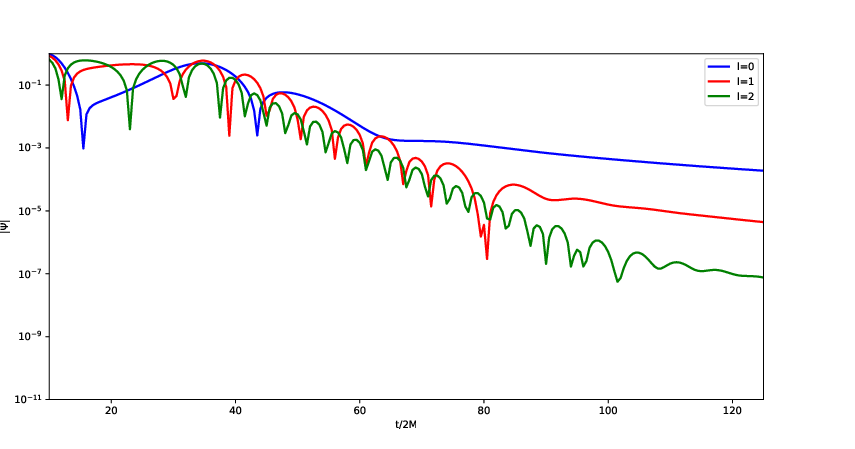
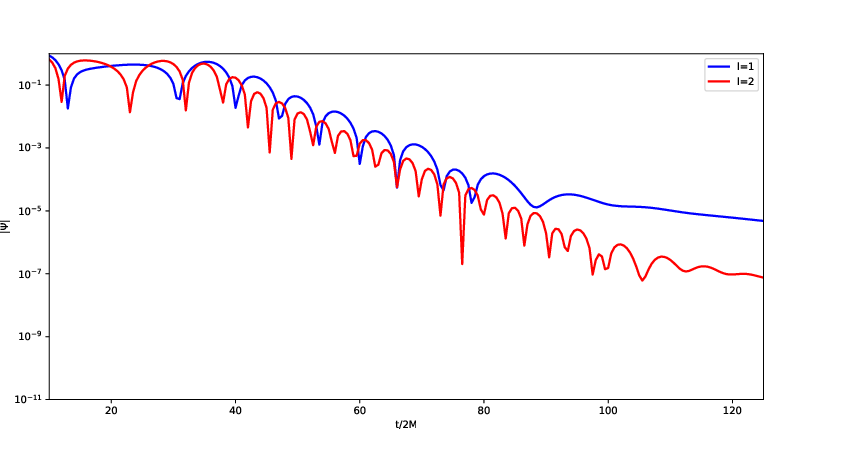
Figure 4: Time evolution of QNMsA in scalar field (left) and electromagnetic field (right) perturbations for Schwarzschild black holes, with parameters M=0.5.
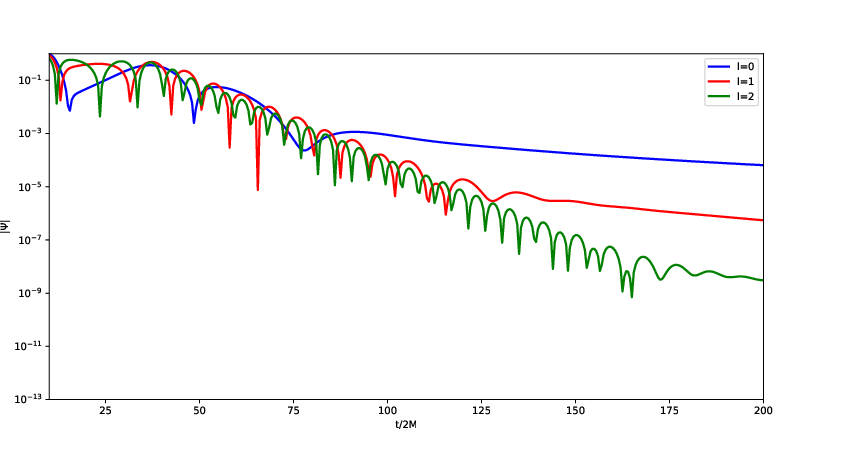
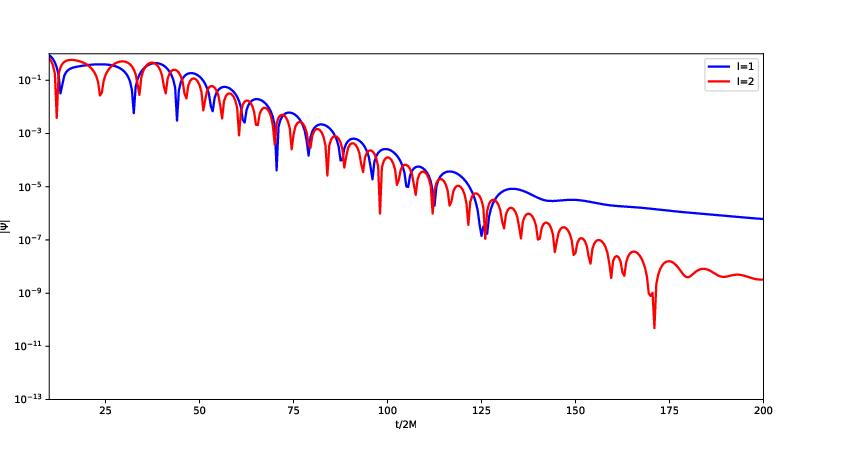
Figure 5: Time evolution of QNMs in scalar field (left) and electromagnetic field (right) perturbations with different angular quantum numbers. Parameters used: M=0.5, a=0.4, lambda=-0.15.
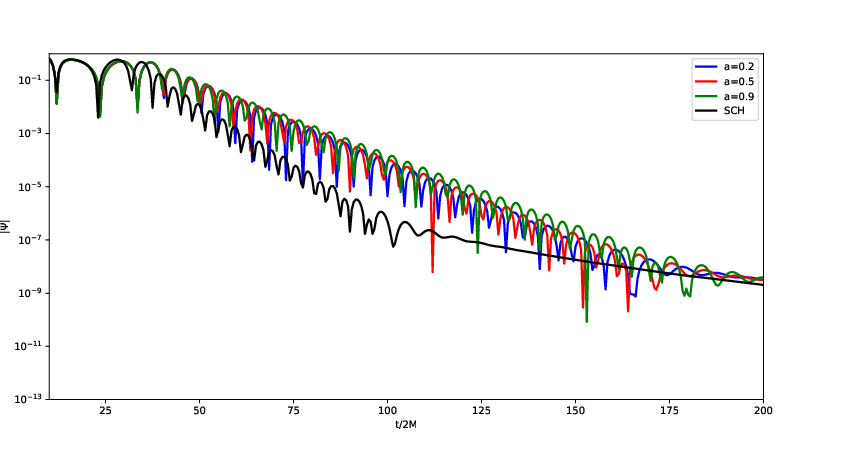
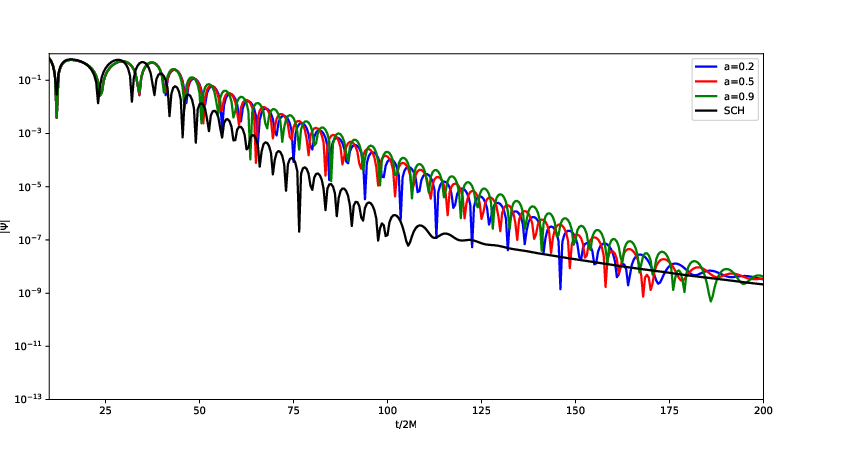
Figure 6: Time evolution of QNMs in scalar field (left) and electromagnetic field (right) perturbations with different magnetic charges. Parameters used: M=0.5, lambda=-0.15, l=2.
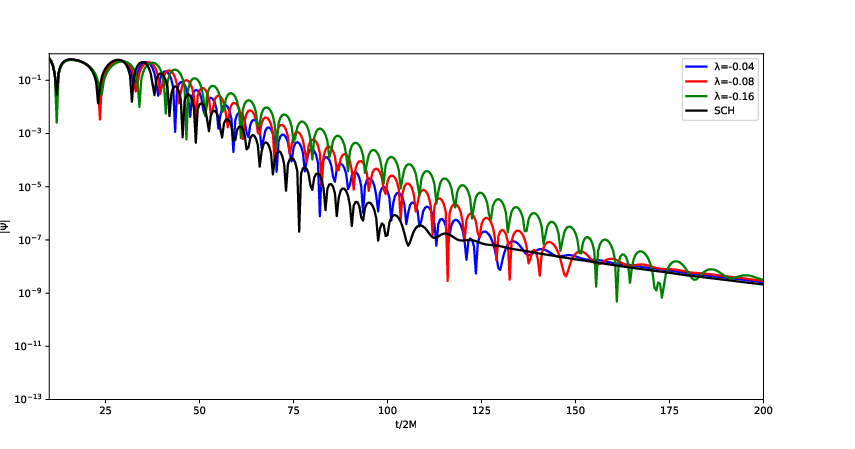
Figure 7: Time evolution of QNMs in scalar field (left) and electromagnetic field (right) perturbations with different PFDM parameters. Parameters used: M=0.5, a=0.4, l=2.
Conclusion
The paper provides comprehensive insight into how electromagnetic interactions and dark matter distributions affect QNM spectra, stressing the potential for gravitational wave detection to distinguish between black hole models. The work lays a theoretical foundation for observational techniques capable of constraining black hole parameters with increased precision, enhancing the understanding of gravitational dynamics in dark matter-laden environments. Future advancements in observational technology will likely further refine these findings, with implications for both astrophysical research and theoretical physics.