- The paper presents an innovative evaluation of personality traits using the Big Five framework and cumulative prospect theory to assess risk-taking in GPT-4 models.
- The methodology involves measuring baseline traits with the IPIP-NEO-300 and applying targeted interventions to modulate risk propensity.
- The findings reveal that higher openness correlates with increased risk-taking for gains, distinguishing behavior between GPT-4o and GPT-4-Turbo models.
Understanding Personality Influences on LLM Risk-Taking Behavior
This paper explores the relationship between personality traits and risk-taking behavior in LLMs, specifically focusing on GPT-4 variations. Employing the Big Five personality framework and cumulative prospect theory (CPT), it evaluates how these traits affect risk propensity, providing valuable insights for designing AI systems with tailored decision-making abilities.
Methodological Approach
Personality Assessment and Intervention
The study begins by measuring the inherent personality traits of GPT-4o using the IPIP-NEO-300 Personality Inventory to establish a baseline. It then employs a system of interventions based on the Big Five traits to modulate these traits within the LLMs. These interventions utilize bipolar adjective markers and intensity modifiers to simulate varying levels of each trait, effectively personifying the models at different levels of traits such as Openness.
Estimation of Risk Propensity
Risk propensity is evaluated using CPT parameters, which describe how the models perceive gains and losses. The methodology involves presenting the LLMs with various prospects, prompting them to report certainty equivalents, which are then used to estimate CPT parameters through regression analysis. The study specifically focuses on the influence of personality interventions on these parameters to identify any statistically significant correlations.
Key Findings
Rationality of GPT-4o
The results indicate that GPT-4o operates as a risk-neutral, rational agent under evaluation conditions, with CPT parameters closely aligning with those predicted by expected utility theory. This suggests minimal probability distortion in decision-making processes, differing from previous versions such as GPT-4-Turbo, which demonstrated cognitive biases.
Influence of Openness
Openness is identified as the most influential personality trait affecting risk propensity in GPT-4o. High levels of Openness correlate with increased risk-taking for gains and decreased aversion to losses. This aligns with human behavior studies where Openness is a consistent predictor of risk-taking.
Comparative Analysis with GPT-4-Turbo
The comparative analysis highlights significant differences between GPT-4o and GPT-4-Turbo. While GPT-4o shows a global correlation between Openness and risk-taking consistent with human data, GPT-4-Turbo demonstrates localized correlations, limited to specific levels of trait markers. This suggests a more complex mapping of personality to risk behaviors in earlier models.
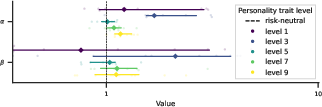
Figure 1: CPT parameter estimates for GPT-4-Turbo with personality interventions on the Openness personality trait, showing estimates across different levels of intervention.
Implications for Future AI Development
The findings from this research underscore the importance of integrating personality-based interventions into LLMs to modulate risk propensity predictably. This has significant implications for deploying LLMs in applications requiring nuanced decision-making, such as financial modeling and automated agents in complex environments.
Future Directions
Future research should explore reinforcement learning to optimize personality interventions and examine the underlying activation directions within LLM architectures. Such studies can enhance our ability to engineer AI with precise behavioral controls and improve the interpretability of LLM decision-making processes.
Conclusion
This investigation into how personality traits influence risk-taking behavior in LLMs offers crucial insights into designing AI systems with human-like decision-making abilities. By providing a reliable framework for predicting and influencing LLM risk propensity, the study lays the groundwork for more robust, personality-calibrated AI agents.

