- The paper introduces HRGraph, leveraging LLMs to extract entities from HR documents and construct comprehensive HR knowledge graphs.
- The methodology incorporates BERT embeddings and an information propagation mechanism to enhance job recommendation and job area classification.
- Experimental results show that KG-based methods improve recommendation accuracy, with GCN outperforming other models in categorizing job areas.
HRGraph: Leveraging LLMs for HR Data Knowledge Graphs
Introduction
The use of Knowledge Graphs (KGs) in managing HR data is examined in "HRGraph: Leveraging LLMs for HR Data Knowledge Graphs with Information Propagation-based Job Recommendation" (2408.13521). This paper presents a framework for constructing HR knowledge graphs using data extracted from various HR documents, such as job descriptions and CVs, through the application of LLMs. The HRGraph framework is designed to facilitate job recommendations, skill assessments, and job area classification by utilizing an information propagation mechanism within KGs.
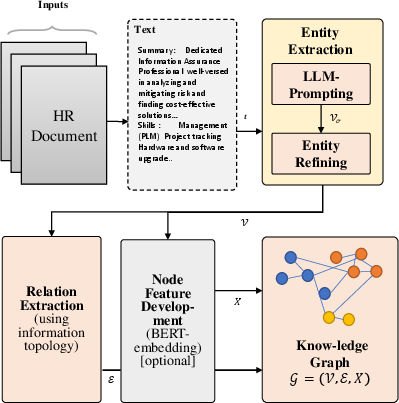
Figure 1: The overall framework of our HRGraph. It involves passing text data extracted from HR documents through a LLM to obtain entities and entity types, which are used to build a base knowledge graph with optional node features as BERT embeddings.
Methodology
The construction of HR Knowledge Graphs involves several critical steps. Initially, text data from HR documents is processed through an LLM to extract entities and entity types, creating a base KG. Node features are optionally enhanced with BERT embeddings, ensuring detailed entity representation. Entity extraction is refined by omitting noise, typically identified by predefined criteria such as entity length and semantic relevance.
Following entity extraction, relation extraction is performed to establish connections based on entity topology. Nodes in the KG are characterized by feature vectors derived from a pre-trained BERT model. The resultant graph encapsulates HR-related knowledge, represented by nodes (entities) and edges (relationships).
Two primary downstream tasks are addressed: job recommendation and job area classification. Job recommendations use information propagation within the KG to assess candidate-job compatibility by identifying sharing nodes such as skills and education. Conversely, job area classification employs GNNs, specifically GCN and GAT, to categorize job areas based on entity-related features in the KG.
Experiments and Results
Experiments demonstrate the framework's efficacy in job and employee recommendations and job area classification. The dataset comprises 200 CVs and job descriptions across 20 job categories, ensuring diversity in job and skill sets. Results show that KG-based methods outperform traditional approaches in job recommendations and classification accuracy.
The recommendation task, measured by average accuracy and precision, highlighted the KG's capacity to enhance job matching against traditional methods. Specifically, both GCN and GAT models showed improvement in job area classification tasks, with GCN achieving the highest accuracy.
Implications and Future Directions
HRGraph's implementation poses significant implications for HR management, enhancing recruitment processes, skill mapping, and retention strategies. Future research may explore refining LLM-based entity extraction, exploring deeper integration of advanced NLP techniques, and expanding the framework's applicability across different enterprise domains.
Conclusion
HRGraph facilitates the development of HR knowledge graphs from textual data via LLMs, addressing crucial HR tasks such as job recommendations and classification. Its methodological innovations and application strategies provide robust frameworks for leveraging KGs and information propagation to improve HR functions, promising substantial benefits for employers and job seekers alike. Further advancements in LLM utilization hold the potential to refine the accuracy and scope of HR knowledge graph applications.

