- The paper introduces an open-source RIS design that employs a cost-effective FR4 PCB and achieves a 180° phase shift for 5 GHz WiFi signals.
- The prototype demonstrates balanced RF performance with reflection coefficients near -5 dB and phase differences up to 180° using 16x16 unit cells.
- The open-source design paves the way for further research in adaptive RIS implementations for next-generation wireless communication systems.
Open Source Reconfigurable Intelligent Surface for 5 GHz WiFi
Introduction
The paper presents an open-source Reconfigurable Intelligent Surface (RIS) specifically designed for the 5 GHz WiFi frequency range. RIS technologies have garnered attention due to their potential to enhance wireless communication and improve sensing systems. The primary contribution of this paper is addressing the accessibility and cost-effectiveness of RIS, as much of the existing devices are prohibitive either in terms of complexity or cost. The authors intend to open up possibilities for further research and real-world applications by providing open-source design details for a 5 GHz RIS.
Unit Cell Design
The unit cell is fundamental to the RIS's functionality, consisting of three copper layers on a printed circuit board (PCB). The top layer features a reflective rectangular patch above a ground plane, connected through a plated through-hole (via). This configuration effectively forms a pin-fed patch antenna suitable for altering wave propagation properties by varying reflective phases.
The design employs the FR4 substrate, chosen for cost considerations, with a dielectric constant ϵr=4.6 and a dissipation factor tanδ=0.028. An Infineon BGS12P2L6 switch toggles between states to provide flexibility in reflection coefficient control. The binary switching induces a phase shift of 180 degrees, which is crucial for manipulating wave propagation. Equations are based on detailed CST Microwave Studio simulations.
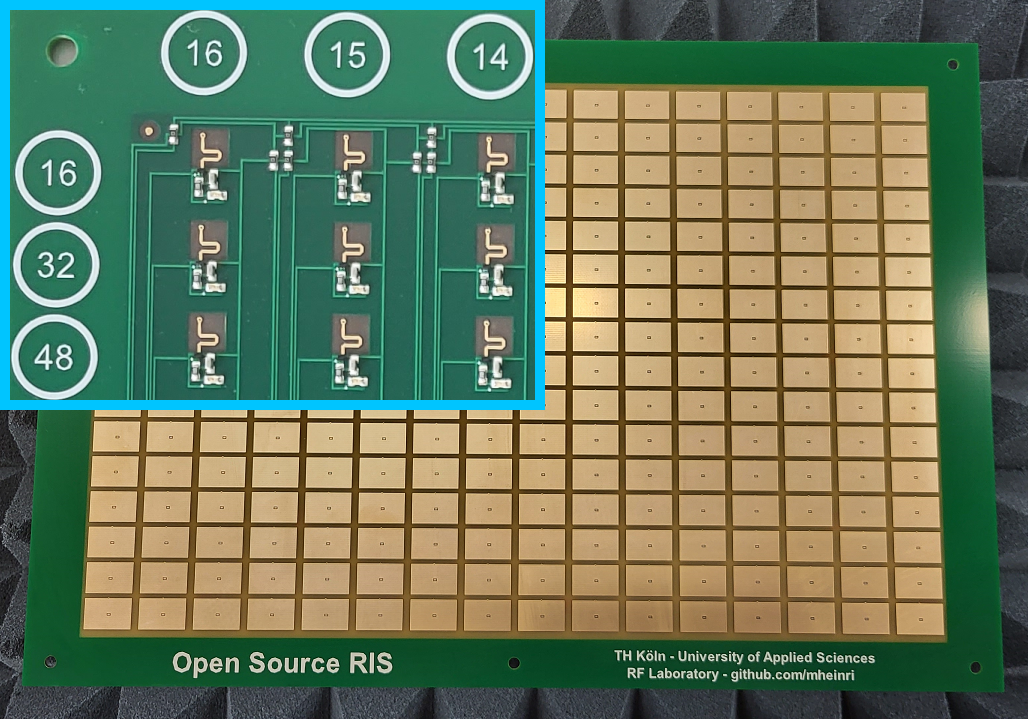
Figure 1: RIS with 256 elements and sectional view of nine backside elements.
The study evaluates the RF performance by measuring reflection coefficients using networks of 16x16 unit cells. The prototype is built on cost-effective FR4 PCB, and the measurements are made with a vector network analyzer set in the aperture of a horn antenna. The reflection coefficient minimizes at $\SI{-5.2}{\decibel}$ for the OFF state and $\SI{-4.8}{\decibel}$ for the ON state within the specified frequency bands. The maximum phase difference reaches 180 degrees, with a minimum of 92 degrees at the extremities of the WiFi band. These performance metrics suggest a balance between performance and cost, with potential improvements if lower-loss RF substrates are used.
Practical Implications and Future Directions
The open-source nature of this RIS design lowers the barrier for experimentation and broader adoption in wireless communication research. By making design files and firmware accessible, the authors hope to catalyze further innovation in deploying RIS within WiFi environments and beyond. The methodology could readily be adapted for various use cases, such as in 6G networks, UAV systems, or secure communication channels.
Future research could further optimize this baseline design by focusing on substrate selection, minimizing loss, and achieving more precise phase control. Additionally, leveraging machine learning for adaptive pattern control in RIS implementations holds promise. Enhanced designs might lead to more robust RS applications in challenging environments, such as urban canyons and buildings, thereby improving overall network coverage and throughput.
Conclusion
This paper outlines a cost-effective and accessible approach to implementing a RIS for the 5 GHz WiFi band, blending design innovation with practicality. By open-sourcing the RIS design and presenting comprehensive RF analysis and results, the authors set the stage for advancements in wireless communication technology. As the telecommunications landscape evolves, the potential for RIS applications will likely expand, offering new possibilities both in research and applied settings.