Hardware Limitations and Optimization Approach in 1-Bit RIS Design at 28 GHz
Published 10 Jun 2025 in eess.SP | (2506.08930v1)
Abstract: Reconfigurable intelligent surfaces (RIS) have emerged as a transformative technology for electromagnetic (EM) wave manipulation, offering unprecedented control over wave reflections compared to traditional metallic reflectors. By utilizing an array of tunable elements, RIS can steer and shape electromagnetic waves to enhance signal quality in wireless communication and radar systems. However, practical implementations face significant challenges due to hardware limitations and phase quantization errors. In this work, a 1-bit RIS prototype operating at 28 GHz is developed to experimentally evaluate the impact of hardware constraints on RIS performance. Unlike conventional studies that model RIS as an ideal phase-shift matrix, this study accounts for physical parameters that influence the actual reflection pattern. In particular, the presence of specular reflection due to hardware limitations is investigated. Additionally, the effects of phase quantization errors, which stem from the discrete nature of RIS elements, are analyzed, and a genetic algorithm (GA)-based optimization is introduced to mitigate these errors. The proposed optimization strategy effectively reduces gain degradation at the desired angle caused by 1-bit quantization, enhancing the overall performance of RIS. The effectiveness of the approach is validated through measurements, underscoring the importance of advanced phase control techniques in improving the functionality of RIS.
The paper’s main contribution is a GA-based optimization that compensates for 1-bit phase quantization, achieving a 2.82 dB improvement in received power.
It employs genetic algorithms to optimize phase distribution across tiny RIS unit cells, effectively mitigating hardware-induced reflection anomalies at 28 GHz.
The study demonstrates that optimizing limited phase resolution enhances mmWave communication performance, paving the way for more effective RIS designs.
Hardware Limitations and Optimization Approach in 1-Bit RIS Design at 28 GHz
Introduction
The paper investigates the design and optimization of reconfigurable intelligent surfaces (RIS) at 28 GHz, focusing on mitigating hardware limitations through innovative optimization techniques. Specifically, the authors construct a 1-bit RIS prototype to experimentally assess performance impacts arising from hardware constraints and phase quantization errors. Unlike traditional studies that assume an ideal phase shift matrix, this research emphasizes the physical parameters influencing the actual reflection pattern. An optimization strategy based on genetic algorithms (GA) is proposed to reduce performance degradation caused by 1-bit quantization, thereby enhancing the overall efficacy of the RIS.
1-Bit RIS Design and Hardware Constraints
RISs are engineered to manipulate electromagnetic (EM) wavefronts beyond the capabilities of conventional reflectors. However, practical implementations face significant challenges due to limited phase shift resolution and hardware-induced reflection anomalies.
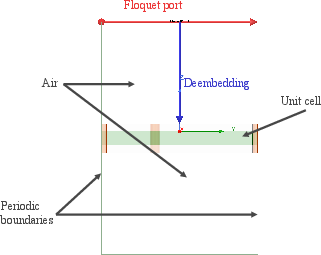
In the study, each RIS unit cell incorporates a PIN diode in the biasing network, which facilitates a binary phase shift control between ON and OFF states (Figure 1).
Figure 1: Setup for the FEM simulation of a unit cell in ANSYS-HFSS.
At operational frequencies like 28 GHz, these unit cells have diminutive physical dimensions and are constrained in terms of phase resolution—the use of 1-bit phase shifters limits each cell to two discrete states, impacting the surface's configurability and reflection quality. Hardware imperfections, such as non-ideal phase differences and specular reflections due to the backplane, degrade intended performance.
Optimization of Phase Distribution
To tackle the constraints posed by 1-bit quantization, the paper introduces a GA-based optimization that adjusts phase shifts across the RIS to align reflections coherently at desired angles. The GA operates by iterating over candidate solutions, selected and refined through a fitness function aimed at maximally constructive interference at the receiver's specific location.
The fitness function targets reducing the phase distribution error:
Performance comparisons demonstrate that continuous-phase configurations achieve optimal reflections, while low-bit quantization degrades them (Figure 2).
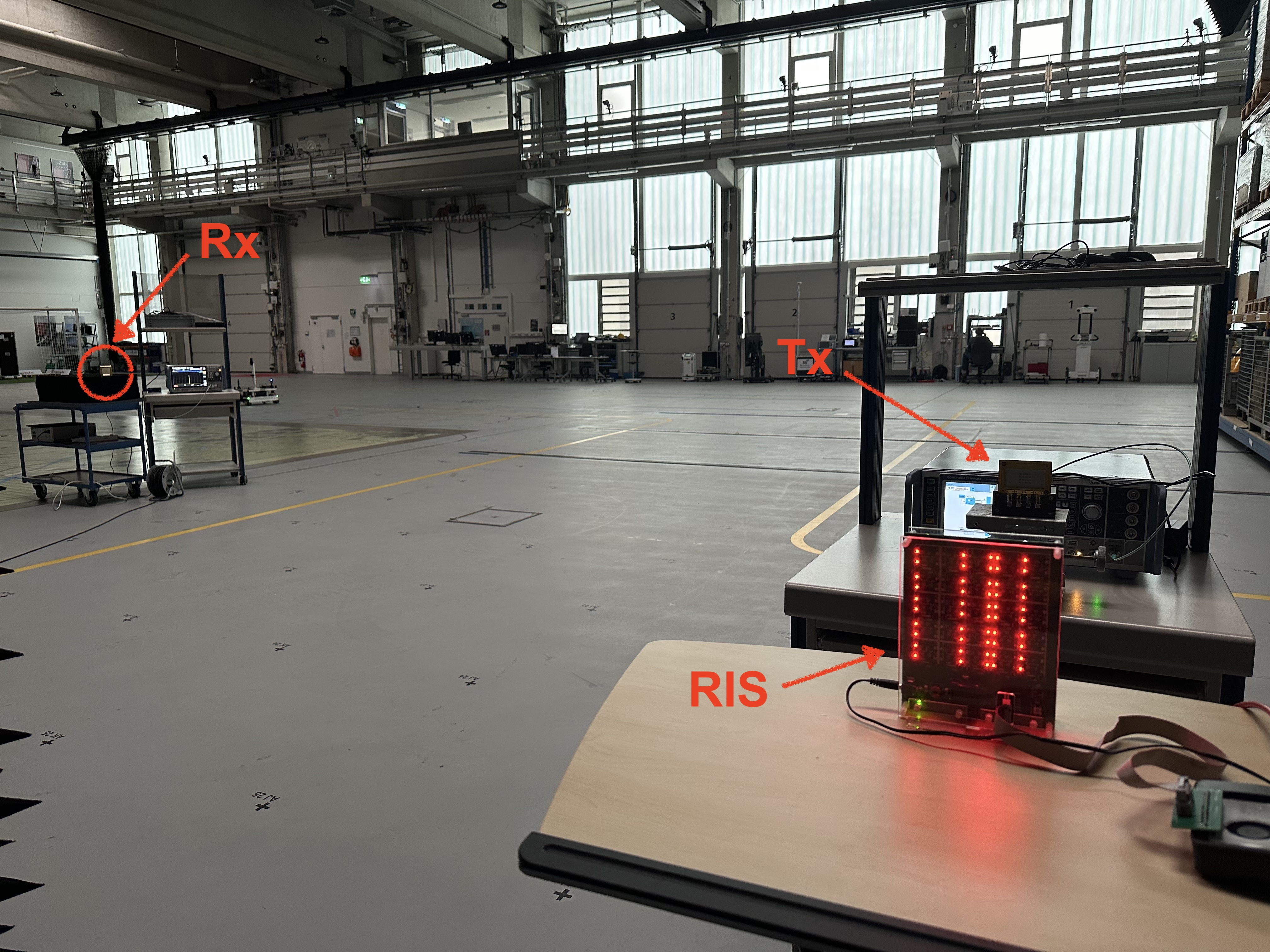
Figure 2: Testbed setup at the LINK Test Center demonstrating the configuration of the transmitter, receiver, and RIS operating at 28 GHz, with the incoming wave impinging normal (0°) on the RIS and its controlled reflection at 60°.
The optimized phase distribution using GA significantly improves reflection gain and minimizes deviation from the desired pattern. This is evident when quantum phase differences straying from the ideal 180 degrees are optimized to closely match the efficiency of continuous phase systems, albeit with inherent limitations in specular reflection control.
Experimental Results
Measurements conducted at Fraunhofer's LINK Test Center verify the proposed method's effectiveness. The GA-optimized phase distribution yields a marked improvement in reflection performance, with a recorded 2.82 dB increase in received power compared to baseline quantized distributions (Figure 2).
These experiments underscore the potential of GA in fine-tuning RIS configurations, significantly compensating for the limitations inherent in low-resolution phase shifting devices. Such advancements affirm the viability of RIS in practical scenarios, especially in mmWave communications.
Conclusion
The investigation reveals substantial benefits from employing optimization methods like GA to overcome phase shift limitations in RIS designs. While hardware constraints pose significant challenges, particularly at high frequencies like 28 GHz, optimized phase distributions pave the way for effective RIS utilization in dynamic and real-world environments.
Future research should explore broader optimization strategies, including adaptive learning techniques, to further increase RIS adaptability and performance. Continued experimentation will be vital for translating these advancements into scalable and deployable wireless communication technologies.
“Emergent Mind helps me see which AI papers have caught fire online.”
Philip
Creator, AI Explained on YouTube
Sign up for free to explore the frontiers of research
Discover trending papers, chat with arXiv, and track the latest research shaping the future of science and technology.Discover trending papers, chat with arXiv, and more.