- The paper presents a 1-bit transmissive RIS design that achieves nearly uniform transmission over a 20% bandwidth at 5.8 GHz with a measured phase difference of approximately 183°.
- The paper validates its approach using CST Microwave Studio simulations and anechoic chamber experiments, confirming precise beamforming at 0°, 10°, and 45°.
- The paper demonstrates practical enhancement in through-wall wireless communication, reporting signal gains of 6 to 8 dBm through advanced PCB prototyping and bias network integration.
Design and Prototyping of Transmissive RIS-Aided Wireless Communication
The paper "Design and Prototyping of Transmissive RIS-Aided Wireless Communication" (2402.05570) presents a novel approach in the domain of Reconfigurable Intelligent Surfaces (RIS) by focusing on transmissive RIS rather than the conventional reflective RIS. This distinction is crucial as transmissive RIS facilitates signal passage through the surface, addressing coverage gaps typically associated with reflective RIS. This paper details the design, prototyping, and experimental validation of a 1-bit transmissive RIS, engineered to enhance wireless communication systems.
Transmissive RIS Design
Unit Cell Architecture
The transmissive RIS unit cell is a composite structure with four copper layers, designed to manage electromagnetic wave dynamics. The elementary configuration is optimized using an antisymmetrical arrangement of two PIN diodes, which allows 1-bit phase tuning. This design choice ensures nearly uniform transmission magnitudes across a broad frequency band with opposed phase states—a critical feature for beam steering.
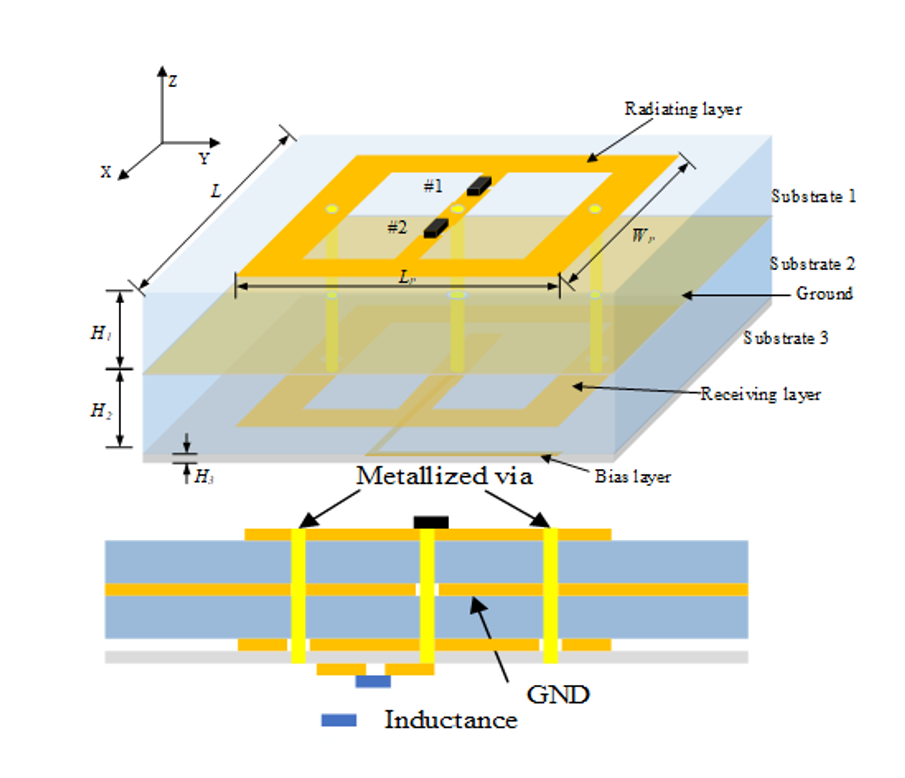
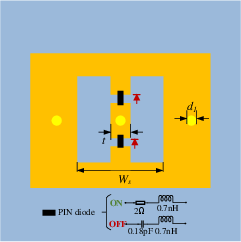

Figure 1: Geometry of the designed metasurface element, including schematic and side view (a), Radiating layer (b), and Receiving layer (c).
Electromagnetic Simulation
Through CST Microwave Studio, electromagnetic simulations verified the effective scattering coefficients of the unit cell. Results showed that the S21 parameter exceeded -3 dB across the frequency range of 5.4 GHz to 6.6 GHz, with minimal insertion loss. The success in achieving a transmission bandwidth of 20% at 5.8 GHz is a noteworthy outcome, indicating the design’s efficiency for high-frequency applications.
Prototype Fabrication and Circuit Design
The prototype comprises a 16x16 array of the designed unit cells, integrated with a bias network and steering-logic control board. This setup ensures dynamic modulation of each unit's phase state via software control. The prototype’s fabrication is achieved through advanced PCB techniques, showcasing feasibility for large-scale deployment.

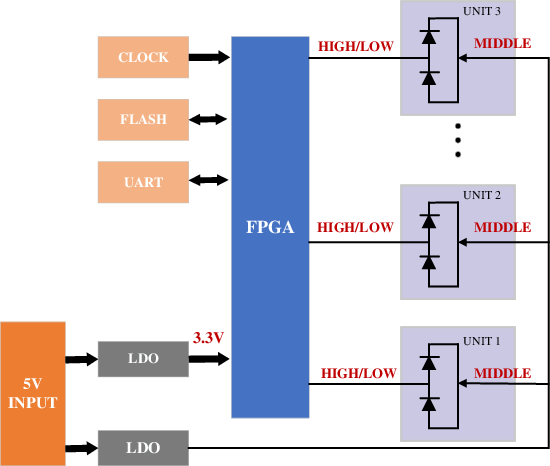
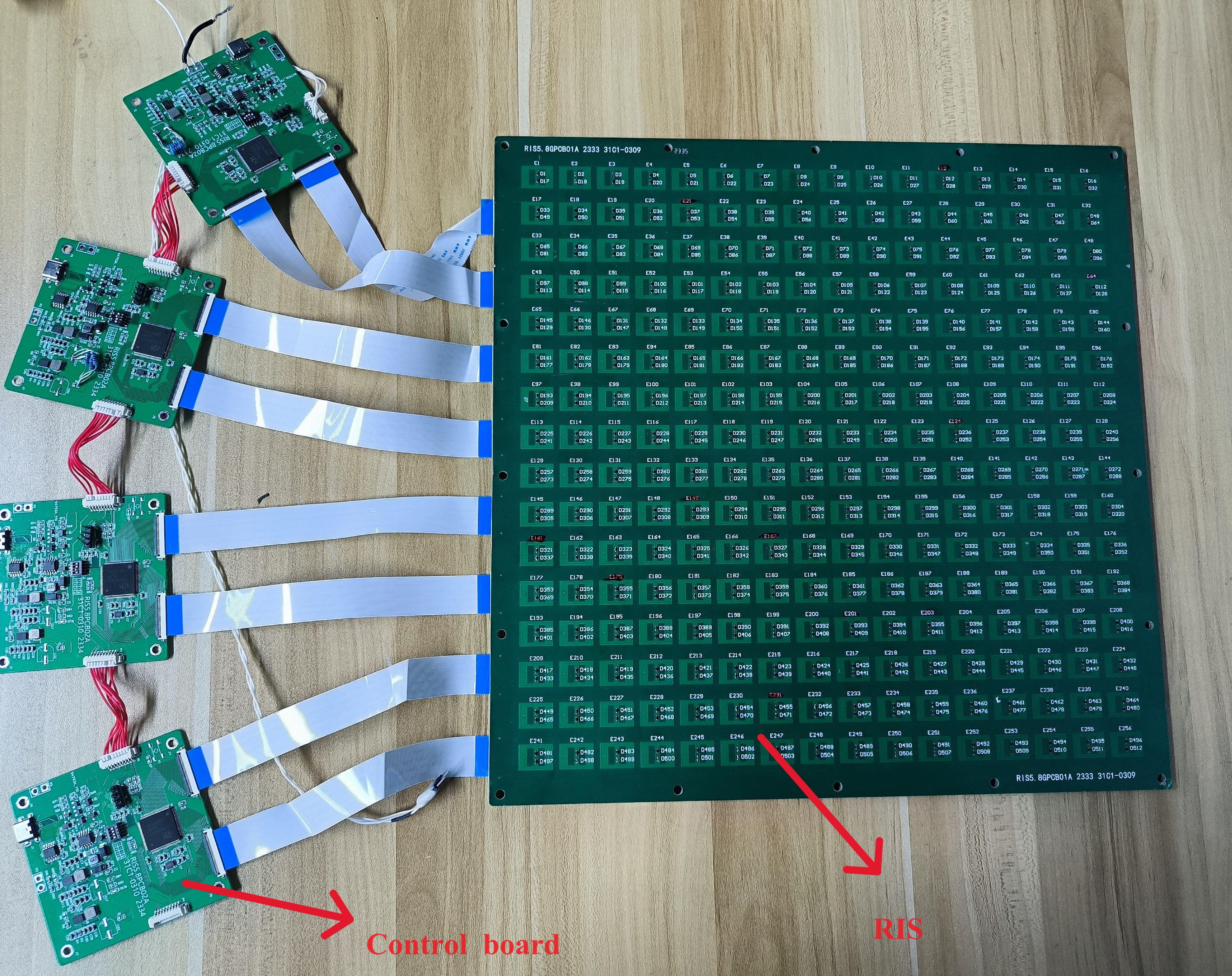
Figure 2: a) The bias layer network layout, b) Schematic diagram of the steering-logic board circuit design, c) Fabricated transmissive RIS prototype.
Experimental Validation
Transmission Coefficient Measurement
Experimental assessment of the transmission coefficients (S21) confirmed the simulated results, highlighting a phase difference of approximately 183∘ around 5.8 GHz. This demonstrates reliability in real-world conditions, essential for practical implementations in communication systems.
(Figure 3 and Figure 4)
Figure 3: S21 test environment.
Figure 4: Measured S21 of RIS for both states.
Beamforming, assessed through experiments in a microwave anechoic chamber, demonstrated precise beam steering at angles 0∘, 10∘, and 45∘. These results align with theoretical predictions, confirming the potential for precise adaptive beamforming in dynamic environments.
(Figure 5 and Figure 6)
Figure 5: The measurement setup in the microwave anechoic chamber.
Figure 6: Measured radiation patterns of scanned beams at 5.8 GHz.
Through-Wall Communication Enhancement
The implementation of the prototype in a real-world environment revealed its efficacy in enhancing signal strength through obstacles. Specifically, gains of 6 to 8 dBm were observed when the RIS was employed in scenarios involving transmission through concrete walls, underscoring its potential as a solution in challenging communication scenarios.
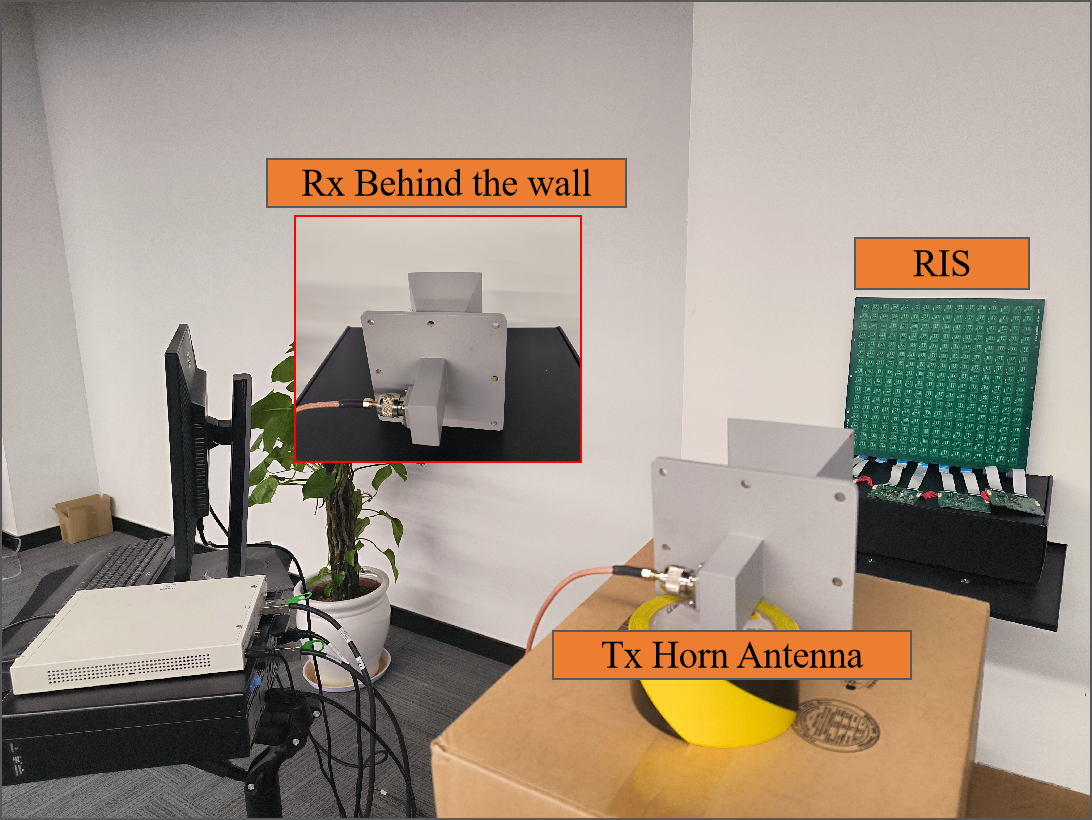
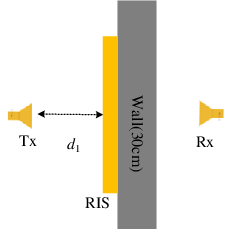
Figure 7: Transmissive RIS-aided wireless communication prototype, a) Experimental scene, b) Schematic diagram.
Conclusion
The investigation into transmissive RIS technology as presented is pivotal for next-generation wireless communication systems. The demonstrated ability of the RIS to provide reliable phase tuning and beamforming capabilities promises significant improvements in network coverage and capacity. Future research could focus on enhancing the versatility of transmissive RIS in various propagation scenarios and integrating it with existing communication infrastructures for optimized performance. The authors' work sets a solid foundation for advancing transmissive RIS technology in practical applications.