Active Reconfigurable Intelligent Surface for the Millimeter-Wave Frequency Band: Design and Measurement Results
Published 7 Jun 2023 in eess.SY, cs.SY, and eess.SP | (2306.04515v4)
Abstract: Reconfigurable intelligent surfaces (RISs) will play a key role to establish reliable low-latency millimeter wave (mmWave) communication links for indoor automation and control applications. In case of a blocked line-of-sight between the base station (BS) and the user equipment (UE), a RIS mounted on a wall or on a ceiling enables a bypass for the radio communication link. In this work, we present an active RIS for the mmWave frequency band. Each RIS element uses a field effect transistor (FET) to amplify the reflected signal and an orthogonal polarization transformation to increase the isolation between impinging and reflected radio wave. By switching the bias voltage at gate and drain of the FET we can establish four states for each RIS element: two reflection states with different phase shifts, an active amplification and an off state. We present results of the active RIS with 37 patch antenna elements arranged in a hexagonal grid for a center frequency of 25.8 GHz. The RIS field patterns obtained by numerical simulations and by empirical measurements in an anechoic chamber are compared. They show a good match and the received power is improved by 12 dB in the active mode of the RIS compared to the reflective mode.
The paper introduces an active RIS design for indoor mmWave communications at 25.8 GHz, demonstrating a 12 dB power gain over passive configurations.
It employs FET-based amplification and orthogonal polarization to enhance signal isolation and reduce the number of required RIS elements.
Numerical simulations and chamber measurements validate an extended path loss model, supporting the integration of active RIS in future 6G systems.
Active Reconfigurable Intelligent Surface for the Millimeter-Wave Frequency Band: Design and Measurement Results
Introduction
The paper discusses an active Reconfigurable Intelligent Surface (RIS) designed for the millimeter-wave (mmWave) frequency band. RIS technology is intended to enhance the adaptability of the radio communication environment by intelligent reflection and focusing of signals to optimize communication links. The focus of this paper is an indoor automation and control scenario where high-reliability and low-latency communication are critical.
Active RIS Design
The authors introduce an active RIS for indoor environments operating at 25.8 GHz, consisting of 37 patch antenna elements arranged in a hexagonal grid. Each RIS element employs a Field Effect Transistor (FET) to amplify the reflected signal and utilizes orthogonal polarization to improve isolation between the impinging and reflected waves. This design differs from passive RIS configurations by providing active signal amplification and phase control, thus enhancing signal-to-noise ratio (SNR) or reducing the number of necessary RIS elements for equivalent SNR performance.
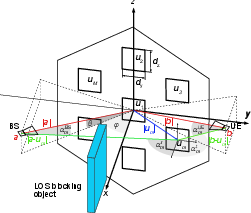
Figure 1: RIS coordinate system for a hexagonal RIS element placement in the yz-plane. The BS horn antenna radiates from position a.
Path Loss Model
A path loss model is developed and extended from existing models for passive RIS to accommodate the active RIS configuration. This is crucial for predicting received power at the User Equipment (UE) by taking into account the complex reflection coefficients of each RIS element, which are pivotal in optimizing the RIS setup to maximize efficient signal transmission.
Measurement and Evaluation
The paper details empirical measurements conducted in an anechoic chamber, comparing these with numerical simulations. The anechoic chamber measurements reveal that in active mode, the RIS provides a 12 dB improvement in received power over reflective mode.
This significant increase illustrates the practical advantage of using an active RIS in enhancing communication link quality in a blocked Line-Of-Sight (LoS) scenario.
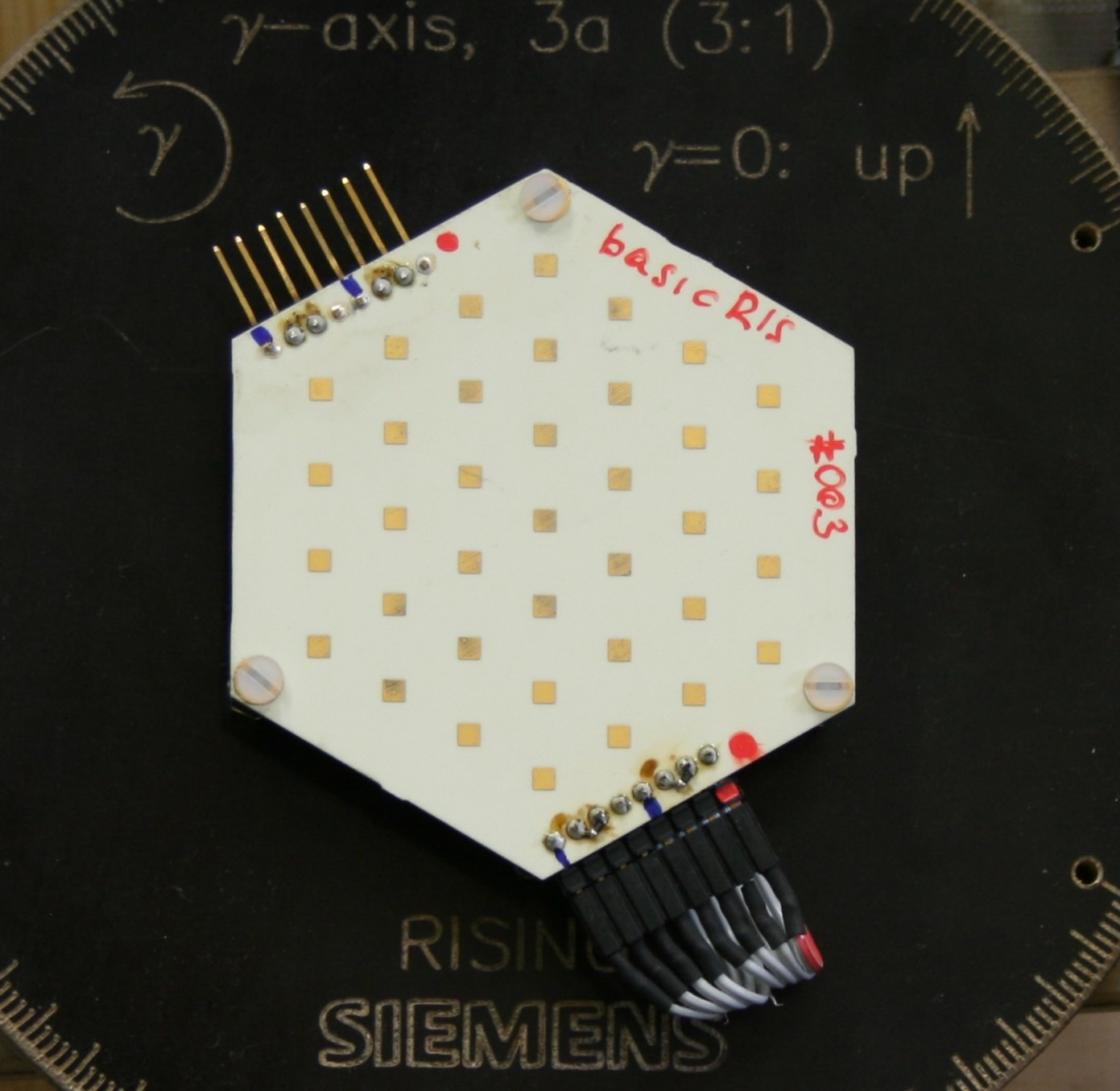
Figure 2: RIS PCB installed in the measurement setup.
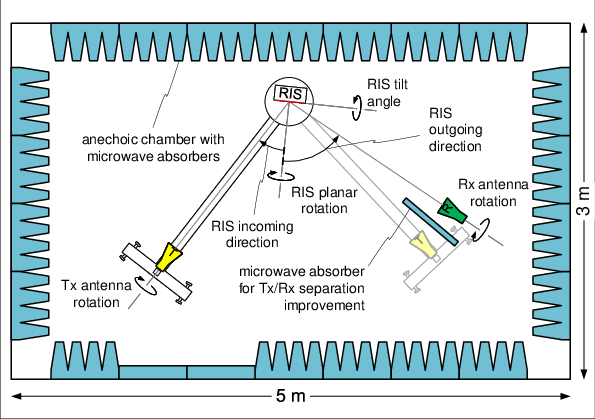
Figure 3: Measurement setup in anechoic chamber. The transmitter (TX) can be moved in azimuth and the receiver (RX) is fixed. Both can be rotated by 90∘.
Numerical and Empirical Analysis
Numerical simulations and empirical results closely align, suggesting the robustness of the path loss model and the practical effectiveness of the active RIS design. The use of a Monte Carlo search algorithm to optimize RIS element configurations minimized power loss impact from quantization errors in phase shifts.
Conclusions
The research conclusively shows that active RIS can effectively improve signal quality in non-line-of-sight situations typical in indoor automation environments at mmWave frequencies. The 12 dB power gain in active mode supports its potential as a component in future 6G systems. The study presents notable advancements in RIS technology and suggests further exploration in the integration of active elements for broader practical applications.
“Emergent Mind helps me see which AI papers have caught fire online.”
Philip
Creator, AI Explained on YouTube
Sign up for free to explore the frontiers of research
Discover trending papers, chat with arXiv, and track the latest research shaping the future of science and technology.Discover trending papers, chat with arXiv, and more.