- The paper introduces a comprehensive methodology that separates domain modeling into abstract and concrete levels for effective CBR deployment.
- It leverages similarity functions and evaluation metrics to accurately retrieve and adapt past case solutions in real-time applications.
- The methodology is exemplified through bandwidth management using BAM models, demonstrating its potential for optimizing network performance.
A Methodological Approach to Model CBR-based Systems
Introduction
This paper introduces a comprehensive methodology for modeling Case-based Reasoning (CBR) systems. CBR is an AI technique that leverages past experiences stored as cases to solve new problems by adapting previously successful solutions. The main contribution is to outline a methodological approach separating the problem modeling into abstract and concrete levels, thereby facilitating deployment across diverse domains, notably where computer science expertise is minimal.
Case-Based Reasoning (CBR) Fundamentals
CBR systems solve problems by retrieving and adapting solutions from a database of prior cases. These cases comprise problems and associated solutions, forming the basis for similarity comparisons using a defined function. The process includes four stages: Retrieve, Reuse, Revise, and Retain. Each step is crucial in adapting old solutions to new problems, validating them, and continuously updating the case database.
Abstract Model
The Abstract Model (AM) serves as a high-level representation of the domain knowledge. It involves defining the technological domain, including objectives, system attributes, and management actions. The abstract model requires domain expertise for setting knowledge frameworks that describe static, contextual, and dynamic attributes of the problem domain. Key components include:
- Technological Domain: Captures the system's scope and objectives.
- Attributes Classification: Differentiates between static, contextual, and dynamic attributes.
- Measurements and Tolerances: Defines objective assessment metrics and acceptable limits.
- Actions: Specifies operations needed to address problem scenarios within the model.
Concrete Model
The Concrete Model (CM) is a detailed representation for CBR system implementation, derived from the Abstract Model. It encapsulates the specific parameters and operational elements:
- Case Description: Maps attributes, measurements, and solutions from AM to form usable cases for the CBR system.
- Similarity Function: Employs weighted measures for evaluating case similarity, critical for retrieving relevant cases.
- Evaluation Function: Optionally assists in real-time system evaluation, indicating performance against predefined tolerances.
Methodology Application: Cognitive Management of Bandwidth
The proposed methodology was exemplified through the BAMCBR application which manages bandwidth in MPLS networks via adaptive BAM models. By defining abstract and concrete models, the system can dynamically switch between bandwidth allocation strategies (e.g., MAM, RDM, ATCS) based on real-time performance metrics.
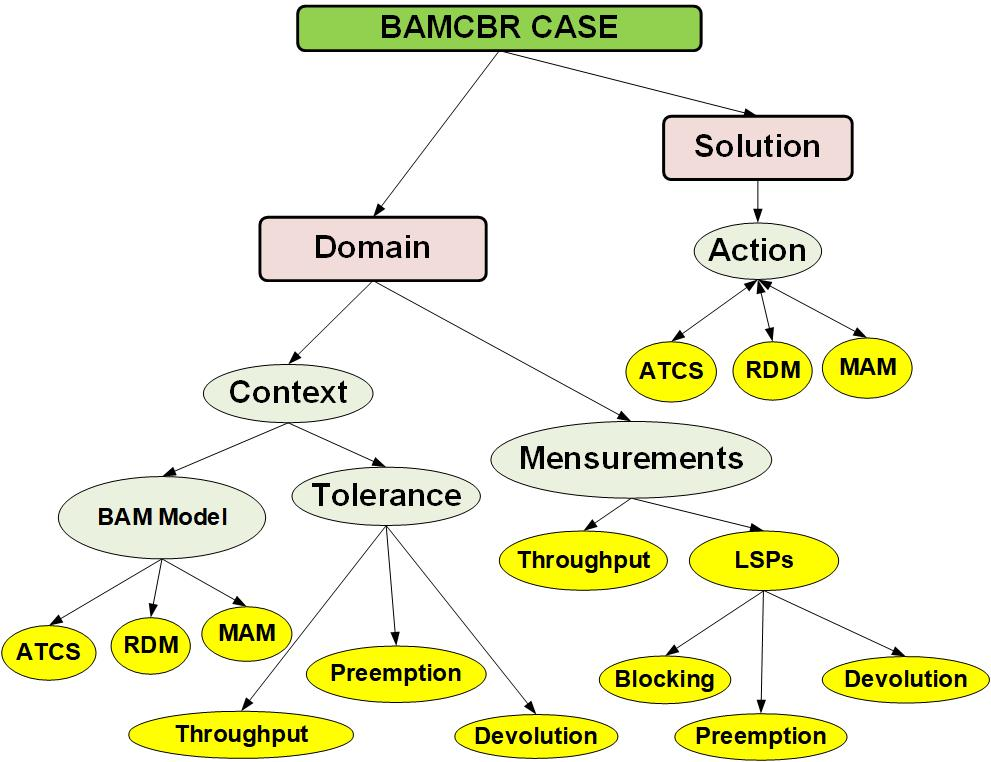
Figure 1: Caso BAMCBR.
In this use case, the Abstract Model defined networking objectives like minimizing preemption and optimizing throughput. The Concrete Model then mapped these objectives into operational parameters for CBR processing, utilizing similarity functions and management actions tailored to the network state.
Final Considerations
This paper advances CBR system deployment by clearly delineating the modeling process into an expert-driven Abstract Model and a more technical Concrete Model. Such a distinction empowers domain experts to define relevant knowledge frameworks while allowing CBR specialists to effectively operationalize these models. The methodology promises expanded and more efficient CBR applications across domains lacking in-depth AI expertise.

