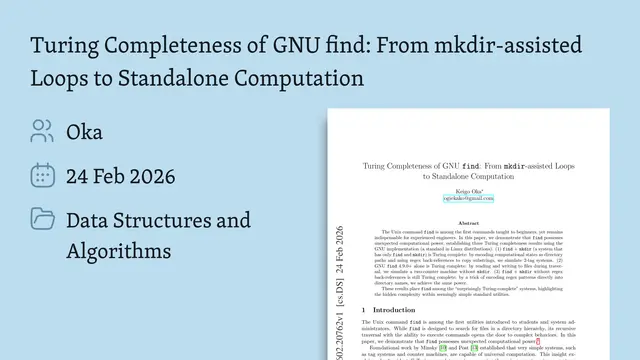
Turing Completeness of GNU find: When a File-Search Tool Becomes a Computer
This presentation reveals a surprising theoretical result: GNU find, the everyday Unix utility designed for searching files, is Turing complete. The paper provides a rigorous proof that find can perform arbitrary computation using only filesystem operations—no external programs required. Starting from constructions that use helper tools like mkdir and progressing to standalone implementations, the work demonstrates how loops, branching, and even full Turing machine simulations can be encoded through file creation, removal, and find's logical operators. This result has implications for security, the theoretical boundaries of Unix utilities, and our understanding of what constitutes a programming language.Script
A tool you use every day to search for files can, in theory, run any computation a modern computer can. GNU find, hidden in plain sight on every Unix system, is Turing complete.
The authors prove that find can emulate any computation by encoding state in files and directories, using its logical operators for control flow, and leveraging filesystem side effects for synchronization. What was previously informal intuition is now a formal theorem.
How do you turn a search tool into a computer?
State lives in the filesystem itself. A file existing or missing represents a bit. Nested directories simulate tape cells. The head moves by renaming files, and branching happens through find's logical combinators, chaining effects across traversals.
Loops emerge from directory creation acting as signals. Later, the authors eliminate the need for mkdir entirely, constructing loops using only find's own logic to propagate state and iterate, proving the tool self-sufficient for computation.
What does it mean when a file-search utility is as powerful as any programming language?
Theoretically, this places find alongside esoteric languages as a model of universal computation. Practically, it's a reminder that minimal privileges plus filesystem access can yield unexpected power, with real implications for sandboxing and security policies.
The proof is meticulous: starting from helper-assisted loops, advancing to self-contained mechanisms, and culminating in a complete simulation. Every transition step, every branching condition, mapped directly to filesystem operations and find expressions.
This work invites us to view command-line utilities not just as helpers, but as computational substrates. The techniques could extend to other tools, mapping out the computational landscape of the Unix toolchain and its hidden capabilities.
A file-search command, a Turing machine in disguise—proof that power hides in the simplest places. Visit EmergentMind.com to explore more surprising results at the intersection of systems and theory.