Lumo-2: Teaching Robots to Predict the Physics of Action
This presentation explores Lumo-2, a breakthrough robotic learning system that reasons about future world dynamics in latent space. By encoding physical transitions between visual observations, Lumo-2 aligns vision, language, and action in a semantically meaningful way. The system demonstrates superior performance on challenging real-world tasks requiring temporal reasoning, physical understanding, and precise control, establishing a new paradigm for scalable, predictive robot intelligence.Script
When a robot pours water into a transparent glass, a single snapshot tells you almost nothing about what the robot should do next. The glass looks the same whether it's empty or full, whether pouring just started or just finished. Lumo-2 solves this by learning to predict how the physical world will change, encoding those future dynamics as a latent task that guides every action.
The authors co-train Lumo-2 on three fundamentally different data sources: vision-language datasets, in-the-wild human videos, and diverse robot manipulation demonstrations. This cross-modal training creates a latent dynamics space where the physics of pouring water by a human hand shares the same representation as a robot arm performing the same task, despite completely different embodiments and camera angles.
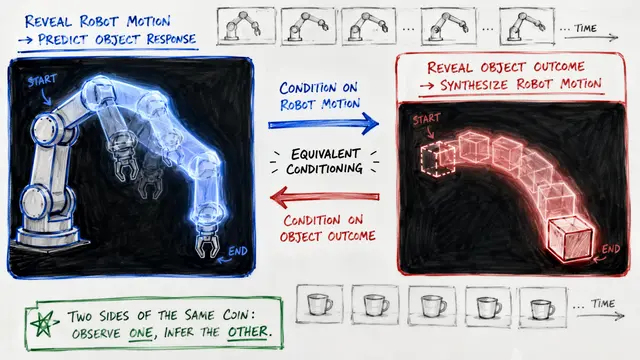
The core innovation is pre-aligning actions with latent world dynamics. An inverse dynamics model encodes the visual transition between frames, suppressing irrelevant factors like lighting changes while preserving only the physics: what moved, what changed, what matters. The action encoder then learns to reconstruct robot commands from this physically grounded latent space, forcing actions to respect the structure of real-world cause and effect.
Visualizations reveal that Lumo-2's latent dynamics tokens cluster by action semantics, not by robot type or scene appearance. Lifting actions group together whether performed by a humanoid robot, an industrial arm, or a human hand in an ego-centric video. The model has learned a compact, embodiment-agnostic representation of physical intent that predicts future state changes in the exact regions where manipulation will occur.
Across 22 real-world manipulation tasks spanning six categories, Lumo-2 consistently outperforms the state-of-the-art baseline. The gains are especially dramatic in tasks requiring temporal reasoning, like remembering object locations across occlusions, and physical understanding, like predicting the stability of stacked objects. The system even transfers human manipulation data to robot control without specialized transfer mechanisms, achieving significant improvements on objects the robot has never seen.
Lumo-2 establishes that predictive reasoning about world dynamics, not just reactive control, is the foundation for scalable robot intelligence. By structuring latent space around physics rather than pixels, the system bridges the gap between human intuition and robot execution. Explore how prediction shapes the future of embodied AI at emergentmind.com, where you can dive deeper into this research and create your own video summaries.