SuperMimic: One GPU Replaces a Cluster for Humanoid Control
SuperMimic trains a humanoid whole-body controller to track over 129,000 motions using a learned differentiable world model, reaching state-of-the-art performance in three hours on one GPU instead of the 168 hours on 128 GPUs reported for the baseline SONIC system. By amortizing shared dynamics across all motions and backpropagating through imagined rollouts, the method eliminates compute as the dominant bottleneck for scaling humanoid control, achieving zero failed motions and transferring successfully to physical hardware for flips, rolls, and locomotion.Script
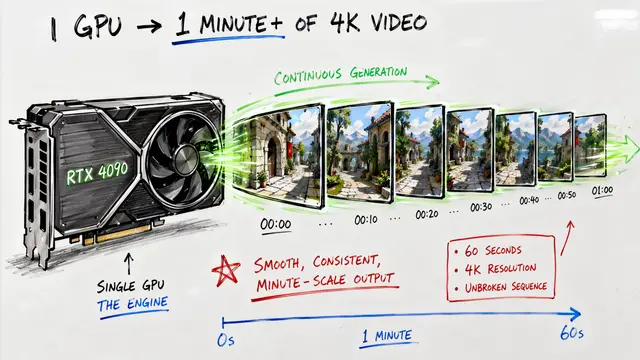
The fastest way to teach a humanoid robot 129,000 whole-body motions used to require a cluster of 128 GPUs running for a week. SuperMimic does it in three hours on one GPU by learning the physics once and reusing it everywhere.
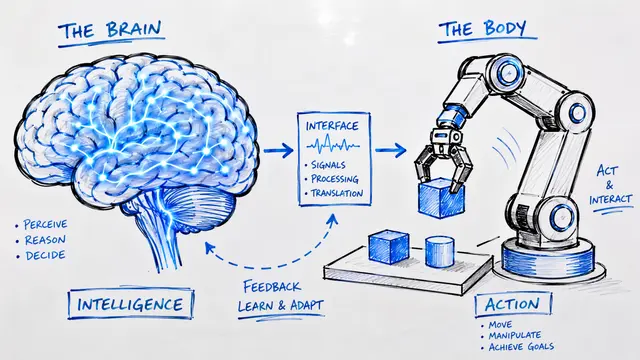
The key insight is that every motion, from walking to flipping, obeys the same underlying physics. The authors train a neural world model on simulator transitions, then optimize the tracking policy by backpropagating through short imagined rollouts instead of repeatedly querying the simulator.
On 129,000 filtered motions, SuperMimic exceeds the released SONIC checkpoint after three hours, using more than 1,000 times fewer GPU hours. After 9.8 hours on two GPUs, it reaches zero failed motions, whereas SONIC failed on 179 clips including all flips and side rolls.
As the motion library grows from 1 hour to 264 hours, the world model's prediction error stays flat because all motions share the same robot and the same flat-ground dynamics. This is amortization: the model learns the physics once and reuses that capacity across the entire library.
The critic is not optional. When trained without bootstrapping, the policy stumbles under even gentle pushes because it cannot see consequences beyond the 32-step imagination horizon. With the critic, it stabilizes under 4 meter per second perturbations in under 2.5 seconds.
SuperMimic transfers to physical hardware without per-motion tuning, executing flips, rolls, and skipping jumps on a real G1. By replacing cluster-scale simulation with one shared differentiable model, it shows that the bottleneck for scaling humanoid control is no longer compute. Visit EmergentMind.com to explore the full paper and create your own research video.