When Fireballs Don't Cooperate: A Statistical Null Result Story
This presentation examines a rigorous statistical analysis of meteor fireball reports submitted to the American Meteor Society in early 2026. Using Poisson regression and modern statistical methods rarely applied in meteor astronomy, the researchers systematically tested claims of unusual activity—a purported surge in large fireballs, radiant clustering, and seasonal anomalies—and found no evidence to support them. The talk reveals how careful methodology, transparent reporting, and appropriate correction for multiple comparisons can transform sensational claims into instructive null results, while demonstrating best practices for analyzing citizen science datasets in observational astronomy.Script
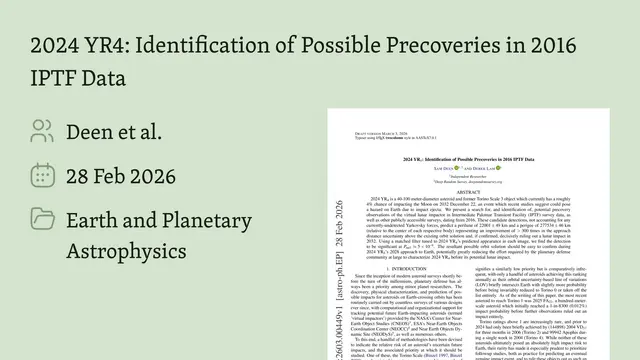
In early 2026, reports flooded social media claiming an unprecedented surge in brilliant fireballs streaking across the sky. The American Meteor Society's database seemed to confirm it, but when researchers applied rigorous statistical methods, they found something equally compelling: absolutely nothing unusual was happening.
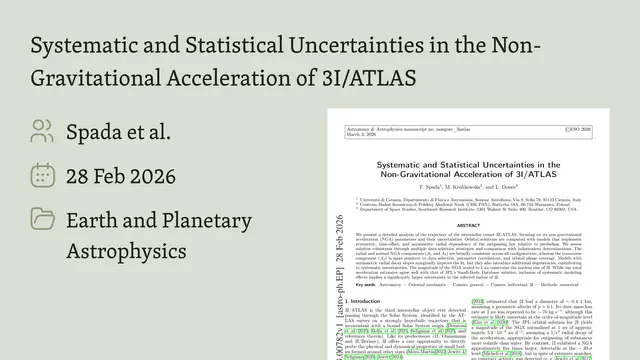
The central claim was a dramatic increase in first-quarter fireballs during 2026. Using Poisson regression to model event counts over 15 years, the authors found that 2026 sat exactly where the linear trend predicted, with residual deviance matching degrees of freedom and no evidence of overdispersion.
Month-by-month analysis revealed natural seasonal variation: November shows peak fireball activity, May hits the minimum. But February and March 2026, the focus of speculation about anomalous surges, were statistically indistinguishable from their multi-year baselines.
Claims of unusual radiant clustering were tested using sun-centered ecliptic coordinates and two-dimensional Kolmogorov-Smirnov tests. The 2026 radiant distribution matched previous years with no statistically significant spatial deviations, though the analysis also exposed substantial inherent uncertainty in reported radiant positions.
The study tested multiple specific assertions, including elevated rates of delayed auditory phenomena and changes in event strength, applying Bonferroni correction to control for inflated error rates across simultaneous tests. Every hypothesis returned a null result, but the methodological rigor itself became the finding.
This comprehensive null result demonstrates that rigorous statistical methods, transparent workflows, and proper uncertainty quantification can turn sensational claims into instructive lessons about natural variability and reporting bias. To explore more research that challenges assumptions with data, visit EmergentMind.com and create your own video summaries.