stable-envs-v1: GPU-Native Simulation for World Models
This presentation examines stable-envs-v1, a system architecture that accelerates pixel-based world-model training by moving simulation and rendering entirely onto the GPU. By storing lightweight simulator states instead of rendered images and generating observations on demand, the system achieves up to 24x rendering speedups while maintaining reproducibility and enabling controlled visual variation across 80 environments.Script
Training a visual world model on a medium-scale dataset often means managing hundreds of gigabytes of image data, decoding frames on the CPU, and transferring them to the GPU. The learning algorithm waits while the data pipeline struggles to keep up.
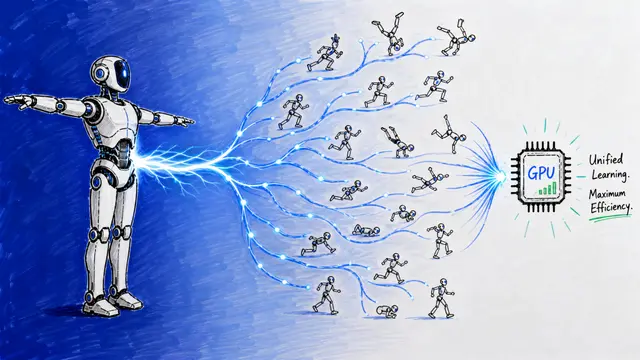
stable-envs flips this model by storing only the simulator state, a compact representation of physics and randomness. Observations are rendered on demand during training, and because state and appearance are decoupled, you can change colors or lighting without touching the underlying dynamics.
The system supports 80 environments across 11 families, from classic control to navigation and manipulation. Depending on the environment and device, it routes execution through vectorized CPU code or batched GPU kernels, while static scene components are rendered once and reused across frames.
Rendering speedups reach 24 times faster for TwoRoom and 19 times for Reacher. Combined stepping and rendering improves by up to 14 times, with the largest gains appearing at higher batch sizes where GPU parallelism pays off.
When integrated into world-model training, stable-envs delivers end-to-end speedups between 1.16 and 1.33 times. GPU utilization climbs by as much as 14 percentage points in Reacher, meaning the accelerator spends less time waiting for data and more time learning.
By decoupling state from appearance and guaranteeing reproducible trajectories, stable-envs turns visual factors into experimental controls rather than fixed dataset properties. To explore more systems work accelerating embodied AI research and create your own video summaries, visit EmergentMind.com.