Solv3R: Turning Multi-View Reconstruction Into a Geometric Solver
This presentation explains how Solv3R reframes learned multi-view 3D reconstruction as an iterative geometric solving problem rather than a fixed-depth prediction task. By using a stationary transformer that can refine reconstructions indefinitely, correct errors, and seamlessly incorporate new views, Solv3R achieves solver-like properties while maintaining competitive accuracy with a compact 117M-parameter model.Script
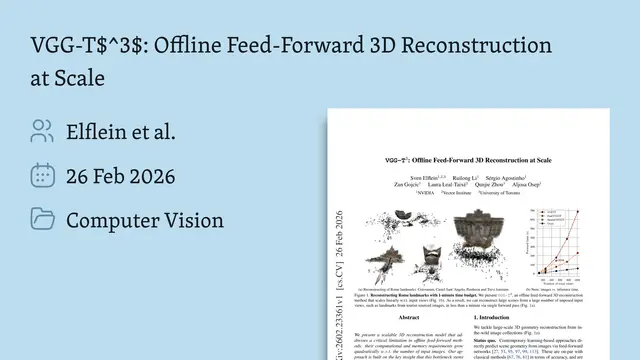
Most multi-view reconstruction models are like assembly lines: images flow through a fixed sequence of layers, and once you reach the end, you are done. Solv3R takes a radically different approach by treating reconstruction as an ongoing geometric solve, using the same update operator over and over until the solution stabilizes.
The key architectural insight is deceptively simple. Solv3R injects the original image features at every refinement call while rescaling the entire latent state to prevent drift, and it removes all timestep conditioning so the same operator works whether this is the first call or the hundredth.
When you run the same operator beyond its training horizon, something remarkable happens. Solv3R maintains sub-degree camera accuracy out to 64 calls, while the baseline model degrades catastrophically after its prescribed 16-step schedule ends, with errors climbing past 5 degrees.
Solv3R can insert new views into an already-solved reconstruction and jointly refine everything together. When twelve views are added to a four-view map, the original camera estimates often improve as the new observations provide additional constraints, demonstrating true revision rather than just appending.
This solver design unlocks bounded-memory streaming reconstruction without any streaming-specific training. Solv3R processes 2,000-frame sequences in 5 gigabytes while conventional methods exceed 80 gigabytes after just a few hundred frames, and it selectively reactivates frozen states when new evidence signals inconsistency.
The method has a sharp failure mode: when view groups share minimal overlap, Solv3R can lock into an incorrect spatial arrangement and stabilize there with low state updates, showing that convergence does not always guarantee correctness. To dive deeper into how learned solvers can reshape 3D reconstruction workflows, visit EmergentMind.com to explore the full paper and create your own video summaries.