Many Retrocausal Worlds: A Foundation for Quantum Probability
This presentation explores Michael Ridley's innovative approach to resolving the probability problem in quantum mechanics' many worlds interpretation. By introducing the Fixed Point Formulation—a time-symmetric framework—the paper demonstrates how quantum probabilities can emerge from the structure of the wavefunction itself, without resorting to conventional probabilistic postulates. The talk examines how retrocausality and self-locating uncertainty provide a coherent foundation for understanding quantum probability as a measure of existence across branching histories.Script
In the many worlds interpretation of quantum mechanics, every possible outcome happens with certainty. So where do probabilities come from? This paradox has haunted quantum foundations for decades, creating what philosophers call the incoherence problem: if all branches are equally real, why should you expect to find yourself on one rather than another?
The tension runs deep. Quantum mechanics combines deterministic unitary evolution with a probabilistic measurement postulate that seems to contradict it. The many worlds interpretation eliminates collapse, making everything deterministic, but then probabilities appear to have no foundation. The challenge is to ground probabilities in the physical structure of reality itself.
Ridley proposes a radical solution: make quantum mechanics fundamentally time-symmetric.
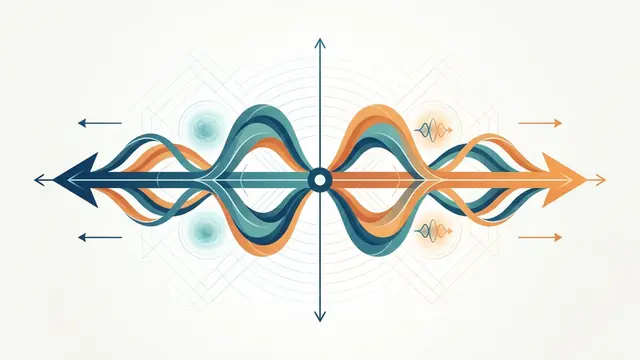
The Fixed Point Formulation reimagines quantum evolution along a Keldysh time contour, where the wavefunction propagates both forward and backward in time between fixed events. These fixed points act as boundary conditions, constraining past and future symmetrically. Within this framework, probabilities aren't added as an extra postulate—they arise naturally from how much of the wavefunction passes through each branch.
This diagram reveals the heart of the framework: time forms a contour rather than a single arrow. The wavefunction evolves forward from an initial time to a final time, then backward again, creating a closed loop. Fixed points where measurements occur act as constraints that the wavefunction must satisfy on both passes. This structure naturally encodes retrocausal influences—future boundary conditions affect past evolution—without violating causality, because the entire history is determined self-consistently as a solution to the constraint equations.
Here's the conceptual breakthrough: probabilities in many worlds reflect self-locating uncertainty, not stochastic outcomes. When the wavefunction branches, you exist in all branches, but you don't know which one you'll perceive yourself to be in. Ridley shows that rational degrees of belief should be proportional to the squared amplitude of each branch—the Born rule—because that's the measure of your existence in that branch. Probability transforms from an external postulate into a geometric property of the wavefunction itself.
By making time symmetric and treating probabilities as measures of existence rather than chances, the Fixed Point Formulation dissolves the paradox at the heart of many worlds. Visit EmergentMind.com to explore more cutting-edge research and create your own video presentations.