Reinforced Attention Learning: Direct Optimization of Attention Distributions in Multimodal LLMs
This presentation explores a paradigm shift in training multimodal large language models. While traditional reinforcement learning optimizes what models generate, Reinforced Attention Learning (RAL) optimizes where models focus their attention across visual and textual inputs. By treating attention patterns as a policy space and applying advantage-weighted divergence objectives, RAL achieves substantial improvements on vision-centric reasoning tasks, especially as image resolution and video complexity increase. The framework demonstrates that internal attention structures are first-class optimization targets for robust multimodal alignment.Script
What if the key to better multimodal reasoning isn't just teaching models what to say, but where to look? Traditional reinforcement learning for language models optimizes token generation, yet this approach shows limited gains when models must ground responses in complex visual contexts.
Building on that observation, let's examine why conventional methods fall short.
Extending this further, the mismatch becomes clear when we consider perception-centric tasks. Models must isolate relevant visual details across high-dimensional inputs, but token-centric reinforcement provides no direct signal for improving this selective focusing ability.
This brings us to the innovative approach that addresses this fundamental gap.
Diving into the mechanism, the authors formalize attention distributions as a reinforcement learning policy. They aggregate causal attention weights from the final transformer layer, creating a discrete probability distribution that quantifies where the model focuses for each generated token.
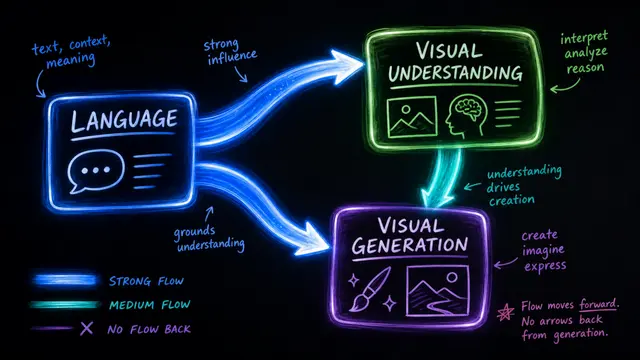
This visual captures the conceptual shift at the heart of the framework. Rather than solely optimizing the output space of what tokens to generate, the approach directly targets the internal attention allocation mechanisms. The policy now operates over where the model directs its computational resources across both textual context and encoded visual data, creating a more principled pathway to multimodal grounding.
Contrasting these approaches reveals the architectural leverage point. The composite loss function sums traditional next-token maximization with attention policy divergence, modulated by a hyperparameter. This preserves linguistic fluency while explicitly reinforcing the structural reasoning patterns that multimodal tasks demand.
Now let's examine how this translates into measurable performance gains.
The empirical validation is comprehensive, spanning image question answering and video understanding benchmarks. Notably, ablation studies confirm these gains persist even without explicit rationalization processes, establishing attention policies as a fundamental optimization space independent of specific prompting strategies.
This scaling behavior is particularly revealing. As multimodal contexts become denser with more frames or higher resolution images, the performance gap between RAL and traditional methods widens consistently. The framework demonstrates robust information selection precisely when the perceptual grounding challenge intensifies, validating that attention-centric optimization addresses a core bottleneck in multimodal reasoning.
Reinforced Attention Learning repositions internal model structures as mature targets for alignment, moving us from optimizing answers to optimizing understanding itself. To explore the full technical details and implications, visit EmergentMind.com.