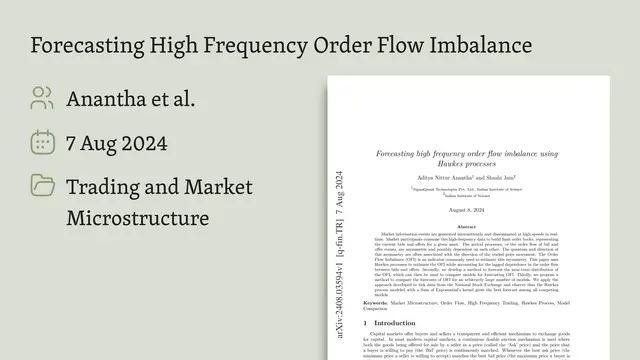
Order Flow Imbalance Prediction
This presentation explores how order flow imbalance—the net difference between supply and demand in limit order books—serves as a critical microstructural signal for forecasting short-term price movements. We examine the mathematical formalism of OFI across multiple depth levels, empirical price impact laws, state-of-the-art predictive models ranging from regularized linear regressions to Hawkes point processes and regime-switching frameworks, and practical integration into algorithmic trading systems for market-making and optimal execution.Script
Every microsecond, thousands of buy and sell orders collide in the limit order book, creating invisible pressure waves that telegraph the next price move. The challenge is reading these signals before the market does.
Let's start by defining what order flow imbalance actually measures.
Building on that foundation, order flow imbalance captures the real-time tug-of-war between buyers and sellers. It's computed by tracking how bid and ask queue sizes change with every order book event, giving us a direct measure of directional pressure before prices actually move.
Extending this idea, we can look beyond just the top of the book. Multi-level OFI aggregates imbalance signals across deeper price levels, revealing hidden liquidity that top-of-book metrics miss entirely, with dramatic improvements in prediction accuracy especially for less liquid instruments.
Now let's examine how we turn these signals into forecasts.
Starting with linear models, empirical studies confirm that short-term price changes are strongly predicted by contemporaneous order flow imbalance. The relationship is surprisingly stable across assets, with the impact coefficient inversely scaling with market depth, and ridge regularization preventing overfitting when using deep-book features.
Moving beyond linear assumptions, point process models like Hawkes processes explicitly model the self-reinforcing nature of order flow, where trades trigger more trades. In parallel, regime-switching models use Bayesian online detection to identify when market dynamics shift, adapting predictions in real time as large hidden orders execute across minutes or hours.
Complementing these approaches, hybrid models marry traditional vector autoregressions with feedforward neural networks that learn nonlinear residual patterns. The combination delivers dramatic error reductions when order flow exhibits sudden bursts or regime transitions, though careful regularization remains essential to maintain performance across market conditions.
Let's see how these predictions translate into real trading systems.
In production environments, order flow imbalance predictions feed directly into algorithmic decision engines. Market makers adjust quote placement in real time based on multi-level OFI signals, execution algorithms modulate trading speed when regime shifts are detected, and risk systems use forecast distributions to anticipate microstructural volatility spikes before they materialize in prices.
Order flow imbalance prediction transforms invisible microstructural pressures into actionable trading signals, bridging the gap between raw order book data and profitable algorithmic strategies. Visit EmergentMind.com to explore the latest research and deepen your understanding of market microstructure.