Forecasting High Frequency Order Flow Imbalance
This lightning talk explores how Hawkes processes can forecast Order Flow Imbalance in high-frequency trading environments. The presentation walks through the challenge of predicting market pressure in real-time, introduces the self-exciting properties of Hawkes processes for modeling trade arrivals, and demonstrates how capturing the clustering and cross-dependencies of buy and sell orders leads to robust forecasts that outperform traditional methods.Script
Every millisecond in high-frequency trading, thousands of buy and sell orders collide in the market, creating waves of pressure that push prices up or down. Predicting these pressure waves, what traders call Order Flow Imbalance, is one of the hardest problems in modern finance.
Let's start by understanding why forecasting this imbalance matters so much.
Building on that challenge, Order Flow Imbalance measures the net difference between buy and sell orders, essentially capturing which side of the market is pushing harder. The authors emphasize that predicting this metric in real-time is essential for effective high-frequency trading strategies and risk management.
So how do the researchers tackle this forecasting problem?
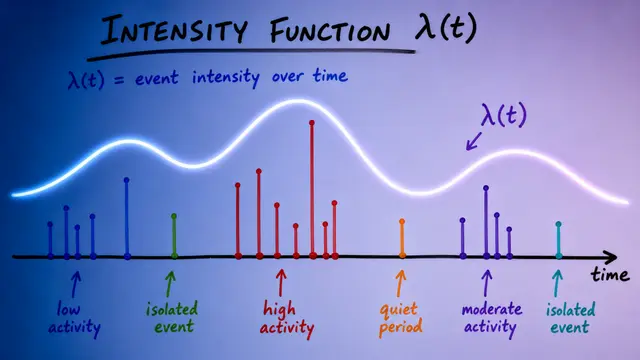
The researchers introduce Hawkes processes as their core solution, which are particularly suited for this problem because they model how past trading events excite future ones. This self-exciting property captures the clustering behavior of trades, where one buy order often triggers more buy orders, creating cascades of market activity.
Now let's break down how this works in practice. The method has two main phases: first, the authors classify each trade and estimate how past events influence future trade arrivals using different kernel types like exponential and power law functions. Then they simulate future trade sequences using these estimated intensities to forecast Order Flow Imbalance minute by minute.
Moving to the results, the authors tested their approach on National Stock Exchange futures data and found that Sum of Exponential kernels delivered the strongest performance. The models successfully captured the intricate dynamics of trade clustering and cross-dependencies, which proved essential for accurate forecasting.
However, the authors acknowledge significant computational challenges. Modeling trade arrivals at the tick level demands substantial processing power, and as kernel complexity increases, so does the difficulty of parameter estimation, which can be a barrier for real-time deployment.
Despite these challenges, this work represents a significant advance in market microstructure modeling. The researchers demonstrate that explicitly modeling the self-exciting nature of trades provides a principled way to forecast market pressure, with clear implications for improving trading strategies and risk controls.
In the end, this paper shows us that understanding how trades trigger other trades unlocks better forecasts of market imbalance, turning the cascading dynamics of high-frequency trading from noise into signal. Visit EmergentMind.com to dive deeper into this research.