Single-Minus Gluon Amplitudes Are Nonzero
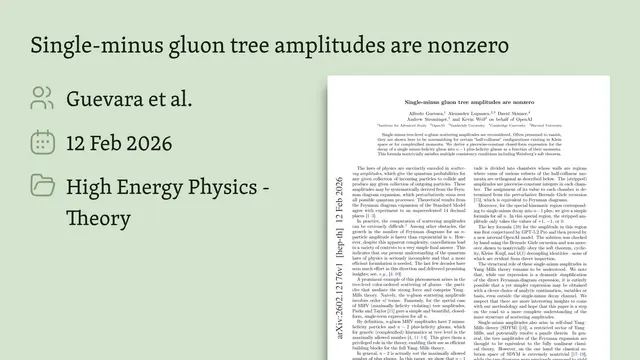
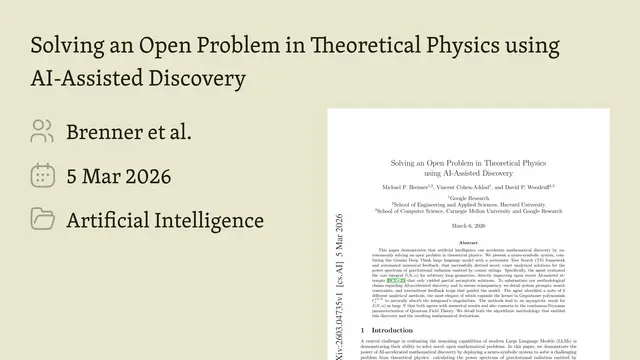
This presentation explores a groundbreaking discovery in Yang-Mills theory: tree-level gluon scattering amplitudes with only one minus-helicity gluon, long assumed to vanish, are actually nonzero in special "half-collinear" kinematic regimes. The talk demonstrates how these amplitudes exhibit a remarkable piecewise-constant, integer-valued structure with deep implications for self-dual Yang-Mills theory, celestial holography, and our understanding of quantum gauge theories.Script
What if an amplitude everyone thought was zero actually hides a rich, piecewise-constant structure that challenges decades of conventional wisdom in gauge theory? This paper reveals that single-minus gluon tree amplitudes are nonzero in special kinematic regimes, opening new doors in Yang-Mills theory.
Let's first understand what was believed and why it seemed so certain.
Building on that context, conventional wisdom held that tree-level amplitudes with only one minus-helicity gluon must vanish for real kinematics. This followed from standard power-counting and the inability to construct consistent reference spinors, but these arguments assumed ordinary Minkowski space.
The authors found these amplitudes are actually nonzero in a special kinematic regime.
Turning to their key insight, the researchers identified the half-collinear regime where all spinor angle brackets vanish but square brackets survive. In this specialized kinematic region, which exists in complexified or signature 2-2 spaces, the usual arguments for vanishing completely fail.
Following from this discovery, the amplitudes exhibit a stunning simplicity: they're piecewise constant and take only integer values. The recursion structure mirrors the well-known Berends-Giele relations, with chamber boundaries marked by sign changes in kinematic invariants.
Remarkably, a closed-form formula for these amplitudes was first conjectured by a generative language model, then rigorously proven. This compact expression involves powers of 2 and products of sign functions, satisfying every known consistency check despite having no manifest symmetry.
The researchers verified their results through multiple complementary approaches.
Connecting theory to practice, the authors validated their formula through both abstract consistency checks and concrete computations. Every standard gauge theory constraint is satisfied, while explicit six-gluon calculations confirm the piecewise-constant integer structure predicted by the recursion.
These results address a puzzle that has lingered for years: self-dual Yang-Mills theory possesses rich classical structure, yet its quantum amplitudes seemed disappointingly simple. The nonvanishing single-minus amplitudes now bridge this gap, providing nontrivial quantum building blocks that match the classical richness.
As with any breakthrough, important questions remain. The amplitudes are nonzero only in specialized kinematics far from standard scattering experiments, and the chamber structure grows intricate at higher multiplicity. The physical meaning of these integer-valued, discontinuous amplitudes deserves deeper investigation.
This work fundamentally reshapes our understanding of what's possible in gauge theory amplitudes. Beyond settling a theoretical question, it introduces computational tools, hints at hidden geometric structures, and extends naturally to gravitational theories through established dualities, promising impact across quantum field theory.
Single-minus gluon amplitudes, once dismissed as zero, turn out to encode rich chamber structures that challenge our assumptions and illuminate quantum gauge theories in unexpected ways. To dive deeper into this discovery and explore more cutting-edge research, visit EmergentMind.com.