Near-Quadratic Sample Compression for All VC Classes
This presentation explains a breakthrough result in computational learning theory: every binary concept class with finite VC dimension admits a sample compression scheme whose size is polynomial in the VC dimension. The work establishes that any realizable labeled sample can be represented by a near-quadratic number of retained examples plus a small amount of side information, from which a consistent hypothesis can be reconstructed. This settles the polynomial version of the longstanding sample compression conjecture and dramatically improves the previous exponential bound.Script
For decades, learning theorists have asked: can every finite VC-dimension concept class compress its training samples down to a bounded number of representative examples? This paper finally proves that the answer is yes, with size polynomial in the VC dimension.
Sample compression asks whether we can represent any realizable labeled sample using only a fixed number of retained examples plus a bounded amount of side information, independent of the original sample size. The reconstructor must recover a hypothesis consistent with every point in the original sample, not just the retained subset.
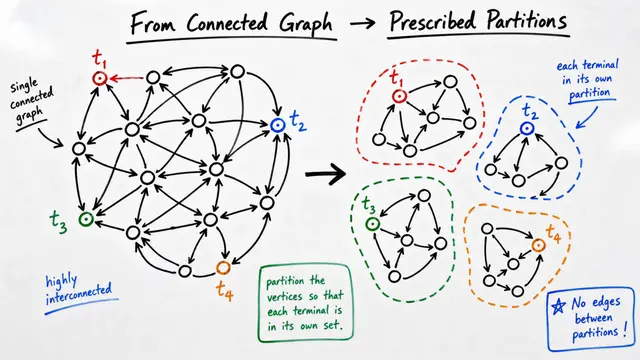
The construction works in two stages. First, unlabeled sample points partition the concept class into cells, with each cell contributing one representative concept to a small pool. Second, a multiplicative weights procedure runs over this pool, selecting labeled points that drive weighted voting toward a consistent hypothesis.
The key technical innovation is iterative refinement. At each round, the algorithm either captures enough mass on cell representatives to terminate, or it increases the entropy of the cell-mass distribution by adding new unlabeled points. Because entropy is bounded above by VC dimension times the logarithm of the number of points, this process must stop after near-quadratic many rounds.
To ensure progress in every round, the authors invoke maximal lotteries, a game-theoretic equilibrium over feasible distributions. Linear programming duality then converts the within-cell ordering of concepts into observable disagreements on sample points, enabling epsilon-nets to refine cells efficiently. This concentrated-versus-spread dichotomy is what avoids the exponential blowup of earlier constructions.
The result improves the previous exponential bound to near-quadratic in VC dimension, settling the polynomial compression conjecture. The linear conjecture remains open. To explore this breakthrough in sample compression theory and generate your own research video, visit EmergentMind.com.