Near-Quadratic Sample Compression for All VC Classes
Abstract: The sample compression conjecture is a longstanding open problem in learning theory, originating in the work of Littlestone and Warmuth in the 1980s. At its heart is a connection between simplification and generalization: if a predictor consistent with a training sample is defined using only a small part of that sample, then it is likely to generalize. Sample compression schemes formalize this idea, and many natural learning algorithms can be analyzed this way. The sample compression conjecture of Floyd and Warmuth (1995) asserts that every binary concept class of VC dimension admits a sample compression scheme of size ; a weaker conjecture asks only for size polynomial in . Both have remained open: the first bound depending only on , due to Moran and Yehudayoff (2016), is exponential in . We prove the weaker conjecture by constructing a sample compression scheme of size .
Paper Prompts
Sign up for free to create and run prompts on this paper.
Explain it Like I'm 14
1. What is this paper about?
This paper studies sample compression, a way of saving only a small part of a training dataset while still remembering enough to make all the same predictions.
Imagine learning to recognize bicycles. You might be given thousands of labeled pictures, but perhaps only a few important pictures are needed to describe the rule you learned. A sample compression scheme finds those important examples and stores them. Later, another person can use them to rebuild a rule that correctly labels the whole original training set.
The paper focuses on learning problems described by binary concept classes, where every example has one of two labels, such as “bicycle/not bicycle” or “spam/not spam.”
Its main result is that every such learning problem with VC dimension can be compressed into roughly
examples, along with a relatively small amount of extra information.
This is a major improvement over the previous best general result, which required an amount of data exponential in .
2. What questions are the researchers asking?
The paper investigates a famous problem called the sample compression conjecture.
The main questions are:
- If a learning problem has VC dimension , can every training sample be represented using only a number of examples depending on , not on the total size of the dataset?
- Is it possible to use only a polynomial number of examples, such as , rather than an exponential number such as ?
- Can the compressed information be used to rebuild a predictor that agrees with every example in the original training set?
The strongest version of the conjecture suggests that only about examples should be necessary. The paper does not prove this strongest claim. Instead, it proves the weaker but still important statement that
examples are always enough.
3. How does the research work?
What is VC dimension?
The VC dimension measures how complicated a collection of possible rules is.
For example, suppose a rule can label points on a page as either positive or negative. If the rule can produce every possible labeling of some set of points, then the class has enough complexity to “shatter” those points.
A larger VC dimension usually means a more complicated learning problem. Roughly speaking:
- Small : fewer kinds of patterns are possible.
- Large : many more patterns are possible.
The goal is to compress data using a number of examples related to this complexity measure.
The compressor and reconstructor
The paper describes compression as a two-part process:
- A compressor receives the entire labeled dataset.
- It keeps a small subset of examples and some extra bits of information.
- A reconstructor receives only this compressed message.
- The reconstructor rebuilds a rule that correctly labels every example in the original dataset.
The reconstructor does not need to recover the original rule exactly. It only needs to produce a rule that agrees with all the original training labels.
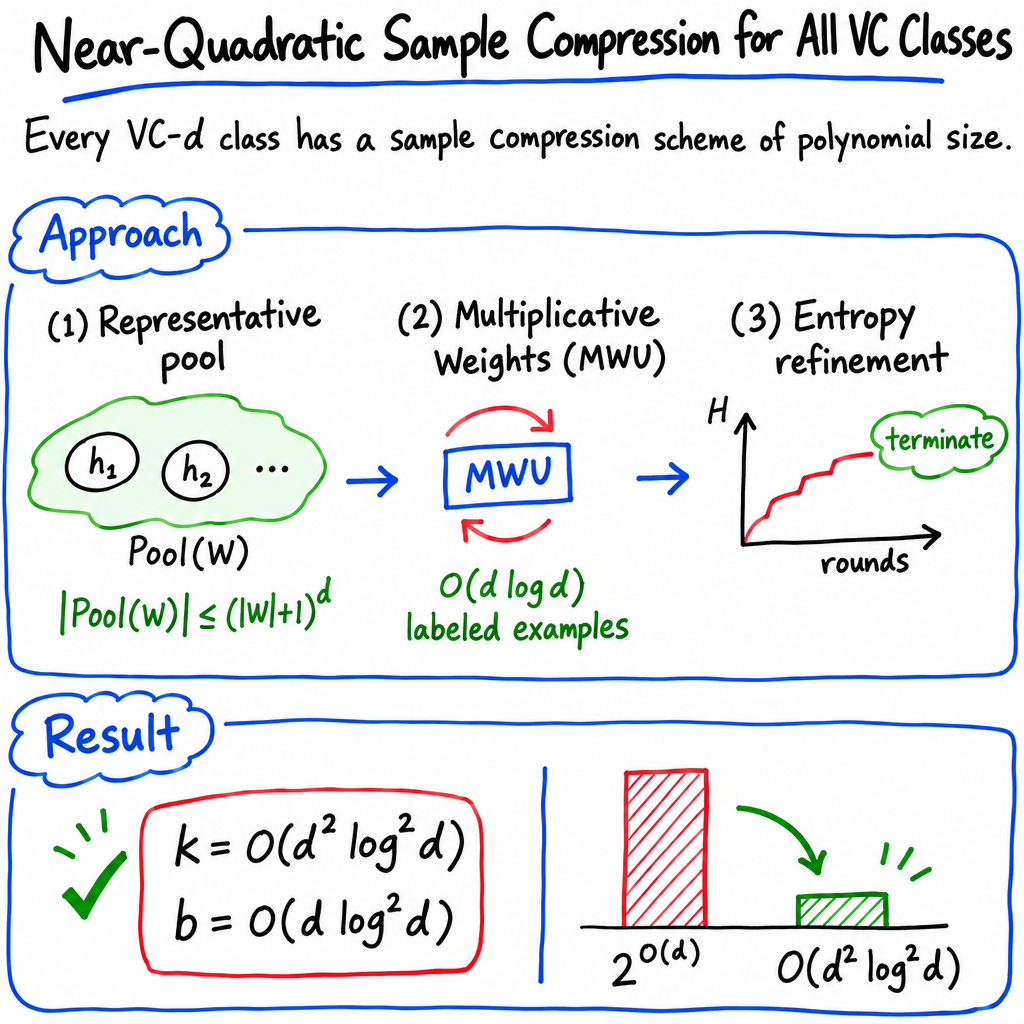
Representatives of groups of rules
The researchers first choose a fixed ordering of all possible concepts, or rules.
They then select some unlabeled examples from the dataset. These examples divide the possible rules into groups:
- Rules in the same group give the same answers on all selected examples.
- Each group gets one representative: the first rule in the fixed ordering.
The selected examples therefore act like questions that help organize the possible rules. The representatives of the groups form a smaller “pool” of candidate rules.
A key mathematical fact, based on the VC dimension, is that the number of different groups is not too large. Even if the original class contains many rules, the number of different behaviors on a small set of examples is bounded by approximately
where is the set of selected examples.
Weighted voting
The reconstruction uses a weighted vote among the representative rules.
Each rule receives a weight, similar to how a group of judges might have different levels of influence. The final prediction is whichever label receives more than half of the total weight.
The researchers use an algorithm called Multiplicative Weights Update, or MWU. In everyday terms, MWU works like this:
- Start by giving all candidate rules some weights.
- Find an example where the current weighted vote performs badly.
- Increase the importance of rules that got that example right and decrease the importance of rules that got it wrong.
- Repeat this process.
After enough rounds, the weighted vote becomes correct on every training example.
The paper shows that only about
labeled examples are needed to describe these updates.
Choosing the important unlabeled examples
The hardest part is finding the unlabeled examples that create a useful pool of representatives.
The researchers repeatedly refine their groups of rules:
- They begin with all rules in one group.
- They add carefully chosen examples.
- These examples split the groups into smaller groups.
- The process continues until the representatives contain enough useful rules to make an accurate weighted vote.
To measure progress, they use entropy. Entropy is a way to measure how spread out something is. Here, it measures how evenly the total weight is distributed among the groups of rules.
If the process has not finished, the entropy increases by a noticeable amount. But the VC dimension limits how much entropy is possible. Therefore, the process cannot continue forever.
This shows that the number of selected unlabeled examples is at most
4. What are the main findings?
The central theorem says:
Every binary concept class with VC dimension has a sample compression scheme using examples and additional bits.
This result is important for several reasons.
It proves polynomial compression for all VC classes
Before this paper, researchers knew that every VC class could be compressed using a number of examples exponential in . The new result replaces that exponential bound with a nearly quadratic one.
For comparison:
- Previous general bound: roughly examples.
- New bound: roughly examples.
Polynomial growth is much smaller than exponential growth, especially when becomes large.
It does not depend on the original dataset size
The number of examples needed for compression depends on , the complexity of the learning problem, rather than on the number of training examples.
For instance, even if the original dataset contains millions of examples, the compression size is still controlled by the VC dimension.
It connects compression and generalization
A compressed rule is often less likely to overfit. If a predictor can be described using only a small amount of information, that suggests it has found a relatively simple explanation of the data.
The paper therefore supports an important idea in machine learning:
A learning rule that can explain its training data using only a small number of important examples is likely to perform well on new data.
It also has consequences beyond perfectly labeled data
The authors explain that their method can also help with agnostic learning, where the data may contain mistakes or contradictory labels.
In that setting, the goal is not to fit every example perfectly. Instead, the goal is to perform about as well as the best rule in the concept class. The paper’s compression result can be adapted to this situation.
5. Why does this research matter?
This work improves our understanding of why learning is possible from data.
It shows that for every binary learning problem with finite VC dimension, there is a compact way to summarize any perfectly labeled dataset. That is valuable in several ways:
- Generalization: Smaller descriptions can lead to stronger guarantees that the learned rule works on new examples.
- Interpretability: A model based on a small number of important examples may be easier to understand.
- Data storage: A compressed representation can save space.
- Learning theory: The result narrows the gap between what researchers believe is possible and what has been mathematically proved.
The paper does not yet prove the most ambitious goal, namely that only examples are always enough. However, it makes a major step toward that goal by showing that a near-quadratic number of examples is sufficient for every VC class.
In simple terms, the paper proves that many complicated-looking learning problems can be reduced to a surprisingly small collection of important examples, and that these examples can be used to rebuild a rule that remembers all the important information in the original dataset.
Practical Applications
Immediate Applications
The paper is primarily a theoretical result: it proves that every binary concept class with VC dimension has a sample compression scheme using examples and side-information bits. Because the theorem does not provide efficient algorithms for finding the compressed subset or reconstructing the predictor, the most immediate applications are methodological, analytical, and applicable to classes for which the required operations can already be implemented.
- Generalization analysis for existing learning algorithms — machine learning and software
- A learning system can be analyzed through the amount of training data needed to specify its output rather than through the full training set.
- For a binary classifier with VC dimension , the result implies a worst-case description based on approximately retained examples, yielding PAC-style sample-complexity bounds on the order of
up to confidence-dependent terms. - This can support theoretical evaluation of classifiers in areas such as document classification, medical diagnosis, fraud detection, and image recognition. - Dependency: The bound is existential and does not imply that current training software can find the compressed representation efficiently.
Training-set reduction and dataset summarization — data engineering
- The compression perspective can be used to design workflows that retain a small, representative subset of labeled records while reconstructing a classifier consistent with the original realizable dataset.
- Potential tools include:
- training-data summarizers,
- prototype-selection modules,
- dataset versioning systems that store representative examples,
- audit logs containing a compact subset of influential records.
- The paper’s distinction between unlabeled witness points and a smaller number of labeled points suggests a practical design principle: preserve many points as structural witnesses while storing labels only for a much smaller adaptive subset.
- Dependency: Exact consistency requires realizability. Noise, mislabeled records, and contradictory examples require the agnostic extension or an empirical-risk-minimization step.
- Memory-efficient model and data storage — edge computing and software infrastructure
- A model-training pipeline could store a compressed representation of a training set rather than the entire set, reducing storage and transmission requirements.
- This is potentially useful for:
- federated learning clients,
- embedded or edge devices,
- low-bandwidth data collection,
- archival of experimental datasets.
- The weighted-majority reconstruction mechanism provides a conceptual route to reconstructing a predictor from a small sample-dependent message.
- Dependency: The theorem bounds the number of retained examples, but not the computational cost, numerical representation of concepts, or runtime memory required by the reconstructor.
- Auditable machine-learning workflows — regulated industries and policy
- A compressed sample can serve as an audit artifact: a compact set of records from which the released classifier can be reconstructed and checked for consistency with the original training data.
- Possible applications include:
- documenting model updates,
- supporting reproducibility reviews,
- maintaining compact evidence packages for regulated healthcare or finance models,
- comparing model versions through their retained examples and side information.
- Dependency: A compressed sample is not automatically an explanation of causal importance or fairness. Privacy, representativeness, and legal admissibility of retained records must be assessed separately.
- Improved theoretical sample-complexity benchmarks — academia
- The result gives researchers a polynomial, sample-independent compression guarantee for arbitrary binary VC classes, replacing earlier exponential-in- guarantees.
- It can be used as a baseline when studying:
- new learning algorithms,
- compression schemes for structured hypothesis classes,
- stability and robustness,
- agnostic learning,
- multiclass reductions,
- regression and pseudo-dimension analogues.
- The paper’s use of multiplicative weights, minimax optimization, representative cells, and entropy potentials also supplies reusable analytical techniques for other compression problems.
- Dependency: The result is a worst-case upper bound and may be much looser than the schemes available for geometric, maximum, extremal, or intersection-closed classes.
- Agnostic learning analysis — machine learning and statistical theory
- The paper states that the realizable compression result implies an agnostic compression scheme of the same asymptotic size by compressing the subsample on which an empirical risk minimizer agrees with the observed labels.
- This can support generalization analyses when labels contain noise, for example in:
- medical records,
- financial risk labels,
- human annotation systems,
- sensor-based classification.
- Dependency: The reduction assumes access to an empirical risk minimizer or an equivalent procedure, and the resulting guarantees concern empirical error and generalization rather than exact recovery of noisy labels.
- Compact communication of learned classifiers — federated and distributed learning
- Instead of transmitting a complete model or the full local dataset, a client could transmit a small set of labeled examples, additional unlabeled witness points, and side-information bits.
- A server with knowledge of the hypothesis class could reconstruct a consistent weighted-majority predictor.
- This is conceptually relevant to federated learning, distributed scientific experiments, and collaborative classification.
- Dependency: Both parties must share the same concept class, canonical ordering, reconstruction procedure, and encoding convention. Communication savings are not guaranteed if model parameters or examples themselves are high-dimensional.
- Curriculum and teaching-set design — education and human-in-the-loop learning
- The representative-cell and teaching-set viewpoint can guide the selection of examples that distinguish competing hypotheses.
- Potential systems include:
- adaptive labeling interfaces,
- active-learning demonstrations,
- educational exercises selected to eliminate candidate rules,
- human feedback systems that query examples with high disagreement.
- The multiplicative-weights component provides a principled way to choose examples that expose the current worst prediction.
- Dependency: The paper addresses compression after observing a realizable sample, not an end-to-end active-learning algorithm or a guarantee on the number of queries required from a human.
- Policy guidance on model complexity and data minimization — governance
- The theorem provides theoretical support for policies that distinguish between the full training corpus and the smaller information content needed to specify a predictor.
- It can inform discussions of:
- retention limits,
- reproducible model documentation,
- data minimization,
- model-card evidence requirements,
- storage of representative training records.
- Dependency: A compression bound does not by itself establish privacy. Retained examples may contain personally identifiable or sensitive information, and side information can also leak information about the sample.
Long-Term Applications
These applications require efficient implementations, empirical validation, extensions beyond the paper’s assumptions, or integration with production systems.
- Polynomial-time universal compression libraries — machine learning infrastructure
- A future library could accept a binary hypothesis class and a realizable dataset, then compute the paper’s compressed subset and reconstruct the weighted-majority predictor.
- Such a library might expose interfaces such as:
compress(sample, hypothesis_class),reconstruct(compressed_sample, hypothesis_class),verify_consistency(compressed_sample, full_sample).- It could provide a general fallback compression method for classes lacking specialized geometric schemes.
- Dependencies: The paper explicitly states that it does not establish the computational complexity of compression or reconstruction. Efficient implementation would require tractable solutions to the minimax games, linear programs, representative-cell construction, entropy refinement, and worst-error searches.
- Distributed and federated learning with example-based model updates — software and telecommunications
- Clients could communicate compact, data-anchored updates rather than full parameter vectors.
- A practical protocol might combine:
- 1. local selection of labeled and unlabeled witness examples,
- 2. side-information encoding of multiplicative-weights updates,
- 3. server-side reconstruction,
- 4. consistency or empirical-risk verification.
- This could be attractive when the global hypothesis class is known and model parameters are expensive to transmit.
- Dependencies: High-dimensional examples may be more expensive than model weights; privacy-preserving release of retained examples is nontrivial; heterogeneous client distributions may violate the common-class assumption.
- Certified dataset summarization for large-scale data systems — cloud computing
- Data platforms could maintain a compact “sufficient evidence set” for a classifier together with a certificate that the reconstructed predictor agrees with the original labeled sample.
- This could reduce costs for:
- long-term archival,
- dataset replication,
- experiment checkpoints,
- compliance audits.
- Dependencies: Exact consistency may be impossible under label noise or concept drift. The storage benefit depends on the size and encoding cost of individual examples, not only on the count of examples.
- Compression-aware privacy and governance systems — healthcare, finance, and public-sector data
- A future system could jointly optimize sample compression, differential privacy, and auditability.
- For example, it might retain a small number of privatized representative records while releasing a reconstructed classifier and a generalization certificate.
- The paper’s separation between labeled examples, unlabeled structural witnesses, and side information could help analyze different privacy risks.
- Dependencies: The theorem provides no privacy guarantee. Formal privacy analysis would need to bound the sensitivity of the compressor, the reconstruction process, and the side-information encoding.
- Robust and adversarially resilient classifiers — cybersecurity and safety-critical AI
- Since compression methods have previously been extended to adversarially robust classification, the new polynomial bound may lead to more manageable robustness certificates for broad VC classes.
- Potential tools could use compressed representations to:
- document robust training sets,
- certify consistency under perturbation constraints,
- compare robust and non-robust models,
- reduce the data needed for repeated robustness audits.
- Dependencies: Robust compression may require modified definitions of consistency and error. The current theorem is for ordinary binary realizable classification and does not itself establish adversarial guarantees.
- Extensions to multiclass, regression, and structured prediction — healthcare, robotics, and perception
- The weighted-majority nature of the reconstruction suggests extensions through binary reductions to:
- finite-label medical coding,
- robotic object or action recognition,
- real-valued sensor prediction,
- structured classification.
- The paper indicates improved bounds for settings governed by graph dimension or pseudo-dimension.
- Dependencies: The guarantees may depend on graph dimension, Natarajan dimension, pseudo-dimension, or other complexity measures rather than ordinary binary VC dimension. Infinite-label settings can fundamentally fail to admit sample-independent compression, as discussed in the paper.
- Interpretable ensemble construction — explainable AI
- The reconstructed predictor is a weighted majority of a bounded collection of concepts. This could lead to ensemble models whose members are tied to retained examples and whose aggregation weights are reproducible.
- Potential products include:
- example-grounded ensemble classifiers,
- compact rule or prototype systems,
- human-review dashboards showing which retained examples and update rounds determine predictions.
- Dependencies: A weighted majority of concepts is not necessarily human-interpretable. Interpretability depends on the underlying concept class and on whether the representative concepts can themselves be explained.
- Active learning and adaptive data acquisition — scientific experimentation
- The compressor’s repeated selection of points with maximal current error resembles an adaptive experimental design strategy.
- A future system could use related mechanisms to select:
- medical tests,
- laboratory experiments,
- robotic interaction trials,
- sensor placements,
- financial stress scenarios.
- The goal would be to find a small set of observations that separates competing hypotheses and supports a reliable final predictor.
- Dependencies: Compression and active learning are distinct tasks. The paper assumes a labeled realizable sample is already available and does not prove query-complexity or noise-tolerance guarantees.
- Model lifecycle and concept-drift monitoring — industry and policy
- Compressed representations could be generated periodically and compared over time. Changes in the retained witness points, representative cells, or reconstructed weighted vote might act as indicators of:
- data drift,
- label drift,
- changes in the effective hypothesis,
- degradation of consistency.
- Dependencies: A changing compressed set may reflect arbitrary tie-breaking or changes in the compressor rather than genuine drift. Reliable monitoring would require stable compression schemes or additional statistical controls.
- Specialized compression for robotics and geometric control — robotics
- For geometric concept classes already known to admit small compression schemes, the paper’s general framework could be combined with domain-specific structure to compress perception or collision-classification datasets.
- Long-term systems might use retained geometric boundary cases and unlabeled witness configurations to reconstruct safety or obstacle classifiers.
- Dependencies: Real robotic data are noisy, continuous, temporally dependent, and often multiclass. The binary, realizable, i.i.d.-style learning assumptions would need substantial adaptation.
- Foundations for automated theorem-to-system translation — AI research tools
- The proof’s architecture—minimax distributions, representative-cell pools, multiplicative weights, and entropy-based termination—could be encoded into automated reasoning or learning-theory software.
- Such tools might search for compression schemes for new hypothesis classes or automatically derive bounds from structural parameters.
- Dependencies: Formalizing the proof is not equivalent to producing an efficient algorithm. The central combinatorial constructions and optimization problems may remain computationally difficult.
Glossary
- Agnostic learning: Learning from data that may contain mislabeled or noisy examples, without assuming perfect realizability. “The reach of compression-based generalization goes beyond realizable binary classification. It extends to agnostic learning”
- Approximate compression: A compression scheme whose reconstructed predictor is allowed a controlled approximation error. “and similarly gives ${O}(d_{\mathrm{P}^2)$-size -approximate compression”
- Cell entropy: The Shannon entropy of the probability masses assigned to the cells of a partition. “An important invariant of the process is that the entropy of the distribution induced by the {cell masses} increases”
- Compactness theorem: A result allowing properties established for every finite restriction of a class to be extended to the entire, possibly infinite, class. “Without loss of generality, we assume that is finite, by the compactness theorem for sample compression of Ben-David and Litman”
- Complementary slackness: A condition in linear and convex optimization relating optimal primal and dual solutions. “Moreover, complementary slackness in Section~\ref{subsec:qem-proof} is asymmetric”
- Concept class: A collection of possible prediction functions defined on a common domain. “let be a domain of examples and let be a concept class.”
- Convex optimization: Optimization of a convex objective or feasible region, often characterized by efficient duality and optimality conditions. “via the classical Slater bound in convex optimization”
- Dual class: A class obtained by exchanging the roles of concepts and domain points in the incidence relation between them. “Moran and Yehudayoff use uniform convergence for the dual class”
- Dual VC dimension: The VC dimension of a dual concept class, measuring the shattering complexity after interchanging concepts and points. “We avoid the dependence on the dual VC dimension, which can be exponential in ”
- Empirical risk minimizer: A hypothesis that minimizes prediction error on a finite observed sample. “such a scheme can be obtained by applying a realizable sample compression scheme to the subsample on which an empirical risk minimizer agrees with the labels.”
- Entropy: A quantitative measure of uncertainty in a probability distribution. “The entropy increase and the Sauer--Shelah--Perles bound on the number of occupied cells give”
- -net: A small subset that intersects every sufficiently large member of a range space. “a -net~\cite{HW87} of size for ”
- Extremal class: A concept class attaining the largest possible number of distinct labelings allowed by its VC dimension under a specified combinatorial bound. “Moran and Warmuth~\cite{MW16} established size- labeled schemes for all extremal classes.”
- Generalization error: The probability that a learned predictor misclassifies a fresh example drawn from the underlying distribution. “for target generalization error , PAC sample complexity”
- Graph dimension: A multiclass complexity measure based on the VC dimension of an associated graph class. “uniform convergence is characterized by finiteness of the graph dimension $d_{\mathrm{G}$”
- Helly-type class: A class whose combinatorial structure satisfies properties analogous to Helly’s theorem, often enabling small certificates or compression schemes. “classes of bounded variability~\cite{BDL98}, Helly-type classes”
- Minimax theorem: A theorem asserting equality between the optimal guarantees of two opposing players in an appropriate zero-sum game. “Moran and Yehudayoff use the minimax theorem to obtain a distribution over concepts with low error at each sample point.”
- Multiplicative Weights Update (MWU): An iterative algorithm that adjusts weights on experts or actions by decreasing the weights of those incurring larger losses. “the compressor runs the multiplicative weights update (MWU) algorithm”
- Natarajan dimension: A multiclass generalization of VC dimension based on pairs of competing labels at each shattered point. “where $d_{\mathrm{N}$ denotes the Natarajan dimension”
- NIP structure: A model-theoretic structure with the “not the independence property,” restricting the complexity of definable families. “definable families in stable, o-minimal, and NIP structures”
- O-minimal structure: A model-theoretic structure in which definable subsets of the line have only finitely many connected components. “definable families in stable, o-minimal, and NIP structures”
- PAC learning: Probably approximately correct learning, a framework requiring low prediction error with high probability using a bounded number of examples. “generalization is captured by Valiant's PAC learning framework”
- Pointwise error: The probability, under a distribution over hypotheses, that the hypotheses predict incorrectly at a particular input. “The pointwise error bound in~\eqref{eq:overview-pointwise} is what makes the weighted majority step work”
- Polytope: A bounded convex set described as the convex hull of finitely many points or by finitely many linear inequalities. “Let be the polytope of distributions over ”
- Pseudo-dimension: A generalization of VC dimension for real-valued function classes. “-valued classes of pseudo-dimension $d_{\mathrm{P}$”
- Realizable sample: A labeled sample whose labels agree exactly with at least one concept in the concept class. “A finite labeled sample is -realizable if some satisfies for every .”
- Regret bound: An upper bound on how much worse an online algorithm performs than the best fixed action in hindsight. “we use nothing about MWU beyond its worst-case regret bound”
- Sauer--Shelah--Perles lemma: A combinatorial theorem bounding the number of labelings a class of VC dimension can realize on a finite set. “By the Sauer--Shelah--Perles lemma~\cite{VC71,Sau72,She72}”
- Shattering: The ability of a concept class to realize every possible binary labeling of a finite set. “every class of VC dimension requires without side bits even on a single shattered -tuple”
- Slater’s condition: A constraint qualification requiring the existence of a strictly feasible point in a convex optimization problem. “Increasing the error budget from to ensures that each round's iterate satisfies Slater's condition for the next round.”
- Stable compression: A compression scheme whose output is unchanged when additional examples not selected by the compressor are added. “so-called stable sample compression schemes admit sharper bounds of order ”
- Uniform convergence: The property that empirical estimates converge uniformly to their population counterparts over an entire hypothesis class. “Moran and Yehudayoff use uniform convergence for the dual class”
- VC dimension: The largest size of a set that a concept class can shatter. “every binary concept class of VC dimension admits a sample compression scheme”
- Weighted majority vote: A prediction formed by selecting the label receiving more than half of the total weight assigned by a distribution over hypotheses. “The reconstructed concept is always a weighted majority vote”
- Zero-sum game: A strategic game in which one player’s gain is exactly the other player’s loss. “We define a zero-sum game in order to choose within this polytope.”

