Self-Improving AI Through Multi-Agent Conversations
This presentation examines a recursive self-improvement method where a single language model learns to coordinate multiple copies of itself to solve complex research tasks. By alternating between searching for better multi-agent workflows and fine-tuning on successful task-solving trajectories, the system improves its performance, evaluator agreement, and token efficiency across two training cycles without relying on a stronger external teacher.Script
When a language model acts as task executor, workflow optimizer, and evaluator all at once, it faces a dangerous trap: self-evaluation may simply reinforce its own mistakes rather than catch them.
Multi-Agent Self-Supervision, or MASS, changes the computational organization instead of adding a smarter teacher. A single base model instantiates an orchestrator and multiple subagents: the orchestrator delegates bounded tasks, verifies artifacts, and integrates results, while subagents handle localized implementation.
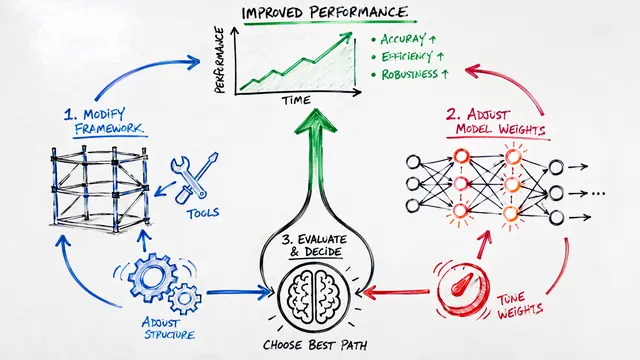
The method alternates two stages. First, the model proposes multi-agent workflows, executes them, compares workspaces, and retains the best under its own judgment. Second, it generates multiple trajectories under the retained workflow, ranks them through self-comparison, and fine-tunes on the top performers.
After two cycles on coding and research tasks, the model achieves 1.2 to 1.6 times higher score per output token on four benchmarks and reaches a 68.3 percent win rate against the base while using 31 percent fewer supervised tokens than a single-agent control trained to 64 percent.
Analysis of workflow evolution reveals that successful workflows encode less task information in role descriptions and more in output contracts and call ordering. Task information in contracts increases from 2.99 to 3.29 nats, and in hop sequences from 5.23 to 6.22 nats, suggesting the model learns to structure what agents communicate and when they communicate it.
MASS demonstrates that multi-agent coordination can supply useful self-supervision even when the same model plays all three roles, though workflow search remains unstable and benchmark-dependent. To explore more research like this and create your own video presentations, visit EmergentMind.com.