Multi-Agent Debate: When AI Argues Its Way to Better Answers
This presentation explores the Multi-Agent Debate paradigm, an emerging test-time inference strategy where multiple large language model agents iteratively discuss and refine their responses to challenging problems. Through structured deliberation, critique, and consensus mechanisms, these systems aim to surpass single-agent performance in reasoning accuracy, robustness, and value alignment—though at significant computational cost and with important limitations.Script
A single large language model answering a hard question gets it right 40% of the time. Now have 3 models debate the same question for 3 rounds, and suddenly accuracy jumps to 55%. This is Multi-Agent Debate, where AI systems argue their way to truth.
The protocol is elegantly simple. First, each agent tackles the question independently. Then in each debate round, agents read everyone else's answers, reconsider their position, and may revise. After several rounds, the system aggregates responses to pick a final answer.
But why does having models argue actually improve performance?
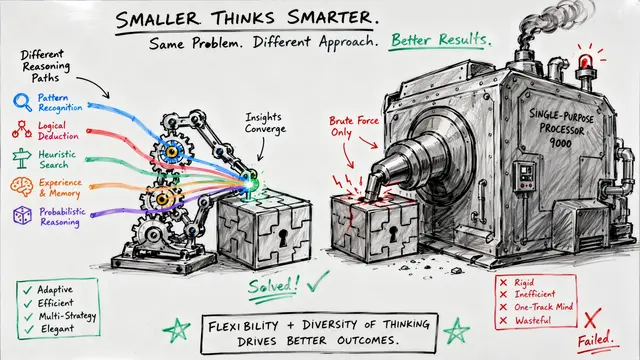
Single agents get stuck in their own reasoning paths, unaware of mistakes. Debate breaks this isolation. Multiple agents explore different approaches, catch each other's errors, and converge toward correct answers through mutual critique.
The catch is cost. Every round, every agent must read everyone else's full responses. With 3 agents over 5 rounds, you're processing 15 times the text. For large models, this explodes inference costs and latency.
So researchers have developed techniques to keep the benefits while slashing the costs.
The breakthrough systems are surgical. SID reads model internals to know when agents are confident and which parts of context matter, cutting 40% of tokens. CortexDebate connects only influential agent pairs. Free-MAD skips iterative rounds entirely, running one adversarial debate with smarter aggregation.
Debate excels in specialized domains. For knowledge-intensive questions, agents retrieve evidence and debate sources, breaking through single-agent knowledge limits. For safety, mixing agents with different vigilance levels produces more robust alignment, though with a dark side: debate systems can also entrench false beliefs when they collectively err.
But debate isn't a panacea. Agents exhibit social biases, deferring to others or stubbornly defending their first answer. Careful experiments show that on many benchmarks, debate barely outperforms simple voting across independent runs. The magic only appears with the right agent diversity, debate structure, and aggregation.
Multi-Agent Debate reveals a fundamental tension in AI: collaboration can unlock emergent intelligence, but only when we architect the conversation itself with as much care as we train the models. To explore more cutting-edge AI research and create your own explainer videos, visit EmergentMind.com.