First Results from the LUX Dark Matter Experiment
This presentation explores the inaugural findings from the Large Underground Xenon (LUX) experiment, a groundbreaking search for dark matter conducted deep underground at the Sanford Underground Research Facility. The talk examines how LUX uses a sophisticated dual-phase xenon detector to hunt for Weakly Interacting Massive Particles, presents the stringent limits established from 85.3 days of data collection, and discusses the implications for our understanding of dark matter and the future of direct detection experiments.Script
A mile underground in South Dakota, 370 kilograms of liquid xenon sit in absolute darkness, waiting for a collision that might never come. The LUX experiment is hunting for dark matter, the invisible substance that makes up 85% of the universe's mass, and its first results have just redefined what we thought possible in this search.
The target is a particle called a WIMP. These hypothetical particles would pass through ordinary matter almost without trace, but occasionally, perhaps once in years, a WIMP might strike a xenon nucleus hard enough to detect. That single recoil could be the first direct evidence of dark matter's true nature.
To catch such an elusive signal requires engineering at the extremes of precision.
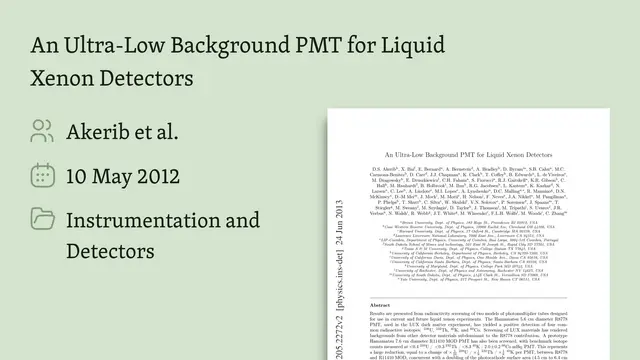
The detector is a dual-phase time-projection chamber. When a particle interacts with liquid xenon, it produces two distinct signals: an immediate flash of scintillation light called S1, and then a delayed pulse called S2 when freed electrons drift upward into xenon gas. These two signals, captured by 122 photomultiplier tubes, create a three-dimensional map of every event, allowing researchers to distinguish genuine nuclear recoils from background noise.
Not every flash in the detector is a WIMP. Radioactive backgrounds constantly bombard the xenon, creating electron recoils that must be filtered out. The key is that nuclear recoils from WIMPs and electron recoils from background radiation produce different ratios of S1 to S2 signals, giving researchers a powerful discrimination tool.
After 85.3 days of data collection, the verdict was in.
The detector recorded 160 events matching the search criteria, but every single one could be explained by known backgrounds. No WIMP signal emerged. Yet this null result is itself profound: LUX set the most stringent upper limit ever on how strongly WIMPs can interact with ordinary matter, reaching 7.6 times 10 to the negative 46 square centimeters for a WIMP mass of 33 gigaelectronvolts.
These results directly challenge earlier experiments that had hinted at low-mass WIMP detections. LUX's sensitivity surpasses those efforts by orders of magnitude, essentially ruling out the parameter space where those signals would exist. This isn't just about not finding WIMPs—it's about fundamentally reshaping the landscape of dark matter search strategies.
The experiment continues. Researchers are extending the dataset to 300 live days, refining calibrations, and pushing background discrimination even further. Each improvement opens new windows into WIMP parameter space that was previously beyond reach.
A mile underground, the xenon still waits in darkness, and with every passing day of silence, our map of what dark matter could be grows sharper. Visit EmergentMind.com to explore more cutting-edge research and create your own videos.