Lagrangian Fillable Legendrian Knots
This lightning talk explores the deep connections between contact topology, symplectic geometry, and low-dimensional topology through the lens of Lagrangian fillable Legendrian knots. We examine how algebraic invariants from differential graded algebras, combinatorial positivity properties, and symplectic filling constructions converge to classify which Legendrian knots admit exact Lagrangian surface fillings in the 4-ball, revealing a rich landscape where algebra predicts geometry and where seemingly similar knots can admit vastly different numbers of fillings.Script
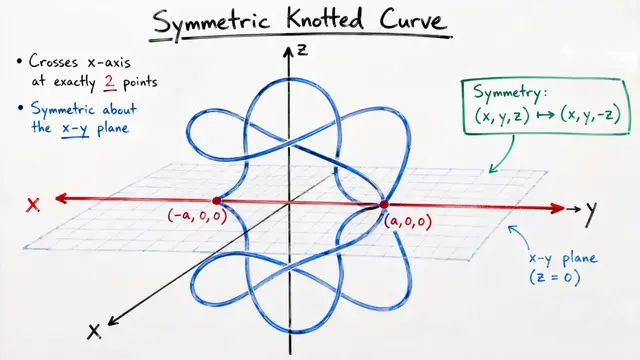
A Legendrian knot sits in 3-dimensional contact space, and the central question is deceptively simple: does it bound an exact Lagrangian surface in the 4-ball? This is the fillability problem, where topology meets symplectic geometry.
The differential graded algebra encodes counts of pseudo-holomorphic disks with boundary on the knot. Generators correspond to Reeb chords at crossings, and the differential counts admissible discs whose combinatorics are controlled by a precise defect formula involving rotation and winding data.
Every positive knot, one admitting a diagram with only positive crossings, is Lagrangian fillable. The proof constructs a decomposable filling via 0- and 1-handle attachments, using oriented normal rulings where every crossing is switched in a coherent way.
The same Legendrian knot can admit multiple non-isotopic fillings. The standard Legendrian 2-comma-n torus link has exactly C sub n exact fillings, where C sub n is the n-th Catalan number. Augmentations induced by each filling provide the invariants that distinguish them.
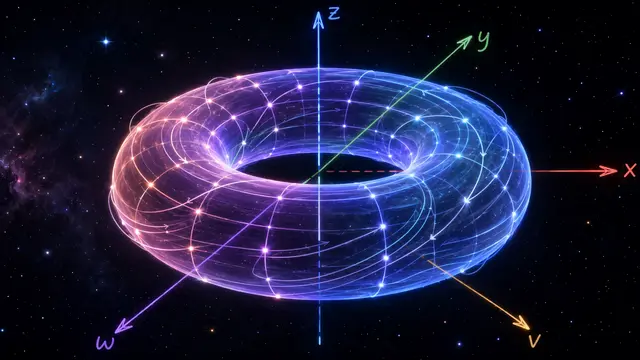
Augmentations that arise from Lagrangian fillings must lie in the injective image of an algebraic torus whose dimension equals the first Betti number of the filling. Certain Legendrian twist knots have augmentations sitting outside any such torus, proving they cannot be filled by any orientable surface.
Non-orientable exact Lagrangian fillings occupy a narrow symplectic window between abundance in smooth topology and severe constraints from exactness. For alternating knots, canonical rulings provide both obstructions and constructions, with crosscap numbers finite and minimal. To explore these connections further and create your own mathematical videos, visit EmergentMind.com.