Hunyuan3D-Buffalo 1.0: A Unified 3D Model That Understands, Creates, and Edits
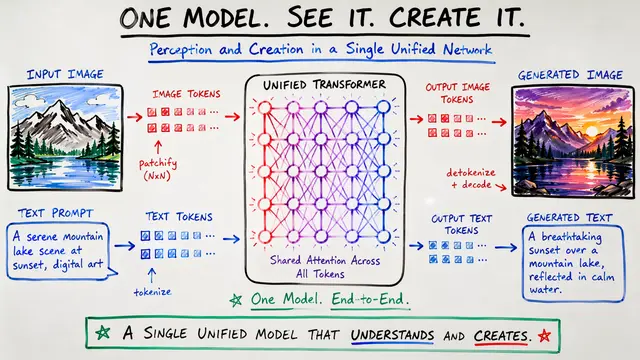
This lightning talk explores Hunyuan3D-Buffalo 1.0, a breakthrough unified multimodal model that consolidates 3D understanding, text-to-3D generation, instruction-guided editing, and part generation in a single architecture. We examine how the researchers constructed an unprecedented 87 million-sample training corpus, developed a synergistic architecture coupling vision-language understanding with diffusion-based generation, and achieved state-of-the-art results across multiple 3D tasks—proving that strong generative priors are the key to scalable, high-fidelity 3D editing.Script
Most 3D AI systems do one thing well. Understanding. Generation. Or editing. But what if a single model could do all three, with each capability making the others stronger?
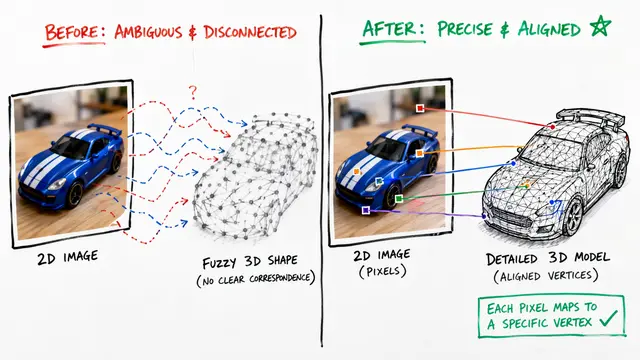
The researchers built an 87 million sample corpus spanning understanding, generation, and editing. The secret weapon is Nano3D-v2, a pipeline that constructs geometrically consistent editing triplets by selecting anchor views, localizing 3D masks, preserving structure through voxel-based refinement, and filtering for multimodal integrity.
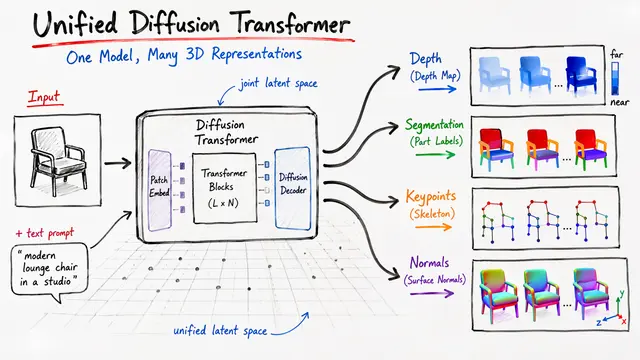
The architecture pairs a dedicated vision-language model with a high-capacity diffusion transformer. For editing, the denoising process is conditioned on both the instruction and the original geometry, ensuring that unedited regions stay intact while targeted areas transform precisely.
On part-level question answering, the model scores 89.06, the highest reported. In text-to-3D generation, it wins 56.6 percent human preference against strong baselines. For editing, it reduces geometric error by 86.7 percent while more than doubling part alignment scores.
Here is the counterintuitive result. Adding text-to-3D generation data directly improved editing performance, even without new editing pairs. Strong generative priors are the limiting factor for editing quality, not editing supervision volume.
Hunyuan3D-Buffalo proves that unified pretraining unlocks cross-task synergy for 3D AI. The next frontiers are single-stage geometry and texture fusion, higher-quality caption supervision, and architectural designs that go beyond modular composition. Explore the full technical breakdown and create your own video summaries at EmergentMind.com.